
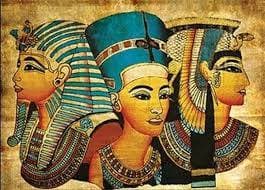
The Quran does not take its information from the Gospels. The reader notes the Old Testament that it uses the title of its branch (i.e. Pharaoh) to refer to the kings of ancient Egypt.
Historical Miracles in the Quran and Sunnah
The historical miracle in the Quran’s use of “Pharaoh said” and “the king said”
The Koran did not take his information from the Gospels.
In the Old Testament, the title of Pharaoh is used to refer to the kings of ancient Egypt, such as the king of Egypt at the time of Joseph and the king of Egypt at the time of Moses.
The Qur'an does not follow the same approach, and this is a historical miracle that shows that the Qur'an is a house from Allah and did not take Muhammad from the medium in which he lived.
The reader of the Book of the Old Testament notes that it uses the title of its branch to refer to the kings of ancient Egypt, similar to the king of Egypt in the time of Joseph and the king of Egypt in the time of Moses. We read, for example, in Genesis 41:14: “And Pharaoh sent and called Joseph, and they rushed him out of prison.” In the story of Moses we read in Genesis 2:15: “And Pharaoh heard that he was killed.”
He said: “Pharaoh said: `You believe in it before I give you permission.’ When he mentioned the story of Joseph (peace be upon him), he said: `The king said: `I see seven fat cows eaten by seven lean ones and seven green ears and the last dry ones.’ [Joseph of the Verse:43].
The author of (Liberation and Enlightenment) commented: "The definition in (King) of the covenant, i.e. King of Egypt. The Qur'an here called him a king and did not name him Pharaoh because this king was not one of the pharaohs of the Coptic kings of Egypt, but he was the king of Egypt at the time of its rule (Hexos), the giants, who are Canaanites, or Arabs, and is expressed by the historians of the Greeks by the kings of shepherds, i.
Is it true that the son of Ashour is consistent with archaeologists and historians?
The archeologist Kenneth Kitchen determines the date of Joseph's entry into Egypt as the "Second Middle Age".[2] Joseph's "Second Middle Age" was created, which spanned approximately 1674 to 1553 BC.[1] The Bible Dictionary (Nelson's Illustrated Bible Dictionary) explains the choice of this era as a candidate for the events of Joseph's story: "During this stage of weakness - the Second Middle Age - many non-Egyptians entered the country.
The Jewish Encyclopedia also states that "those who regard Joseph's story as a historical fact generally believe that the pharaoh who made Joseph the de facto ruler of Egypt was one of the kings of the Hyksos."
The view that Joseph's entry into Egypt was in the time of the Hyksos is reinforced by the presence of the Semitic name - the ancient Arab - (Jacob) on the list of kings of that era. The dictionary of the Bible says: "The assumption of a high position in the Egyptian government by a stranger also refers to the rule of the Hyksos who were also strangers. Indeed, one of their rulers was called (Jacob-Har)"[4]
When the Hyksos were not part of the Pharaohs, their rulers were known by the title (King) as an abstract. The name of God Moses (peace be upon him) lived, according to most of the foreign sources approved, in the thirteenth century BC, i.e.: in the era of the New Kingdom. The World Jewish Encyclopedia says: "The era in which Moses lived - it seems - was the third or fourth quarter of the thirteenth century BC..."[5]
What does this era of Egyptian dynastic rule have to do with the title (Pharaoh) used by the Holy Quran for the King of Egypt in the story of Moses and the exodus of the children of Israel. We talk about this (Dictionary of the British Museum of Ancient Egypt) saying: "Pharaoh: a title used by contemporary writers steadily to refer to the King of Egypt ... and was used in its origin to refer to the royal palace and not the king..
This is supported by Nelson's Illustrated Bible Dictionary: "The word of his branch: Pharaoh in the Egyptian language (the Great House). This word was originally used to describe the palace of the king. Around 1500 BC he called the king".[7]
It turns out that "Pharaoh" is a title for the kings of Egypt during the new kingdom during which Moses lived, peace be upon him, as I explained earlier, and he who used it during the time of the Hyksos in which Joseph lived was mistaken. Therefore, the dictionary (The Thames & Hudson Dictionary of Ancient Egypt) stated that "the use (Pharaoh) of a title for the rulers of Egypt before the new kingdom is an explicit anachronism that should be avoided" [8].
And when he learns of this, he realizes the favor of Allah upon him, when He honoured him with a Book from Himself that would not have made him crooked; and if it had been from other than Allah, they would have found therein much disagreement.
Material Link: http://iswy.co/e10hdf
—
Source: Posted on Dr. Mohammed Bourbab's Facebook page on 2020-05-03
https://www.facebook.com/bourbab.m/posts/pfbid0c9357fdu2GAuBFQhdvPHJU1s75yNGh1mYMTWLZ4SsS52n8W2GMHwuBvh8AXYjs5Cl