
In the science of reproduction and the formation of gametes (from gametes to egg) This rule shows the precedence in the mention of the creation of gametes and semen and the stage of fertilization and shows the correction of the Quran and Sunnah for the concepts of this section throughout the past history of mankind in the science of reproduction ...
Updating the Miracle Database in the Qur'an and Hadith (1)
In breeding science, gametes form.
(from gametes to egg)
This rule shows the precedence in mentioning the creation of gametes and semen and the stage of fertilization and shows the correction of the Qur'an and Sunnah to the concepts of this section throughout the past history of mankind
In the science of reproduction and gamete formation, the database of miracles in the Qur’an and in the Prophet’s Hadith includes all the data related to the subject that humanity has only discovered in recent centuries, and includes topics that describe male and female gametes and alert to the complexity associated with their creation, and facts about fertilization sincere in the following points:
* Create it.
The Quranic miracle in referring to the creation of semen.
Have you considered what you wish to create, or are we the creators? 59 We have ordained death among you, and we are not to be predestined.60 We shall change your likes and raise you up in that which you do not know.61 And you have already known the first creation, so why do you not remember?
He will say, “Have you seen what you desire in the wombs of your wives, are you creating it or are we the creators?”
The first miracle in the verse is that the semen is created.
“Have you seen what you wish, are you creating it, or are we the creators?”
Miracle sign at the level of science history
It required the knowledge that semen created a historical period associated with the development of the microscope, where historical knowledge was established proving that semen created in 1677 and the first observation of the female follicle was made between 1641 and 1673 by Reinier De Graaf.
The second miracle station:
This is a complex and important creation, and this is why the Almighty attributed to himself: "Are you creating it or are we the creators?"
At a time when semen can only be seen as a white liquid called "insulting" water, which indicates the importance of this creation, which is confirmed by modern scientific data, whether at the anatomical or physiological level. The creation of gametes requires timeless calculations accurately estimated not subject to any change or transformation and morphological changes that could not be done by the deaf material created, and no one imagined over the first centuries that the creation of semen this complexity.
Signs of miracles at the level of scientific data
Are you creating it or are we creating it?
The miracle in the creation of gametes requires accurate and irreducible cytoplasmic calculations and changes (the subject of mathematics and biology is present in the book of God Almighty, in the saying: (Have you seen what you wish to create or we are the creators) O the fact is, there are complex calculations where there is an even division that produces two cells genetically identical with the mother cell to maintain the same genetic characteristics, and a reduction division that produces four daughter cells containing half of genetic material for the sake
Miracles signal at the level of mathematical calculations
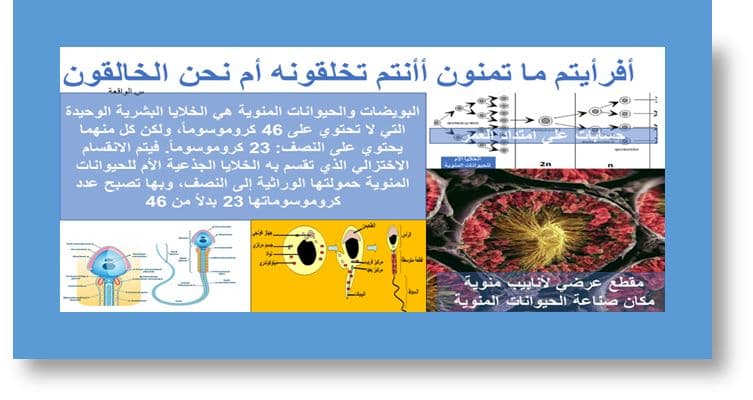
Eggs and sperm are the only human cells that do not contain 46 chromosomes, but each contains half: 23 chromosomes. The meiosis by which the stem cells of the sperm divide their genetic load in half, and the number of their chromosomes becomes 23 instead of 46. The meiosis produces 4 daughter cells that contain half of the genetic material of the mother cell.
A reductionist dichotomy goes through the following stages:
The first intermediate division where the sperm cell divides I to give two second-order sperm cells n
During equilateral division the sperm cell divides II to give two nuclei n
Dispersal stage: sperm turns into 4 sperm n
Miracle signal at the level of cytoplasmic changes
At the level of the cellular form, a cell is transformed from its usual circular form into an object called a mushy (sperm) that carries an integrated project in which the sperm's head specializes in carrying genetic chromosomes, and provides in the Mediterranean segment an engine carrying movement tubes and mitochondrial energy, and then a whip that enables the sperm to enter the competition to catch up with the egg cell.
The creation of the sperm is subject to careful calculations that show the greatness of its creator and his creativity in his creation, and also show the complexity and precision of the workmanship that testifies to the ability of the maker, so it is a scientific miracle and historical precedent that God attributed the creation of the sperm to himself at a time when humanity was not aware of the components of the sperm.
Miracle signal at the level of the time period in which the gametes are formed
Sperm Components and Sources:
Sperm consists of a liquid with sperm and contains each 1 cm3 of semen with 120 million sperm..Sperm production is done at the testicular level while semen is secreted from the glands of the accessory:
- Sperm vesicles: secretes a viscous fluid rich in albumin, levine generator, vitamin C and fructose sugar, which is used as an energy source for sperm.
- Muth: secretes a white liquid such as milk containing citric acid and enzymes analyze to reduce the concentration of sperm.
Cowper glands: secretes alkaline (base) secretions that work on the acidic breakdown of vaginal secretions and residual urine in the urethra.
The sperm is a reproductive cell (or male placenta), which participates in sexual reproduction. In order to form a sperm, it is subject to eternal calculations and significant formal changes in the stages of its formation and in the stages of its irreducible composition:
Stages of sperm formation within the testis:
The gametes are formed in a continuous way from puberty at the testicular level through stages, namely:
Reproductive stage: Sperm 2n undergoes three indirect divisions to give sperm 2n to replenish spermatozoa.
Growth stage: The spermatozoa increase in size and turn into sperm cells of the first degree 2n.
– Maturity stage: the charges of reductionist division.
During meiosis the sperm cell divides I to give two second-order sperm cells n
During equilateral division the sperm cell divides II to give two nuclei n
Dispersal stage: sperm turns into 4 sperm n
The goulash vesicles fuse to form the enzyme-rich humus.
The distant centipede is an apex that grows to form a whip.
The mitochondria are clustered as a spiral in the intermediate piece.
SERTOLI cells act on excess cytoplasm phagocytosis
Animal Composition
The head of the sperm contains a nucleus with 23 chromosomes in humans, and at the front of the head there is an apical body (Acrosome) secretes the enzyme Hyalourenes, this enzyme dissolves part of the shell of the egg, facilitating the process of pollination and entry into the egg.
The sperm nucleus contains one copy of each pair of chromosomes (23 pairs of chromosomes or a total of 46 chromosomes) contained by each cell in the man's body, half of the number of chromosomes (23 chromosomes), and thus each sperm provides half of the number of chromosomes, while the egg cell coming from the woman provides the other half to get a new human with the first fixed number of chromosomes, which is 46 chromosomes.
Neck: Contains two nearby and distant centriole particles that play a role in the division of the fertilized egg.
The middle piece contains the mitochondria, which gives the sperm the energy it needs to move.
Tail: Consists of an axis and ends with a tail piece and helps the sperm move. During fertilization, the sperm and the egg combine to form a fertilized egg, which grows into a leech and then into a chew and then the rest of the stages until it gives a new member of the same species.
Stages of egg creation:
An egg is a sex cell (or placenta) produced by females, and like all gametes, an egg contains half of the chromosomes.
The egg begins to form before the birth of the female (from the 15th week to the 7th month of gestation in humans), during which the protocells of the mother are formed within the ovary, and then undergo several successive indirect cell divisions. This results in about 7 million cells. This amount becomes non-renewable. The reduction divisions then begin to form primary eggs. This stage of reduction division is blocked until adulthood, where each menstrual cycle develops a mature semi-ovary.
In the end:
The egg also contains half the number of chromosomes, one copy of each chromosome (which totals 23 pairs of chromosomes, or 46 chromosomes), so the egg contains half the number of chromosomes (23 chromosomes) compared to what each cell contains in the woman's body, and thus each egg provides half of the number of chromosomes, while the sperm coming from the other man provides a new human with the first fixed number of chromosomes, which is 46 chromosomes.
—
Source: Published on Dr. Mohammed Bourbab's Facebook page on 18-07-2021
https://www.facebook.com/bourbab.m/posts/pfbid0Gzv6LnPuzAJhcRWBnjU4YvZGtGDwAYXBkhKqfMBQswvBWXHw2cvTZSh6ydGFqUZ9l