
Then He ascended to the heavens and made them seven heavens, and in the verses of the Qur’an He brings together two time-distant stages in creation: the preparation of the earth first, and then the organization of the sky, which is proved by modern astronomy.
Then he ascended to heaven, and they were seven heavens.
The Qur'anic text combines two time-spaced stages in creation: first equipping the earth, and then organizing the sky, which modern astronomy has proven.
Verses 9-12 detail the creation of the earth and the creation of the seven heavens/atmosphere.
1. The chronology of the evolution of the Earth's atmosphere in Surat-e-Sut is the same as that mentioned in the scientific literature.
2. Seven Heavens is a detail in the composition of the atmosphere with its seven layers.
3. It is revealed in every sky an indication of the allocation of each layer of the atmosphere with its specific functions.
...
1. The chronology of the evolution of the Earth's atmosphere is the same as that mentioned in the scientific literature and in the chapter
Chronology of the formation and evolution of the Earth's atmosphere
The verses of Surat-e-Satt (9-12) draw a precise sequence of the stages of the creation of the earth and its atmosphere, and its statement can be organized as follows:
1) Creating the Earth in 2 Days
A. Do you disbelieve in Him who created the earth in two days?
b. Initial initialization of the land mass and the formation of its infrastructure.
2) Mountaineering and troop assessment
A. And he placed in it my anchors from above it and blessed it, and he destined in it its sustenance in four days, both for the inquirers.
b. Establish continents, stabilize the crust, and prepare diverse food and environmental resources for all organisms.
3) Move to the sky as it smokes
a. And then leveled up to the sky and it's smoke
b. A description of the primordial cosmic gaseous state after the initial creation, prior to the organization of the astronomical structure.
4) The cosmic order of organization
A. He said to her and to the earth, come willingly or unwillingly.
b. An indication of the submission of the laws of the universe to the command of God in both earth and heaven.
5) Compromise the seven heavens and give each one its command
a. Seven Heavens were destroyed in two days and revealed in every sky her command
b. Organize the layers of the sky (or the seven heavens), and determine the functions of each layer, which corresponds to what has been revealed by modern astronomy about the multiplicity of levels and functions in space near and far.
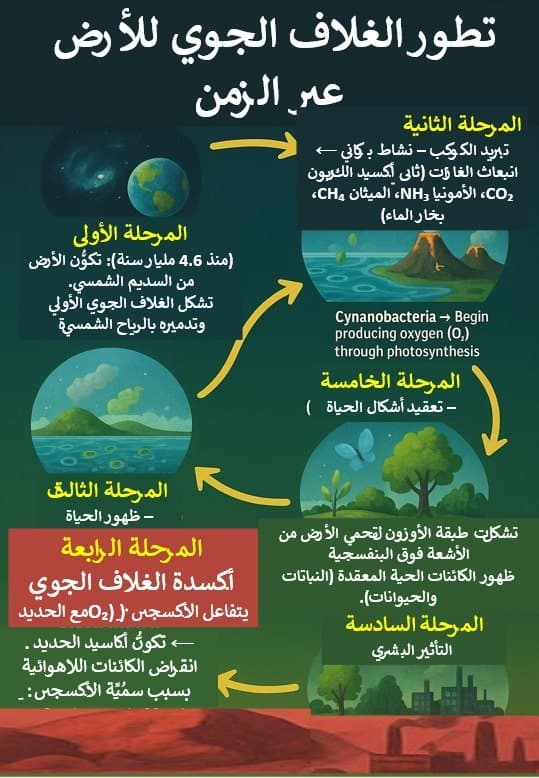
Details about the stages of atmospheric formation
4.6 billion years ago
The Earth is a solar nebula.
The core of the Earth is formed as a result of the accumulation of heavy materials.
* Primary atmosphere: made up of hydrogen (H2) and helium (He), but quickly faded due to strong solar winds and lack of magnetic protection.
4.0 billion years ago
Massive volcanic activity.
Emission of gases: CO2, H2O, CH4, NH3, SO2
* Formed secondary atmosphere: anaerobic, dense, unfit for most life forms.
The earth's crust was formed, and the first water cycle was initiated by condensed water vapor.
3.8 billion years ago
Condensation of water vapor forms the oceans.
* Absorption of CO2 into low-greenhouse water.
This provided an aquatic environment suitable for the emergence of the first simple life forms (single-celled).
3.5 billion years ago
The emergence of cyanobacteria
The first organisms to photosynthesize using water and produce oxygen.
O2 is beginning to appear but remains dissolved in the oceans, has not yet entered the atmosphere.
3.0 billion years ago (approx.)
Formation of primitive continents (first continents)
This has led to a diversity of environments and ecosystems, helping to diversify early life.
2.7 billion years ago
Deposition of iron oxides (BIFs)
Oxygen reacts with dissolved iron in the sea, forming banded iron deposits.
The O2 phase drains water, delaying its release into the atmosphere.
2.4 billion years ago
The Big Oxygen Event (GOE)
Oceans overtake O2 absorption capacity is beginning to accumulate in the atmosphere (1-2%).
The extinction of anaerobic organisms is the largest early extinction in history.
It is associated with an ice age (Huronian glaciation) due to low greenhouse gases.
1.8 billion years ago
Evolution of eukaryotes
Complex cells containing nuclei and organelles, based on the presence of O2 in low degrees (5-10%).
CO2 is still high, and oxygen is completely unstable.
1.2 billion years ago (additional detail)
Sexual reproduction first appears.
It led to increased genetic diversity and the subsequent development of multicellular organisms.
800 million years ago.
Second Oxygen Event (NOE)
A significant rise in O2 (up to 15-20%), a marked decrease in CO2.
Prelude to the development of multicellular organisms (Metazoans).
It may be related to the breakup of the continent of Rodinia.
600 million years ago
Formation of ozone layer (O3)
Protecting the earth from ultraviolet radiation.
The appearance of complex animals in the oceans (Ediacaran biota).
Additional contribution of large algae to oxygen production.
540 million years ago
Cambrian explosion (Cambrian explosion)
O2 is close to its current level (?21%).
Rapid and significant diversity of organisms, including the first vertebrates.
A dynamic interaction between the atmosphere and the biosphere.
470 million years ago
First appearance of wild plants (Bryophytes)
Absorb CO2 and raise O2 more via land-based photosynthesis.
The ozone layer was strengthened, and land was colonized by invertebrates and plants.
300 million years ago
The Age of Coal (Carboniferous)
O2 levels reach highest historical value (-35%).
Widespread forest fires, large insects, and the formation of large coal deposits.
252 million years ago
Permian-Triassic extinction (The Great Dying)
96% of marine species are extinct.
Severe climatic and galvanic changes due to massive volcanic activity (Siberian Traps).
66 million years ago
Asteroid Collision - Dinosaur Extinction (Chicxulub Impact)
Emission of heavy dust and gases such as CO2.
*Sudden cooling, and later warming temporarily imbalance the atmosphere.
* 200 years ago
Beginning of the Industrial Revolution
CO2 concentration increased from 280 to 420 ppm.
Increased CH4.
Rapid climate change, major threat to biodiversity, and disruption of the natural atmosphere.
Compendium of causal relationships leading to the formation of the Earth's atmosphere (in the form of an interconnected chain)
4.6 billion years ago.
The Earth is a solar nebula.
The core of the Earth is formed as a result of the accumulation of heavy materials.
* Primary atmosphere: made up of hydrogen (H2) and helium (He), but quickly faded due to strong solar winds and lack of magnetic protection.
* Composition of the second atmosphere * Volcanic activity
Steam Condensation > Ocean Formation
Oceans – an environment for blue bacteria
Blue bacteria – production of O2
* O2 * Iron oxides * Extinction of anaerobic organisms * Appearance of complex cells
* High oxygen * Ozone * Prosperous complex life
Land Plants – Strengthening the Modern Atmosphere
Industry – the threat to this ecological and atmospheric balance
Structured comparison of the two sequences:
Comparison of Qur'anic and Scientific Sequences in the Formation of the Earth and the Sphere
—
Source: Published on Dr. Mohammed Bourbab's Facebook page on 2025-08-12
https://www.facebook.com/bourbab.m/posts/pfbid035g8BDVcyuaZx5a2LpYgzbZWJE4HCXecsT83VswqA46WZKKfX3RGwwkm4GPifP43Rl