
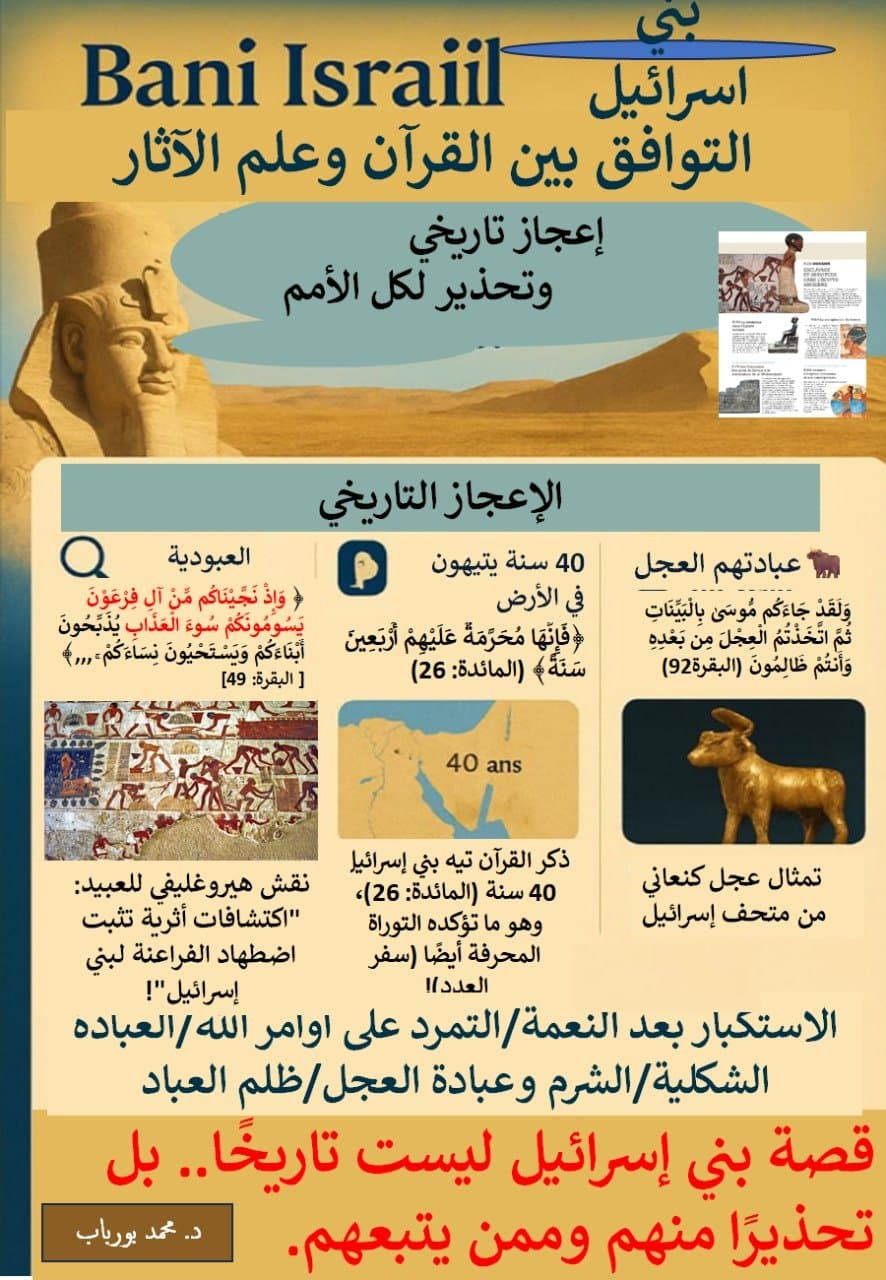
And when We delivered you from the people of Pharaoh, they afflicted you with the worst of punishment, slaughtering your sons and sparing your women.
And when We delivered you from the people of Pharaoh, they afflicted you with the worst punishment, slaughtering your sons and sparing your women.
Historical Miracles and the Compatibility of the Quran and Archaeology
A. Slavery in Egypt and Pharaoh
Pharaoh’s punishment of the Israelites was clear.
And when We delivered you from the people of Pharaoh, they afflicted you with a terrible torment, slaughtering your sons and sparing your wives.
Pharaoh was on the earth, and he made his people into a sect of them.
Archaeological evidence:
1. Hyksos (Semitic people):
The discoveries confirm that the Hyksos (a Semitic people) lived in the east of the delta (Avaris) as rulers and then slaves.
- Expulsion of Ahmose I (founder of the family 18), which may correspond to the novel Exodus.
References:
- Archaeologist Manfred Bietak in the excavations of Tal al-Dabaa.
"The Hyksos: A New Investigation" by John Van Seters
2. Ipuwer Papyrus:
- Describes events similar to the strikes in Egypt:
- Niles turned to blood.
The spread of death and unrest.
Archived from the Leiden Museum, Netherlands (No. 344).
3. Pharaonic inscriptions on forced labor:
- The drawings of the tombs of Thebes show the Semitic workers building the cities of the storehouses (such as the house of Ramesses mentioned in the Torah).
B. Exit and Teh in Sinai
It is forbidden for them for forty years to wander in the land.
The Torah: Numbers 14:33-34 confirms that he is 40 years old.
Archaeological evidence:
1. Sinai Wild Camps:
The remains of Bronze Age camps (1500 1200 BC) have been discovered in areas such as Kadesh-Barnea.
"In Search of the Mountain of God" (Bruce Gore)
2. Egyptian inscriptions on "Shasso":
Egyptian documents mention Bedouin tribes in Sinai, which may be associated with the Israelites.
---
c. The worship of calfs and their deviations
And the people of Moses after him took from them a haste.
Exodus 32 mentions the incident.
Discoveries:
1. Canaanite Calf Statues:
- Golden calf statues were found in Tel Dweir (Palestine) and the site of Ugarit (Syria).
- Reference: "The Archaeology of Cult" (Raphael Giveon).
2. The God of Baal in inscriptions:
It is the story of the children of Israel, and the story of the Israelites.
Scientific comparison:
Qur'anic text Examples of archaeological evidence
Persecution of Pharaoh by forced labor Expulsion of the Hyksos
the Sinai Bronze Camps
Calf worship. Calf statues. Canaanite.
Western sources
1. References on Slavery and Exodus from Egypt: A. Academic Books: "Exodus: The Egyptian Evidence"
Edited by Ernest S. Fririchs & Leonard H. Lesko
He discusses archaeological evidence of the presence of the Semitic people in Egypt, including the forced papyrus and its relationship to the story of the Exodus.
"The Bible Unearthed"
Israel Finkelstein & Neil A. Silberman
The book is controversial, but offers an analysis of Exodus events based on archaeological finds in Egypt and Sinai.
"Out of Egypt: The Archaeology of the Exodus"
Charles R. Krahmalkov
It focuses on Egyptian inscriptions that may indicate the presence of Hebrews.
B. Court Research: "Egyptologists and the Israelite Exodus from Egypt"
James K. Hofmeier (yes, he is the author of "Israel in Egypt", but here we mention his research published in the journal Near Eastern Archaeology).
He discusses the Anastasia papyrus which mentions Sami slaves working in the construction of the cities of Pharaohs.
"The Store-City of Pithom and the Route of the Exodus"
Edomund Naville (British Egyptologist)
He analyzes the location of Tell al-Maskhotah in Egypt, which is believed to be the city of Betom mentioned in the Torah.
2. References about the wanderings in Sinai and the worship of the calf: A. wrote: "The Gold of Exodus"
Howard Blum
A journalistic investigation into archaeological finds in Sinai that may have been linked to the journey of the Israelites.
"The Rise of Ancient Israel"
Edited by Hershel Shanks
A complete chapter on Canaanite monuments and calf worship in Palestine.
"Calf Cult in the Ancient Near East"
Raphael Patai (published in the Journal of Biblical Literature)
The golden calf of the children of Israel is linked to the worship of Baal in Canaan.
"The Cult of the Bull in the Ancient Near East"
Othmar Keel
A comparative study between Canaanite statues and biblical texts.
3. References on Hyksos and their relation to Exodus: A. wrote: "The Hyksos Period in Egypt"
Charlotte Booth
A new analysis of the role of the Hyksos as a Semitic people and how they were expelled from Egypt.
"A History of Ancient Egypt"
Nicolas Grimal
A chapter on the Hyksos shows that they brought Semitic customs to Egypt.
B. Research: "The Expulsion of the Hyksos"
Kim Ryholt (published in the Journal of Egyptian History)
He explains that the expulsion of the Hyksos was a major event that may have been related to the Exodus.
Scientific Documentary and Film: "Patterns of Evidence: The Exodus"
A documentary showing archaeological evidence of the Exodus, with the participation of scholars such as David Rohl.
"The Exodus Decoded"
Produced by James Cameron, it shows a match between Egypt's strikes and documented natural disasters.
5. Sites and museums providing primary sources: British Museum (London):
It includes Egyptian papyri about forced labor, such as the Anastasia 6 papyrus.
Link: www.britishmuseum.org
Museum of Israel (Jerusalem):
He displays the Canaanite calf statues of Tell al-Dawair.
IMPORTANT NOTE: These references offer a neutral scientific perspective, some of which support the Qur'anic/Toranic narrative, and some of which question it. But they all show that:
The Semitic (including the Hyksos) lived in Egypt.
There are historical events that resemble the story of the exit.
The worship of calf was widespread in Canaan.
And those parables We set forth for mankind, and none can make sense of them except the worlds.
Conclusion:
The Qur'an provides an accurate historical account that is consistent with:
1. Egyptology (persecution of Hyksos).
2. Sinai Monuments (Teh Journeys).
3. Near East inscriptions (veal worship).
We will show them Our signs in the horizons and in themselves until it becomes clear to them that it is the truth.
The Scientific Explanation and Scientific Miracle of Dr. Mohamed Bourbab
—
Source: Published on Dr. Mohammed Bourbab's Facebook page on 2025-08-14
https://www.facebook.com/bourbab.m/posts/pfbid0oBzQo8BBdJUztKNvZh39FeAH5cNDFnXJvtcu7HmZ3UTdSW2zCsi6arqVzNcT2D9vl