
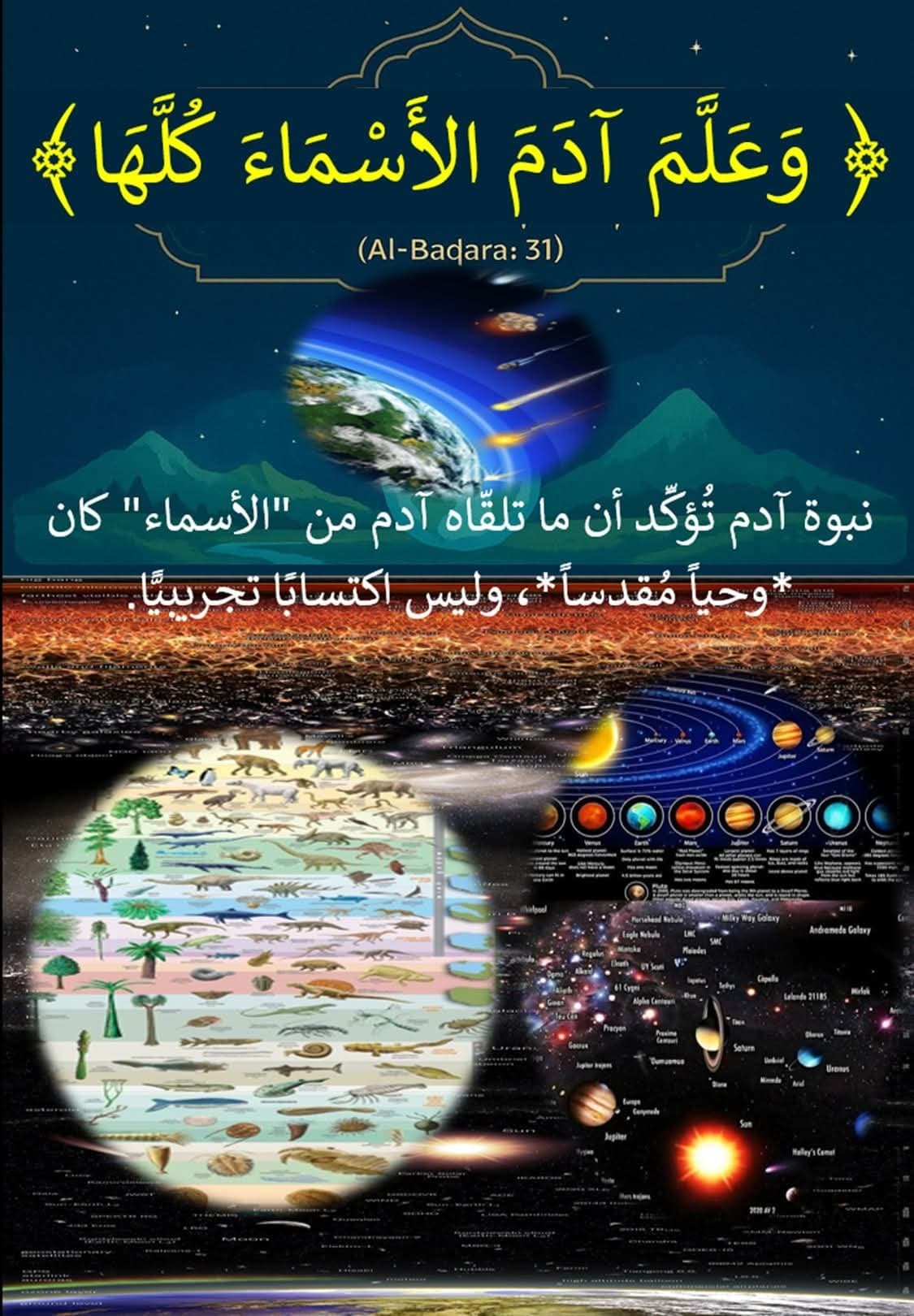
The verse "Adam knew all the names" is a complete Qur'anic theory of knowledge that bears the verse "Adam taught all the names" deep meanings about the nature of divine science and the empowerment of man.
And Adam knew all the names of the Qur’an.
The verse "And Adam taught all the names" has profound meanings about the nature of divine science and the empowerment of man.
These are the most prominent suggestions for interpretation and reflection:
First, Adam's prophecy asserts that what Adam received from "names" was a holy revelation, not an empirical acquisition.
The story of the sons of Adam in the Qur'an "And recite to them the news of the sons of Adam with the truth when he received a sacrifice" [Table: 27], when he gave one of his seed, and the other of his sheep, is not just an isolated incident, but a window into the nature of the first knowledge that God deposited in man. The Qur'an shows that Adam received knowledge directly from his Lord, and "Adam taught all names" [the cow: 31], i.
1. The comprehensiveness of Adam’s gifted knowledge
However, the Qur’anic text states that God gave Adam the ability to perceive “all the names,” that is, the keys to universal knowledge and its elementary laws. This explains how from the first generation his sons practiced agriculture (Qabil) and herding (Habil), which are the pillars of any civilized economic system.
2. The First Civilizational Nature of Man
Physical vision considers that man went through "primitive" stages before he founded civilizations, but the Quran presents the opposite picture: The first civilization was full-fledged because it was founded on a talented science, and backwardness was not original, but came later as a result of deviation or loss of science. Here the Quranic text meets with archaeological evidence showing that ancient civilizations appeared suddenly without long introductions. For example:
* Sumerian civilization (circa 3100 BC) suddenly emerged with a sophisticated writing system and laws (Kramer, History Begins at Sumer, 1981).
Ancient Egyptians constructed pyramids in the third millennium BC using engineering techniques that are still controversial today (Lehner, The Complete Pyramids, 1997).
Antikythera (about 200 BC) found in a Greek shipwreck, represents a complex astronomical computer that does not fit the hypothesis of a primitive progression of knowledge (Freith et al., Nature, 2006).
3. Distinguishing between Divine Science and Experimental Knowledge
Adam knew that fire burns, and his descendants have experimentally discovered how fire burns and how it turns into energy. Thus, revelation is a civilizational accelerator that shortens man’s life by centuries of trial and error.
4. The role of revelation in accelerating progress
Islamic texts indicate that the prophets of God were the teachers of humanity: the teaching of peace was attributed to him writing and industries, Noah taught people the manufacture of ships, and Abraham the science of architecture. This is consistent with the phenomenon of the "sudden emergence of civilizations", where revelation is the basis of departure and not the slow experience alone.
5. The Theory of Cultural Forgetting
The Qur'an states: "He forgot and we found no determination for him" [Taih:115], which can be understood as part of the original knowledge lost through generations. So in history we find cycles of sudden progress then collapse (such as the pyramids then dark ages, or the sciences of Muslims then medieval Europe). It is not a "linear development", but a frequent loss and retrieval of knowledge.
6. The Moral Dimension of Knowledge
The divine science that Adam inherited was not technically abstract, but a science related to wisdom and purpose. When knowledge was separated from revelation as in modern material civilization, technical progress accompanied by serious moral and environmental crises (pollution, nuclear weapons, social disintegration) emerged.
7. Dialogue between Adam and Angels: The Social and Political Dimension of Knowledge:
Then he showed them to the angels and said, “Tell me the names of these, if you are truthful.”
Prove human competence to succession: Succession was not a free gift, but was coupled with the giving of cognitive competence to it. God Almighty, by His absolute will, wanted to prove to the angels that this new creature (Adam) possessed the tools to carry out the task of reconstruction on earth.
Distinguishing knowledge from innate knowledge: Innate knowledge of angels is limited by the limits of their function (praise and sanctification). Adam's knowledge is comprehensive, scalable and transferable, and this qualifies him for succession that requires continuous management and development.
Knowledge is a source of honor and responsibility: the worship of angels to Adam was a tribute to the knowledge that he carries. This places a moral responsibility on man: to use this knowledge in good and constructive, not in corruption and destruction. It is a point that connects directly to our contemporary crisis (technique without ethics).
The Qur’anic text shows that the first man was not a primitive, but a “scientist” from the beginning, and that humanity inherited from Adam a comprehensive knowledge asset, and then entered into cycles of remembrance and forgetting. The civilizations that suddenly appeared (Sumaria, Egyptian, Greek) are not “leaps of evolution”, but evidence that the original knowledge existed and then was lost and rediscovered in the way of the human being. Hence, building a balanced human future requires the combination of revelation as a guiding tool and mind.
How did God teach Adam all the names?
1. The nature of "nouns" and their philosophical and linguistic interpretations: Multiple interpretations of the term "all nouns" are not explicitly mentioned, which is essential for understanding the depth of gifted knowledge.
The first explanation (vocabulary and language): is the most common, i.e., God taught Adam the names of all beings (sun, moon, water, fire...), making him the father of human language. Language here is not just sounds, it is a symbolic system with concepts and the ability to distinguish and communicate, and is the basis of any knowledge.
The second explanation (mathematics and facts): The name here means "name" or the fact of the thing and its nature and properties. Adam did not learn that this is a "tree", but learned the fact of the tree, and what benefits and harms it, and its usefulness, and the laws of its growth. This explanation raises the level of knowledge gifted from vocabulary to a total understanding of the universe and its laws (physics, chemistry, biology at a basic level). This strongly supports the idea of "key".
The third explanation (functions and ends of things): To learn names means to know the functions of things and the purpose of their creation. To know that fire is for burning, maturing and illumination, and that water is for drinking, agriculture and purity. This "functional" knowledge is the foundation upon which civilization and technology are built.
Third: The Deep Dimensions of Adam's Being a Prophet and Its Significance in the Story of Creation and Education
Several legal texts have been received that prove Adam's prophecy, including:
1. Evidence from the Holy Quran
A. Saying in Surah Al-Imran (33-34):
Allah chose Adam, Noah, the family of Abraham, and the family of Imran over all the worlds, offspring of one another; and Allah is Hearing, Knowing.
This is the first time that Adam has been revealed to him.
B. Saying in Surah Taha (121-122):
And Adam disobeyed his Lord, so he seduced him, and then his Lord rebuked him and guided him.
It is a sign of repentance and guidance from the prophets.
2. Evidence of the Prophetic Year
Hadith – Mishkat, Narrated Abu Sa’id May Allah be pleased with him
A man asked, “Was Adam a prophet?” and he said, “Yes, he was a talking prophet.”
It was Adam’s testimony that he was speaking directly from God.
B. The long intercession talk in Bukhari:
The Prophet (peace and blessings of Allaah be upon him) said: “Go to Noah, the first Messenger sent by Allah.”
The difference between Adam as the first prophet and Noah as the first messenger.
Hadith – Mishkat, Narrated Abu Sa’id May Allah be pleased with him
He said, “One hundred thousand and twenty-four thousand, the first of them is Adam.”
3. Statements by scientists
A. Many son at the beginning and the end:
"Adam (peace be upon him) is the father of mankind and the first of the prophets."
B. Al-Qortubi in his interpretation:
"Scientists agree that Adam was a prophet."
T. Ibn Taymiyyah in total fatwas:
"Adam was a prophet by Muslim agreement".
4. Indications learned
a. Time priority: Adam is the first of the prophets as he is the first of mankind.
B. Graduality in the messages: The messages began with Adam and then followed until the conclusion of the prophets.
C. Divine selection: Prophecy is the selection and choice of God, not human acquisition.
5. Answering a Suspicion
Some of them doubt that Adam disobeyed, how can he be a prophet?
The Prophet (peace and blessings of Allaah be upon him) said: “The Prophet (peace and blessings of Allaah be upon him) was a sinner.”
The legitimate texts are explicit in Adam's prophecy, and it is the subject of consensus among scholars, confirming his position as the first Prophet and the father of mankind.
The proof of Adam's prophecy in the Sharia texts (as in the Hadith: "The Prophet sent to his people a special message, and it was sent to all people" narrated by al-Bukhari, noting that the first prophets Adam) adds layers of meaning to his saying: "And Adam knew all the names" and enriches our understanding of the relationship between prophecy, science, and the task of dispute.
Sixth: Adam's prophecy confirms that what Adam received from the "names" was a holy revelation, not an empirical acquisition.
For example, the prophets received the names of things and their truths anonymously (as Abraham knows the reality of the stars and planets in Surah al-An'am).
1. Prophetic Science vs Human Science:
Adam's knowledge of the universe was complete in its domain (what he needed to dispute), while mankind's knowledge of today is cumulative and relative.
2. Prophecy links science to worship and commission, where:
- Knowledge for worship.
Adam did not learn the names to control the universe, but to worship God and establish His justice.
“You and your wife shall dwell in Paradise, and you shall not approach this tree” (Qur’an 2:35).
Differences from materialist philosophies: Secular theories separate knowledge from morality, while the prophetic model makes it a tool for self-verification.
3. Prophecy emphasizes differentiation by science, not by element
When the angels failed to answer the names, Adam’s superiority appeared with knowledge and not with sex (Adam from dust, angels from light).
It is a sign of God’s love for you that you will know Him.
4. Prophecy explains the mystery of the conflict with Satan
Iblis refused to prostrate himself to Adam because he saw himself as righteous, but the Qur’an revealed that the trade-off was with knowledge and not with matter.
The conflict between man and Satan is a conflict of right versus false knowledge (as in the story of Adam's tree seduction through the promise of the "Immortal King").
The deep significance: the conflict is not only material, but a cognitive conflict, where Satan tries to distort concepts and convince man that disobedience is science, and that the Haram contains a benefit!
The difference between good knowledge and bad knowledge is that Satan took them away from them and drove them out of what they were in.
This pattern is repeated in man’s life: Satan adorns his sin with a “false flag” (such as the justification of usury, or moral deviation under the banner of freedom), while revelation comes with the truth.
5. Prophecy established the message of monotheism from the beginning
Adam means that the first message to mankind was:
- Unite God.
- Understanding the cosmic tooth.
- Resist the devil's hex.
Discernment: This differs from biblical narratives that focus only on the Fall, while the Quran focuses on education and selection.
6. Linking with modern scientific theories (for the enrichment of subtraction): Promoting the idea of "sudden emergence of civilizations" by linking them with non-traditional theories in archaeology and history, which face several difficulties:
The Cultural Catalysm theory suggests that cultural evolution is not always slow, but may take huge leaps due to revolutionary discoveries or “contact” with a higher source of knowledge.
-The debate about "behavioral modernity": indicates that the "modern anatomical human" (Homo Sapiens) appeared about 200,000 years ago, but the "modern behavior" (symbolic art, complex language, advanced technologies) suddenly appeared about 50-70,000 years ago in the so-called "explosion of the Upper Paleolithic". Some interpret this as the moment of "discovery" of the latent ability of the Qur'an.
7. Contemporary Implications: Towards a Balanced Knowledge Model/Developing a Suggested Model of Human Knowledge Derived from the Verse, an Alternative to the Pure Material Model:
* The origin is revelation and inspiration (total and infinite knowledge): it is the source that provides us with the total map and moral foundations and the purpose of existence. (Example: Quranic text and conversations that encourage the quest for science and learning).
* The tool is the mind and experience (detailed and applied knowledge): it is the mechanism given by God to detail that total knowledge, and discover its laws and applications through observation and experience. (Example: the development of experimental science).
The danger is the break between them: when technology (the son of experience) is separated from wisdom and morality (the son of revelation), the sick progress we see today results.
Future in integration: Reconnecting all branches of knowledge (natural, human, social) to their roots from the absolute values that come from revelation. A scientist who understands the "name", its truth and its function will also understand its limits and the ethics of dealing with it.
8. The verse Adam taught all names is an integral Qur’anic theory in knowledge as opposed to physical theories
The "Quranic Theory of Knowledge" derived from the verse "Adam taught all the names" can be briefly elaborated in the following central points:
Foundations of Qur'anic Theory in Knowledge
1. Divine Source: True knowledge is gifted and not fully discovered from scratch.
God is the first teacher, and man is the receiver and developer of this gift, not the creator of knowledge out of nothing, which increases the value of man (honor of knowledge) and limits his arrogance (knowledge of his origin from God).
2. Inclusiveness and Perfection (Grant):
The first epistemological grant (all names) was all-encompassing (for all subjects of knowledge) and fundamental (explaining the essences, functions, and laws of things). This contradicts the idea of the "first primitive" and establishes the idea of man's first qualitative perfection in terms of cognitive potential.
3. Integration of Sources (Automatic):
Transport/Inspiration Source: Provides the holistic, teleological and ethical framework (road map and destination).
* Mental/experimental source: is the tool for detailing that holistic knowledge and exploring its applications (walking the road).
* Optimal knowledge is the fruit of a balance between revelation (the end) and reason (the tool).
4. Historical Cycles (Fate):
Human history is not purely linear, but cycles of remembrance and forgetting.
Civilizations thrive when they preserve and exploit that knowledge endowment and advance when they forget or separate knowledge from its moral purpose.
Interpret the "sudden" emergence of civilizations (such as Sumerian and Egyptian) as a partial restoration of that original knowledge, not an "invention" of nothing.
5. Ethical Responsibility (End):
Knowledge is not neutral. Its value is conditioned on its use in the reconstruction of the land (caliphate) and the achievement of justice, not in corruption and destruction.
The disconnect between "technique" (which is the product of reason and experience) and "wisdom" (which comes from revelation) is the origin of modern moral and environmental crises.
Theory in one sentence.
"Knowledge has a total divine origin, its mechanism of acquisition is empirically mental, its purpose is urban moral, and its history is cycles of integration and separation between grant and acquisition."
This theory offers an alternative to historical materialism (elevating linear evolution) and social Darwinist hypotheses about human primitiveness, and sets a balanced framework for understanding knowledge that combines faith, science, matter, spirit, power and wisdom.
Conclusion:
This analysis is tantamount to opening additional windows in the intellectual construction constructed by the verse "And Adam taught all the names", which is not just a story of initiation, but a "Quranic theory of knowledge" that lays out a framework for understanding the history and fates of civilization, offers a Diagnose (diagnosis) for the crisis of modern man, and heralds a Prognose (expectation) for a more balanced future if man returns to combine the light of revelation and the power of reason.
Adam's prophecy transforms the story of creation from a mere historical event into an integral model of the relationship between man and the universe, the Almighty Creator, and the accursed devil. It responds to materialist theories that humanity began with a divine gift, not with the darkness of ignorance!
God, yes, I know.
About the book: The Scientific Interpretation and Scientific Miracle of Dr. Mohamed Bourbab
Dr. Mohamed Bourbab
Specialty: Biology and Geology
Founder and Chairman of the Authority for Miracles in the Quran and Sunnah in the Kingdom of Morocco
Founder and member of the International Association of Miracle Scientists
Founder and Chairman of the World Authority website
Miracles in the Quran and Sunnah
Founder and editor-in-chief of Ijaz International Journal for Scientific Research and Reflection
Founder and Chairman of the International Conference of Tetouan, Morocco
—
Source: Posted on Dr. Mohammed Bourbab's Facebook page on 2025-08-19
https://www.facebook.com/bourbab.m/posts/pfbid028KZmXTvVhSz93aM22i4ibmM93V1Cj9bzjCmvCS99xkc9tYHUVvfsShxvzKGdnuiKl