
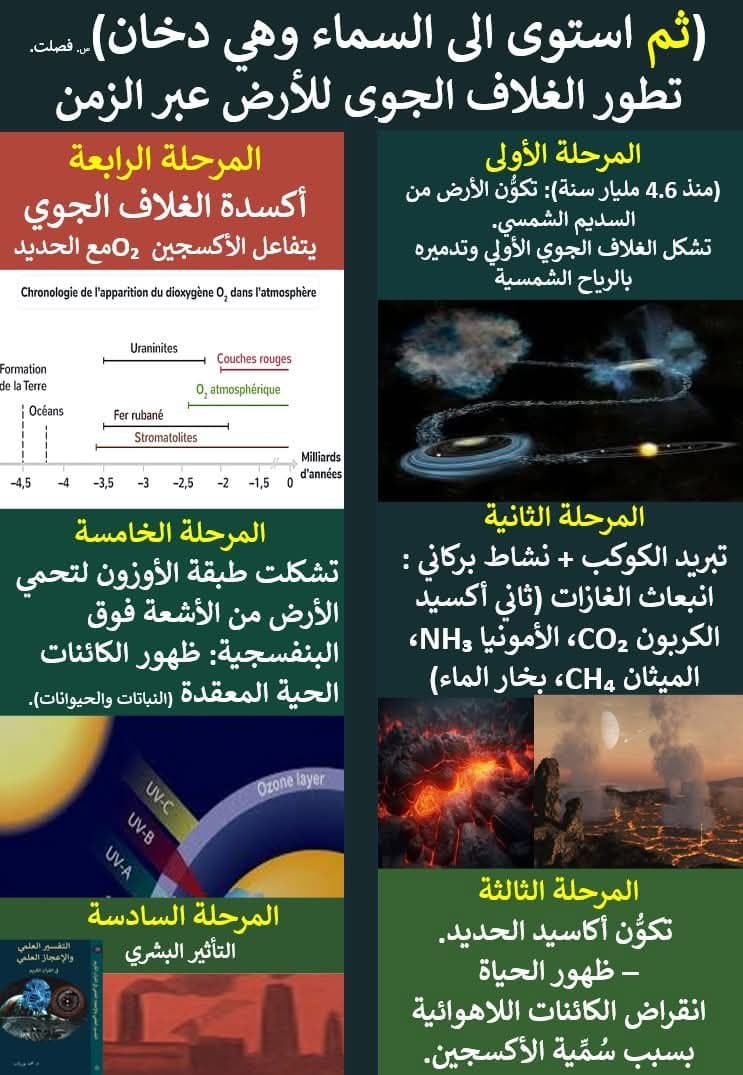
The perfect correspondence between the Qur'anic and scientific sequences in the composition of the earth and its atmosphere As I have already pointed out, this Qur'anic text combines two time-spaced stages in creation: first equipping the earth, then organizing the sky, which has been proven by modern astronomy...
Full compatibility between the Quranic and scientific sequence in the composition of the earth and its atmosphere
As I pointed out earlier, this Qur'anic text combines two time-spaced stages in creation: first preparing the earth, then organizing the sky, which has been proven by modern astronomy, the earth's sky was present in the form of smoke (gases and vapors), then underwent a process of adjustment and a timescale that ended up making it seven organized heavens, each with a function.
This accurately reflects what science proves about the atmosphere was not created suddenly in its current form, but went through long evolutionary stages until it settled on its image, which was succeeded by a chapter detailed in the saying:
The verse in Surah is separated:
Then he turned to the smokeless smoke and said to her and to the earth, "Come, willingly or unwillingly," and they said, "We have come willingly."
The word "smoke" is a very accurate description of the cosmic state, because science proves that the first sky (surrounding the Earth) was in its beginnings gases and fumes rising from volcanic emissions and meteoric collisions, which corresponds to the word smoke.
In the words of the Qur'an, "Then it was leveled to the sky": "Then" here is the time laxity rather than the immediate arrangement, that is, the process of leveling the sky (including the atmosphere) did not occur at once, but was phased through long stages.
This is consistent with what we have scientifically stated: that the atmosphere took billions of years to evolve from a dense, different atmosphere to a stable one that protects life.
Details of the stages of atmospheric formation
4.6 billion years ago: Earth formed from a solar nebula
The core of the Earth is formed as a result of the accumulation of heavy materials.
* Primary atmosphere: made up of hydrogen (H2) and helium (He), but quickly faded due to strong solar winds and lack of magnetic protection.
4.0 billion years ago: Massive volcanic activity
Emission of gases: CO2, H2O, CH4, NH3, SO2
* Formed secondary atmosphere: anaerobic, dense, unfit for most life forms.
The earth's crust was formed, and the first water cycle was initiated by condensed water vapor.
3.8 billion years ago, water vapor condenses: oceans form
CO2 Absorption in water: Low greenhouse.
This provided an aquatic environment suitable for the emergence of the first simple life forms (single-celled).
3.5 billion years ago
The emergence of cyanobacteria
The first organisms to photosynthesize using water and produce oxygen.
O2 is beginning to appear but remains dissolved in the oceans, has not yet entered the atmosphere.
3.0 billion years ago (approx.), forming primitive continents (first continents)
This has led to a diversity of environments and ecosystems, helping to diversify early life.
2.7 billion years ago: Reaction of oxygen with dissolved iron, where alternating layers of iron oxides/BIFs (e.g., Fe2O3 hematite, Fe3O4) and silica (chert) were deposited.
Depletion stage of O2 from water, delaying its release into the atmosphere: The oxygen (O2) produced by photosynthesis in microorganisms was completely consumed in chemical reactions with iron and reductive elements in ocean water, preventing its release into the atmosphere for a long time.
2.4 billion years ago:
The Great Oxidation Event (GOE) occurred when oxygen production exceeded the capacity of the oceans to absorb it, and began to accumulate in the atmosphere, reaching about 1-2 percent. This represented a radical environmental shift that led to the widespread extinction of anaerobic organisms, the oldest known mass extinction in the history of the Earth.
Climate effects: The major oxygen event was associated with the Huronian glaciation, which resulted from lower levels of greenhouse gases (such as methane) interacting with increased oxygen, leading to intense cooling of the global climate.
1.8 billion years ago: Eukaryotes
Complex cells containing nuclei and organelles, based on the presence of O2 in low degrees (5-10%).
The CO2 level is still high, and the oxygen level is quite unstable.
1.2 billion years ago (additional detail): Sexual reproduction first appears
It led to increased genetic diversity and the subsequent development of multicellular organisms.
800 million years ago: Second Oxygen Event (NOE)
A significant rise in O2 (up to 15-20%), a marked decrease in CO2.
Prelude to the development of multicellular organisms (Metazoans).
It may be related to the breakup of the continent of Rodinia.
600 million years ago: the formation of the ozone layer (O3)
Protecting the earth from ultraviolet radiation.
The appearance of complex animals in the oceans (Ediacaran biota).
Additional contribution of large algae to oxygen production.
540 million years ago: The Cambrian Explosion
O2 is close to its current level (?21%).
Rapid and significant diversity of organisms, including the first vertebrates.
A dynamic interaction between the atmosphere and the biosphere.
470 million years ago: First wild plants emerge (Bryophytes)
Absorb CO2 and raise O2 more via land-based photosynthesis.
The ozone layer was strengthened, and land was colonized by invertebrates and plants.
300 million years ago: Carboniferous
O2 levels reach highest historical value (-35%).
Widespread forest fires, large insects, and the formation of large coal deposits.
252 million years ago: The Great Dying
96% of marine species are extinct.
Severe climatic and galvanic changes due to massive volcanic activity (Siberian Traps).
66 million years ago, a massive asteroid impact in the Chicxulub region led to the extinction of the dinosaurs, resulting in the emission of dense dust and gases such as carbon dioxide, causing sudden cooling of the Earth followed by subsequent warming, temporarily disrupting the balance of the atmosphere.
200 years ago: The beginning of the Industrial Revolution
CO2 concentration increased from 280 to 420 parts per million (ppm).
Increased CH4.
Rapid climate change, major threat to biodiversity, and disruption of the natural atmosphere.
Compendium of causal relationships leading to the formation of the Earth's atmosphere
(Chain shaped threaded)
4.6 billion years ago: Earth formed from a solar nebula
The core of the Earth is formed as a result of the accumulation of heavy materials.
* Primary atmosphere: made up of hydrogen (H2) and helium (He), but quickly faded due to strong solar winds and lack of magnetic protection.
Composition of the second atmosphere: volcanic activity
Steam Intensification: Ocean Formation
Oceans: An Environment for Blue Bacteria
Blue bacteria: O2 production
The formation of oxygen (O2) led to the formation of iron oxides, which caused the extinction of anaerobic organisms, and thus led to the emergence of complex cells. As a result of the high oxygen content and the presence of the ozone layer, complex life flourished and protected organisms from harmful ultraviolet radiation. Wild plants also played a major role in promoting the modern atmosphere through the production of oxygen and carbon fixation. However, industrial activity has become a threat to this ecological balance and atmosphere, highlighting the need to protect the environment to sustain complex life.
—
Source: Posted on Dr. Mohamed Bourbab's Facebook page on 2025-09-29
https://www.facebook.com/bourbab.m/posts/pfbid02XJUWf2TpT8Sp8pw5hnxL1EUBitB6Xm62sSS82p5aypEAqnxb8n9jm6TEidvKuuMgl