
By Dr. Gunter Bickley Paleontologists usually discover new species during fieldwork, while digging in the ground, or by studying the huge collections of fossils hidden within the corridors of museums. However, in...
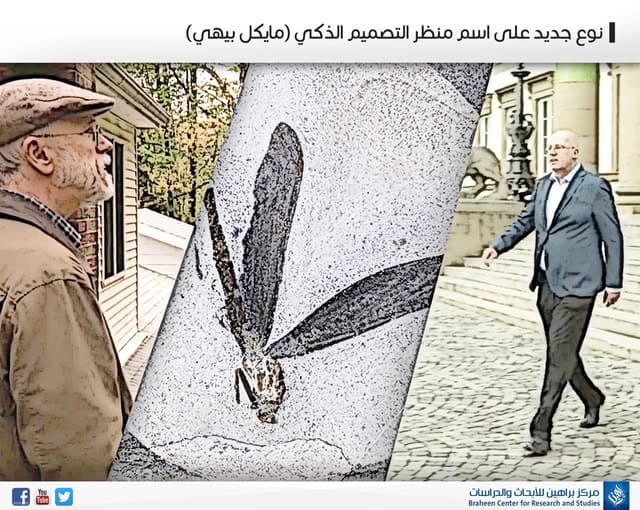
A new species named after the intelligent design viewer Michael Behe.
By Dr. Gunter Beckley
Paleontologists usually discover new species of organisms during fieldwork, while digging in the ground, or by studying the huge collections of fossils hidden within museum galleries. However, in rare cases, rare species can be discovered online. One of my colleagues once discovered a May fly species in Kahraman excavated from the Baltic region on eBay.
Something similar happened to me seven years ago. In July 2011, I stumbled across a beautiful image of a dragonfly at the site of an early Jurassic deposit on the English coast of Charmuth in the county of Dorset, England. I immediately realized that not only is this piece remarkably well preserved, but it also belongs to an unknown species.
It turned out that the owner of the fossil was the famous British collector (Chris Moore). I contacted him and asked him if he could lend me the manuscript to describe it scientifically. He kindly agreed, and we met at a fossil show in Munich in November 2011, where he brought the fossil with him so that I could study it in my lab with a binocular microscope, which shows all the details of the micrographs, and so that I could prepare large drawings with a special device.
What's so special about this fossil?
The fossil is not only a new and beautiful species of dragonflies, which lived 191 million years ago. But the good preservation of its features, specifically the arrangement of veins in the wing, allowed the fossil to be classified into a new genus and a new species of the extinct family Asiopteridae, which turned out to belong to the degree of the dragonflies-combined family Damsel-dragonfly grade and which are located within the order of the extinct Asiopters.
In fact, the fossil represents one of the most beautiful and best preserved fossils, and is the most complete of the early Jurassic eras known. It allowed the description of the physical characteristics of the family Axiopteraidae for the first time, which includes; compound eyes converging from the back, a strong chest cage, legs with short spines, and many leaf-like peripheral appendages (anal cerci). 43 cm (4.5 in), they are also relatively large dragonflies, especially for their age. They are really noteworthy fossils.
The implications of that for intelligent design?
The study of the various anatomical properties of this fossil and its comparison with other fossils of the dragonfly, has shown a highly inconsistent pattern of similarities. Such homoplasy similarities are a widespread phenomenon in systematic biology, and they do not easily align with the hierarchical system required in evolutionary classification. While this inconsistency is surprising from the perspective of the common ancestor, it does not represent a surprising limit for common design.
Naming the new "baby":
After finishing the study and coming close to finishing the manuscript, I was faced with one final question: What name should be given to the new species and genus? As for the genus, I had promised the owner of the fossil to name it after him, in recognition of his generosity in making the fossil available to science, and for his subsequent pledge to deposit a collection – including that fossil – in an expected museum in the Charmuth and Lime Riggs area.
But what about the name of the new species? I could have called it liassicus relative to his age, or dorstensis relative to the county where I found Dorset. But I had another idea.
Last year I had the privilege of appearing in the documentary film Thorey, which celebrates the pioneering work of Professor Michael Behe of Lehigh University. Behe is known as a proponent of intelligent design because of his concept of irreducible complexity, which is evident in molecular machines in the cell, including the famous bacterial whip. His brilliant explanation of the problem of waiting time for mutations in his second book, The Edge of Evolution, has had a powerful impact on my journey.
So who deserves the honor of having this important new species named after him? I didn’t find myself needing further thought. It should be Michael Behe. So I decided to name it Christmooreia michaelbehei, and publish the details in BIO-Complexity, the journal open to intelligent design, which you can find in this year’s first issue.
Article in English:
https://evolutionnews.org/.../new-species-of-fossil.../
Link to research paper:
http://bio-complexity.org/.../view/BIO-C.2018.1/BIO-C.2018.1
—
Source: Published on Facebook's "Braheen Center" page
https://www.facebook.com/braheen.org/posts/pfbid0S4sBqYF7G1TQwSmaozMgEXf6Ba86CMXiZ5gHZP7RsY3d7LWJPYSurs7XkshK8EXAl