
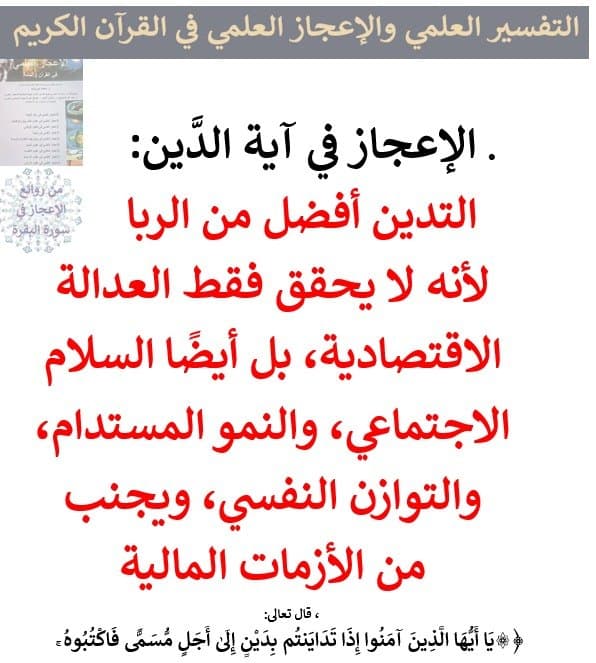
“O you who believe, when you are condemned for a term of time, write it down and let a writer write between you.
“O you who believe, when you owe a debt for an appointed term, write it down, and let a writer write it between you with justice, and let him write it as Allah has taught him. Whether he is right or weak or unable to fill himself, let him fill his guardian with justice and martyrize two of your men. If they are not two men, a man and two women who are satisfied with the martyrs, you should mislead one of them, so remember each other. Martyrs do not care if they pray and do not get tired of writing it small or large for that purpose. I swear by Allah that you will not be suspicious unless there is a present trade between you, so it is not for you to write it down, and bear witness that when you sell it, no writer or witness will be harmed, and if you do, then he will believe in you, and fear Allah, and Allah knows all things.
This verse - the longest verse in the Holy Quran - is a comprehensive financial and legislative constitution, as it dealt with the smallest details of financial transactions between people, to establish a fair economic system, based on documentation, trust and solidarity, as an alternative to the unjust riba system.
The legislative miracle in the system of debt and documentation
God’s Son, the Son of God, said (v. 492):
Allah has made it lawful for people to keep the customary debts between them so that they do not think that the prohibition of usury is a nullity of all debts.
The Quranic legislation does not eliminate the need for financial dealings, but regulates it to preserve rights and prevent financial corruption. The Quran in this directive preceded all modern legal systems that did not commit to documenting and certifying debts until centuries later.
In essence, religion is early civil legislation that establishes a culture of legal documentation, prevents gharar, and promotes individual and collective responsibility in transactions.
Religiosity is God’s alternative legislation to usury:
An integrated system in times of financial crisis, Ayatuddin (Surah al-Baqarah: 282) is a miraculous financial constitution, unprecedented in the history of human legislation. It provides not only an alternative to usury, but also an integrated system of financial dealing based on justice, transparency, interdependence, and moral responsibility, thus overcoming the structural flaws in the usury capitalist system.
Why is religion better than usury?
First: The Quranic legislative vision of justice as an alternative to exploitation
The Qur’an does not forbid usury in the abstract, but portrays it as a war on the values of society and man. It says: “Those who eat usury stand only as one who is touched by the devil” is an accurate diagnosis of the state of systemic disorder, not just individual ones. This disorder is what we see in periodic financial crises that start with collapses in phantom financial markets and end with millions suffering on the ground.
In return, the Islamic debt regime is based on:
Justice in Evidence: Writing and Testimony.
* Justice in performance: by God's fear and not to abuse rights.
Equity in adaptation: taking into account the circumstances of the weak and the weak by assuming the guardian of dictation.
* Fairness in cost: no harm to the writer and the martyr.
This system converts money from a commodity bought and sold at interest (as in usury) into a means of financing real economic activity (trade, agriculture, industry).
* This verse describes not only human usury psychological disorder, but also the general economic disorder that affects usury-based societies - such as financial turmoil, recurrent crises, and the collapse of trust between institutions and individuals.
* Religion is better than usury because the usury system is based on financial exploitation and non-productive inflation, while the religious (Islamic) system is based on justice, solidarity and real development of man and society.
Second: Modern scientific and economic analysis: The bankruptcy of the usurious model and the survival of the Islamic alternative The evidence of the failure of the usurious system has become clear in the Western economic literature itself, while the evidence of the strength of the Islamic alternative.
1.Western Research
Crises of the Usury System: Diagnosis and Findings on the Effects of Usury and Interest
World Bank report (2023): The report warns that global debt has reached a record level of $307 trillion, equivalent to 349% of global GDP. This huge debt, which pays compound interest, drains countries’ resources and diverts them from spending on health, education, and infrastructure to paying off the debt interest of the lending class.
Nature Climate Change, 2024: The study links the interest-based financial system to the climate crisis. The pressure to make short-term financial returns (to pay interest) drives companies to exhaust natural resources mercilessly, and hinders investment in long-term, sustainable projects that do not yield quick profits.
Silicon Valley Bank Collapse (2023) Model: The direct collapse was caused by rising interest rates by the Federal Reserve, which led to the collapse of the bank’s bond value. This incident shows how usurious monetary policies create systemic fragility in the financial system, as banks become vulnerable to collapse once the interest rate changes.
2. In contrast, Islamic Economics:
The Islamic economy is based on profit-and-loss sharing (speculation-sharing-mrabaha), mechanisms that recent studies in the Cambridge Journal of Economics (2021) have shown to lead to greater financial stability because they link finance to actual production.
World Bank’s 2020 Islamic Banking Report showed that non-interest-based institutions were less affected by the global financial crises (2008-2020) than traditional banks.
Researcher on behavioral economics Richard Thaler (2017 Nobel laureate) has suggested that financial systems with moral or religious constraints on quick profit are more sustainable and closer to long-term rational behavior.
The Islamic Economy of Participation: Stability and Sustainability
Islamic Finance Development Report 2023: The size of the Islamic finance industry has exceeded $3.2 trillion, with rapid growth in non-Islamic markets such as the UK, Luxembourg and Southeast Asia. This growth is a practical demonstration of the attractiveness and feasibility of the model.
The Bank for International Settlements study (BIS, 2022) confirmed that Islamic banks showed higher resilience during the 2020-2021 coronavirus pandemic. The reason is that the profit-and-loss-sharing model means that losses are distributed to all parties, not concentrated only on the debtors’ side as in the usurious system, preventing the rapid waves of bankruptcy.
Islamic Sukuk vs Traditional Bonds: Sukuk represent ownership in a real asset (project, real estate), while bonds represent interest-bearing debt. During periods of inflation, sukuk retain their value because they are tied to a physical asset, while the real value of fixed-yield bonds erodes. This makes Islamic finance more suitable for the real economy and less prone to inflation.
The psychological and social dimension
From the greed community to the trust community, a study from the Massachusetts Institute of Technology (MIT, 2023) found that financial environments based on fierce competition and compound interest (such as Wall Street) foster anxious behaviors, selfishness, and fraud among their workers, in an attempt to adapt to abnormal pressures to make impossible profits.
World Happiness Report 2024: repeatedly shows that societies with high levels of social trust and interdependence (the two pillars of the Islamic debt system) rank high in the happiness index. The usury system undermines this trust and turns the neighbor into a competitor and colleague into an opponent.
Conclusion:
The Failure of Capitalism and Communism and the Revival of the Islamic Model
The world witnessed the collapse of the communist model with the fall of the Soviet Union, and today it is witnessing the slow demise of the usury capitalist model, which was exhausted by successive crises (2008, 2020, 2023) and the widening gap between classes.
Capitalism has tried to separate economics from morality, producing a financial monster that enslaves both humans and nature.
In this scene, the system of debt and documentation in Ayatuddin stands out not only as a financial system, but as a comprehensive vision of life. It offers a model:
Balanced: Connects money to the real economy.
Fair: Protects rights by documenting and taking into account circumstances.
Ethically: instills piety and forbids exploitation.
* Takaful: makes the rich partner in the success of the poor, not exploit the narrowness of his ploy.
This legislative miracle, which came down fourteen centuries ago, is today the strongest argument that the solutions to humanity's problems are not in the invention of more complex theories, but in a return to the divine guidance that defines human instinct and what fixes it.
Religiosity is better than usury because it brings not only economic justice, but also social peace, sustainable growth, and psychological balance.
A usury system creates financial bubbles and recurring crises, while a system based on Shariah principles creates a productive human being and a symbiotic society.
—
Source: Published on Dr. Mohammed Bourbab's Facebook page on 2025-10-12
https://www.facebook.com/bourbab.m/posts/pfbid0WWcDM8NdxynciF45ZVTEN9M64m5iKUdbaieLFg7kM44M58ngsEWyekyCtsZU8CXTl