
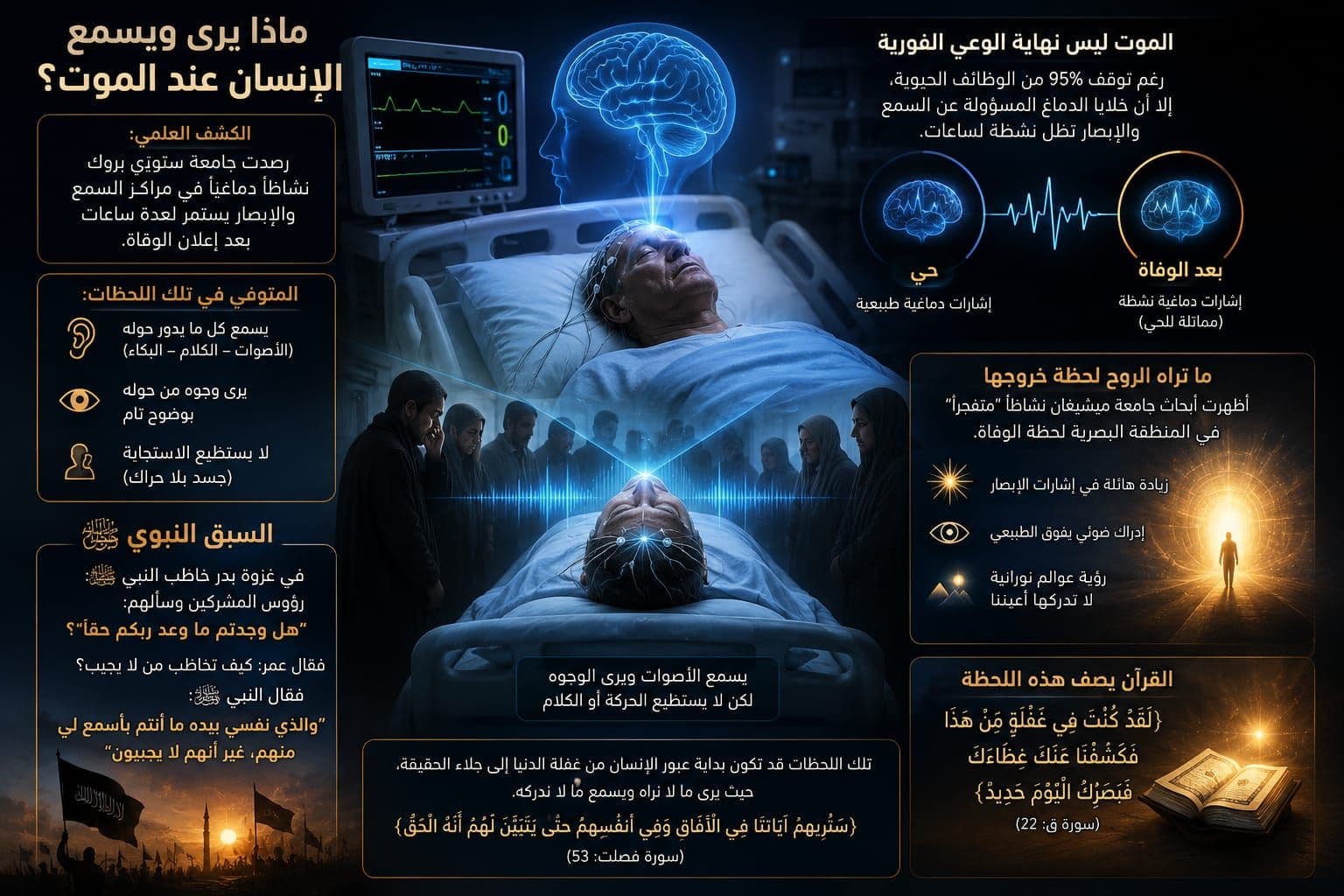
Introduction The limits of death and the equation of consciousness The concept of death in traditional medical culture has long been associated with the cessation of vital functions: the heart, breathing, and brain stem response. But the rapid development of neuroimaging techniques and the monitoring of electrical activity...
Consciousness and Sensory Perception at the Moment of Death: Modern Scientific Discoveries and Religious Texts
Introduction: the limits of death and the equation of consciousness
The concept of death in traditional medical culture has long been associated with the cessation of vital functions: the heart, breathing, and brain stem response. But the rapid development of neuroimaging techniques and monitoring of the brain’s electrical activity has reopened a thorny file on the “timing” of consciousness. Is human cognition instantaneous with cardiac arrest, or is the brain testing us in a transition in which some of its cells still retain a limited ability to receive and analyze?
---
I. Neurological activity after clinical death
1. Stony Brook Studies: Not the End of All Activities
In a pioneering study conducted by Stony Brook University (New York), researchers led by Dr. Sam Parnia observed that cardiac arrest does not necessarily mean complete silence of the brain. In animal (mouse) and later human models, sudden "mutations" of electrical activity (gamma waves) were detected immediately after the blood flow to the brain stopped. These waves, which range from 25-30 Hz, are known under normal conditions to be associated with higher cognitive processes such as attention, memory, and image retrieval.
The novelty revealed by the study is that these waves do not appear randomly, but are organized into coherent patterns, often originating from the occipital-temporal region, responsible for processing visual and auditory information. This discovery undermines the traditional theory that hypoxia (choking) immediately leads to a chaotic "electric storm" that carries no cognitive meaning .
2. Evidence from Near Death Experiences (NDEs)
Research has linked this ongoing brain activity to what survivors of heart attacks describe. In a comprehensive systematic study published in 2025 in the journal OMEGA, analysis of research spanning 1977 to 2025 showed that clinical death survivors often describe three types of experiences that correspond to the brain regions that were in vitro:
1. Late auditory perception: the ability to re-narration conversations between doctors and nurses in the recovery room with extreme accuracy, despite being in cardiac arrest and having no motor response. Researchers suggest that hearing centers (in the temporal lobe) are more resistant to oxygen deprivation compared to higher motor centers.
2. Visual perception from an upper perspective: This is the most problematic part of science, where some describe seeing precise details of the shape of their room and resuscitation machines from the angle of the ceiling, which requires (neurologically) a mechanism to form a 3D image that does not rely on visual inputs to the eyes (which is known as visual imagery). This condition approximates some forms of brain activity recorded in cases of delayed neuronal death.
Academic note: The real scientific disagreement is not about the “presence” of brain activity, but about its “content.” Are these waves just biochemical “echoes” of cell stress and identity (similar to the heating of a car’s engine after it is extinguished), or do they actually represent a moment of “pure awareness” separate from the physical body?
---
Second: Islamic Perception: A Different Kind of Perception
While modern science was struggling to prove the existence of a "cognition" after the death of the body, Islamic texts were providing a clear allusion on the matter fourteen centuries ago.
1. The Hadith of the Dead in Badr: The Hearer Does Not Answer
The Prophet Muhammad (peace and blessings of Allaah be upon him) said: “When I ordered the bodies of the leaders of disbelief to be thrown in a private well, he stood on them and said: O you who are sons of men, and you who are sons of men, have you really found what your Lord promised?
Umar ibn al-Khattab said to him, "O Messenger of Allah, how can you speak of bodies in which there are no souls?"
2. Islamic Analysis: An Abstract Sense Perception of the Ability to Act
Muslim commentators (such as Ibn Hajar and al-Nuwawi) offer a nuanced vision that solves the problem at which modern science stands helpless:
The “miracle” versus the “normal” perception: Muslim scholars have not said that the dead are heard as the living hears based on normal physical laws. Rather, they have considered that God creates a perception of the dead in that particular moment (post-burial or in the isthmus) as a tribute to the Prophet (peace be upon him) and weeps for the infidels.
Separation of perception and response: The prophetic sentence "but they do not answer" was very accurate. Modern science has found that the postmortem brain may be able to "receive" sounds, but it is certainly unable to send a motor signal to the muscles to respond (speech or movement). This corresponds to the saying of the Prophet: They hear perfectly, but they are powerless to answer. The Quran describes this state as "blocking" any barrier that prevents interaction [Sura Yass: 9].
3. The difference between perceiving the dead (barsiform) and perceiving the dying (clinical)
It is very important in the Islamic conception to distinguish between two situations:
1. The clinical stage (death): It is studied by Stony Brook research. At this stage, the soul has not yet completely left the body. The remaining consciousness here can be explained by the survival of brain functions. Islam does not object to this, but rather asserts that the soul leaves the body "tweeting" gradually and not at once.
2. Postmortem and burial: This stage is inaccessible to science, because it is a metaphysical world. The talk of the dead in Badr refers to this particular stage, which is superior to just the electrical activity left in the cells.
---
Third: The points of intersection between science and law
The relationship between the two sources can be reworked more deeply than is common:
1. Expanding the concept of "life": Modern science has had to redefine "death" from being a cardiac arrest to an irreversible total brain arrest. Islam defines "worldly life" as being linked to the body, but defines "isthmus life" only as being related to the soul. What scientists have discovered is just an electrical "glare" in the body, but Islam talks about "hearing" and a full realization of the soul after leaving the body.
2. Hearing the dead between truth and metaphor: There is no real contradiction. Science says: You may hear the ear with a very disabled mechanism. Islam says: The dead hear. The mind combines them that what the dead hear is not necessarily through the dead physical ear, but God creates for him a direct perception, which in quantum physics is called "spiritual entanglement" that does not subject to our current tools.
3. The wisdom of the Hadith: If the Prophet (peace be upon him) was speaking a guess to the Quraish secularists, he would have said to them, “They do not hear.” But his insistence on saying “What are you hearing from them” confirmed an obscure scientific fact that consciousness (or perception) is broader than simply pumping blood to the brain.
Conclusion
Recent neurological studies (especially by Stony Brook and Cambridge) have revealed that in moments of clinical death, humans retain a specific ability for auditory and visual perception, which redefines the meaning of death. In contrast, Islamic perception offers a deeper model that suggests that this perception does not stop when brain activity ends completely, but moves to another level (the isthmus) that our laboratory experiments do not recognize, based on certain texts such as Badr’s Hadith.
---
Enhanced scientific references:
1. Parnia, S., et al. (Stony Brook University). AWARE Study (AWAreness during Resuscitation). Their results indicate that there is conscious brain activity during the first minutes after cardiac arrest .
2. Romand, R., Ehrett, G., & Laureys, S. (2025). Consciousness in Medicine. In Near-Death Experiences: Scientific Perspectives on Stories of Personal Truth. Cambridge University Press. (Confirms that brain activity recorded after cardiac arrest exhibits organized patterns compared to brain patterns during conscious perception.)
3. Barretto, S. (2025). Near-Death Experiences: A Bibliometric and Systematic Review of Published Literature from 1977 to 2025. OMEGA - Journal of Death and Dying. (provides a comprehensive analysis of patterns of near-death experiences and their association with neuronal variables) .
4. Hadith of the Prophet (may Allah's peace and blessings be upon him) for killing Badr: Narrated by Imam Bukhari (Book of Al-Mughazi, The Door of Killing Abu Jahl) and Imam Muslim
—
Source: Published on Dr. Mohammed Bourbab's Facebook page on 2026-05-15
https://www.facebook.com/bourbab.m/posts/pfbid0eLA4ha9ZeXGQkPdKe5VG59XoiRTWdyyBL9YQhj91k6DHZ6BN5n3b7vMnE7hpSYA8l