
Bones (both human and non-human) can be transformed into something quite like iron through a geological process known as permineralization, specifically through a mechanism called pyrite mineralization.
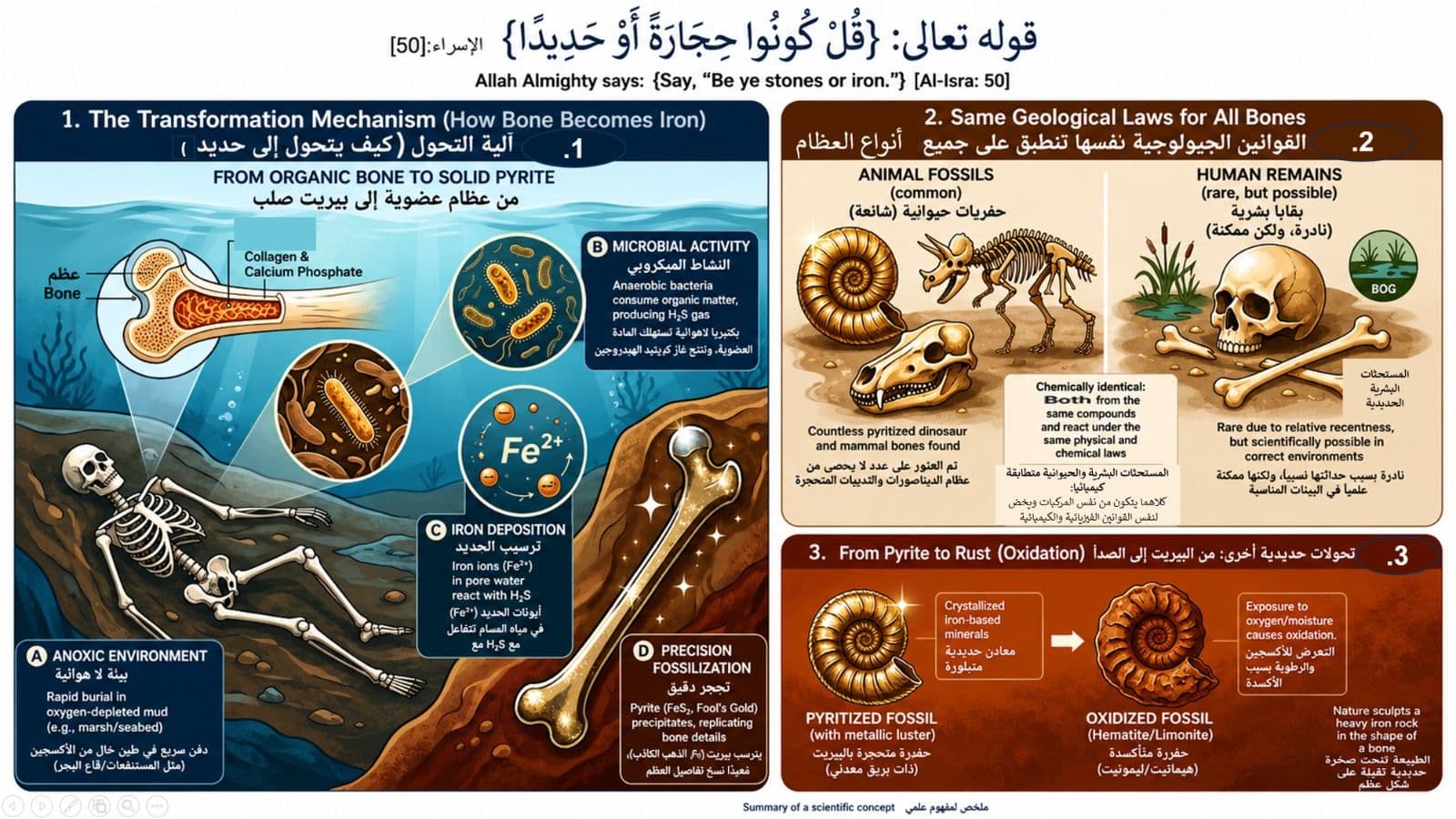
Bones (human and non-human) can be transformed into something quite like iron through a geological process known as permineralization, specifically through a mechanism called pyrite mineralization.
The stages that make up this amazing scientific phenomenon:
1. Transformation Mechanism: How does the bone become iron?
The bones originally consist of an organic matrix (collagen) and calcium phosphate metal. When an organism dies and is rapidly buried in a certain sedimentary environment, the transformation begins as follows:
Oxygen-free environment: the bone must be buried in seafloor mud or sediments or marshes where there is no oxygen (O)
2).Role of sulfur-reducing bacteria: In this anaerobic environment, special bacteria feed on the remaining organic matter in the bones, producing hydrogen sulfide gas (H2S).
Reaction with iron: If the surrounding sediment is rich in dissolved iron ions (Fe 2 ), the iron reacts with the sulfide produced by the bacteria.
Precipitation of pyrite (gone gold): An iron disulfide compound (FeS 2), known as pyrite metal, is deposited within the micropores of the bone to gradually replace cells and tissues.
Over millions of years, these ferrous metals crystallize very precisely, preserving the cellular anatomical details of the bone, and the bone looks like a statue of iron or copper gold.
2. Human bone vs non-human bone
Chemically and geologically, there is no difference between human and animal bones; both are composed of the same basic compounds and are subject to the same physical and chemical laws underground.
Animal fossils: There are thousands of unearthed examples of fossils of dinosaurs, ammonites, and bones of ancient mammals that have been completely turned into iron berets and polished like metals.
Human remains: Because human presence on Earth is relatively recent from a geological perspective (a few thousand compared to hundreds of millions of dinosaurs), finding human bones "completely fossilized with iron pyrite" is very rare, but is 100 percent scientifically possible if proper environmental conditions exist (such as burial in an acidic swamp rich in iron and sulphur).
3. Other iron transformations (lemonite and hematite)
If "pyrite" fossils (made up of iron sulfide) are subsequently exposed to oxygen and moisture as a result of erosion factors, they undergo an oxidation process:
The pyrite is converted to lemonite (iron oxide) or hematite (iron oxide), which is true rust.
In this case, the fossil loses its golden sheen and turns into a heavy rock with a reddish-brown or orange color, a solid iron shaped like a bone by nature.
References on Human Osteoporosis and Anthropology
Summary: This type of archaeological research studies how human bones change depending on the nature of the soil and the surrounding groundwater, and discusses cases of bone absorption of iron compounds (such as hematite and lemonite) in ancient iron-rich tombs, giving bones a hardness and rust-like color.
"Say, be stones or iron."
[Esra: 50]
—
Source: Published on Dr. Mohammed Bourbab's Facebook page on 2026-07-10
https://www.facebook.com/bourbab.m/posts/pfbid0GiRdYBRwoY4Q2JiGYLYpTyqDf1bFwK1UjPzVC16n79Tyuw8MhHJ9igR42ie2iX6ml