
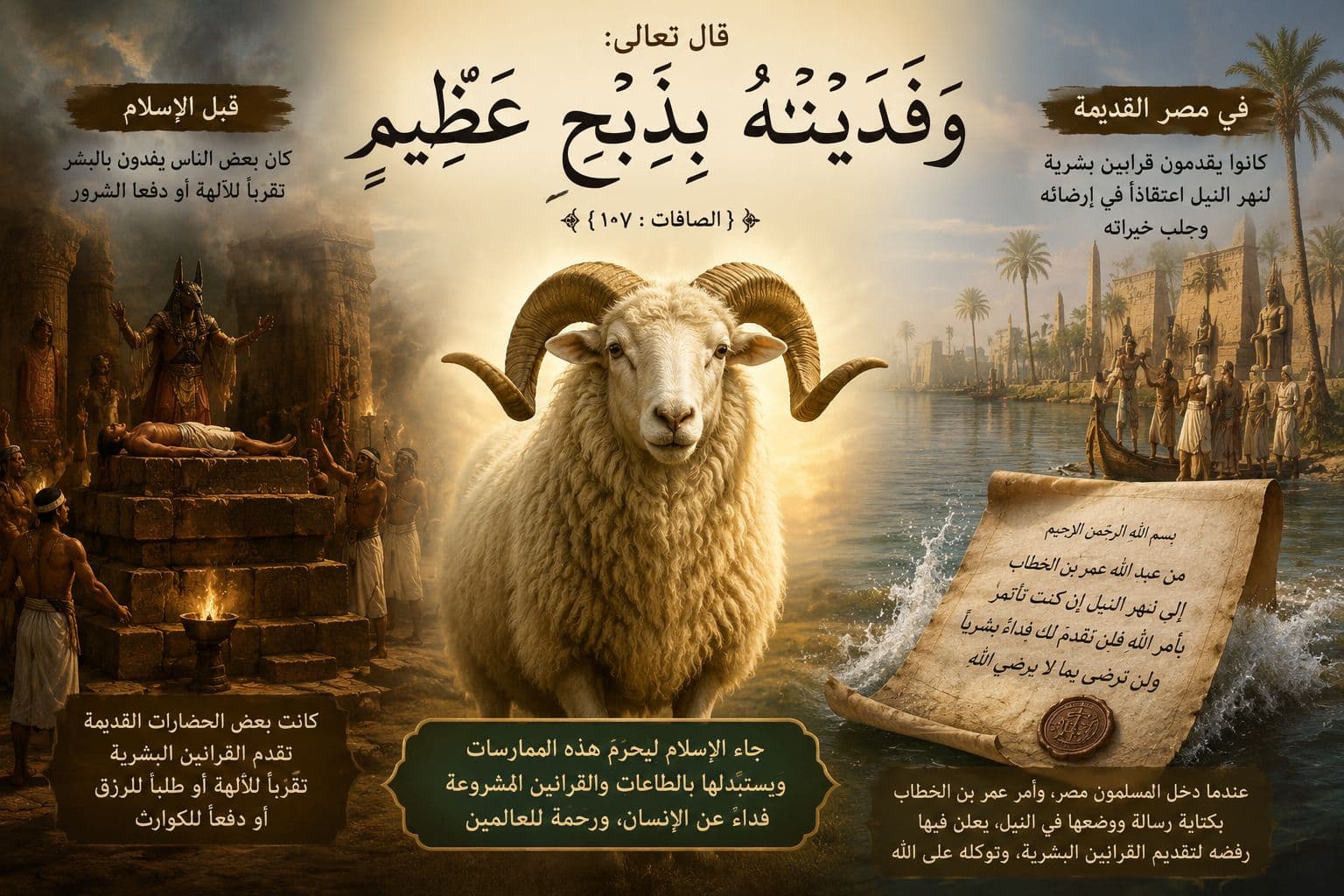
We will not say: I leave it as the “spring” of the legislative and historical miracle (1) The phenomenon of human sacrifice was historically known in a number of ancient civilizations, and was addressed by historians, archaeologists and ancient texts. But it was not common to all peoples, but...
Rite of Sacrifice
We're not gonna say, "Let him sell."
Legislative and Historical Miracle (1)
The phenomenon of human sacrifice was historically known in a number of ancient civilizations, and has been addressed by historians, archaeologists, and ancient texts. But it was not common to all peoples, but was associated with religious rituals, major crises, or certain pagan beliefs.
Among the most prominent historical evidence:
The civilizations of the Canaanites and Phoenicians were some Canaanites and Phoenicians offering children as offerings to some gods such as “Mulk” or “Baal” according to ancient texts and some archaeological discoveries in Carthage. Greek and Roman historians have mentioned these practices.
The Old Testament says, “Do not give of your seed to the leave of your Lord.”
Carthaginian archeological sites have found children's burials that some researchers have interpreted as being associated with sacrificial rites, with academic disagreement over the details.
For some Aztec peoples in ancient Mexico, human offerings were a well-known part of religious rituals, especially to the gods of the sun and war according to their beliefs. These practices were documented by the Spaniards after they entered the region, and supported by archaeological discoveries.
Some practices in ancient Egypt do not have strong evidence of widespread and systematic human offerings in late Pharaonic Egypt as in other civilizations, but some studies suggest that there were burials of servants or followers with kings in very early times, especially in the early dynasties.
As for the famous story of the “Nile Bride”, historians differ in its historical proof in the popular form, but there are accounts in the Islamic heritage of a custom associated with an ongoing dumping in the Nile, and that Omar bin al-Khattab sent a message to the Nile River to invalidate this habit after the Islamic conquest of Egypt.
Other Civilizations
Some ancient pagan tribes in Europe, Asia, and Africa practiced forms of human sacrifice.
Similar rituals have also been observed among some Inca peoples and others.
In Islam, this view has been radically negated:
It is forbidden to kill the human soul.
And neutralized the pagan sacrifices.
He made the story of Abraham and his son a symbol of the transition from human sacrifice to lawful redemption with animals: “We sent him with a great slaughter.”
This verse is seen by many scholars as a declaration to prohibit the idea of approaching God by shedding human blood.
Dr. Mohamed Bourbab
Chairman of the International Association of Miracle Scientists
—
Source: Published on Dr. Mohammed Bourbab's Facebook page on 2026-05-17
https://www.facebook.com/bourbab.m/posts/pfbid0MGc2YS8mXbSznoBtWATMtTgqFrgcm6o64cmgwddv8RzRvPA9V4oQEe8yoiveYoBdl