
The day after day passes, and we find ourselves between countless terms and concepts. If we memorize its Latin name and its Arabic translation, we find that we have forgotten the meaning. If we remember it, it is either a strange mixture, or a confused image whose features we barely realize. Conceptual...
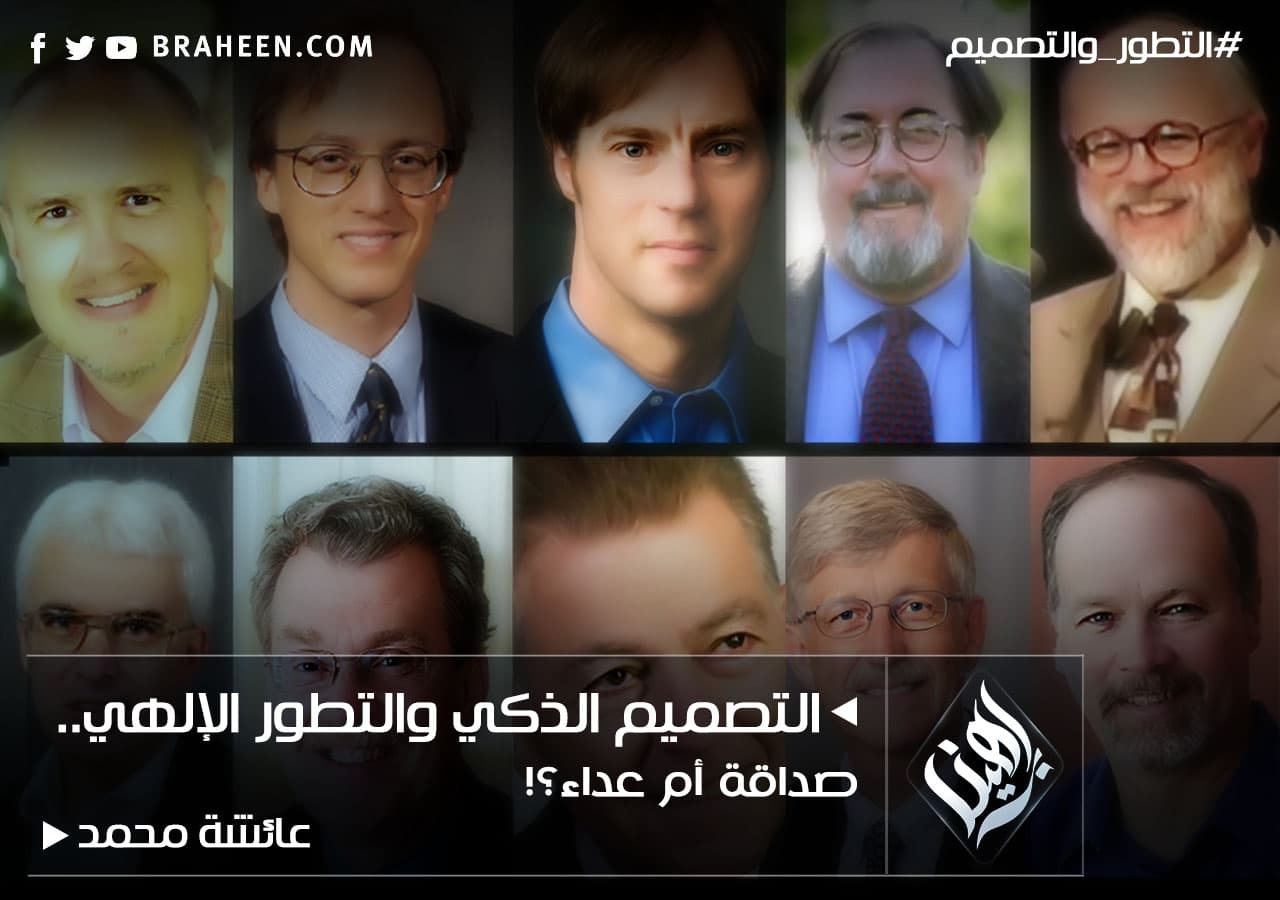
Intelligent Design and Theistic Evolution: Friendship or Hostility?
The day after day passes, and we find ourselves between countless terms and concepts. If we memorized its Latin name and its Arabic translation, we find that we have forgotten the meaning. If we remember it, it is either a strange mixture, or a confused picture whose features we barely realize. The conceptual momentum in which man lives today, is too great to be absorbed by one mind, but who originally said that the individual must understand everything and memorize everything and understand everything!
One of the most famous examples of this is the dialogue about evolution between believers in a god. Today, hardly anyone talks about this area, suggesting that he has read everything and understood everything. The amount of going into the things we know about them is very frightening.
The result is that for every serious researcher’s delay in publishing even a small part of his research, others, without the slightest effort, publish what distracts them. I am aware of how difficult it is to publish to those who consider research a way of life, but I also become aware that the harm of delay in publishing serious material – though only a small part of it is more useful.
So far we have published six translated books on evolution and intelligent design; (Life Design), (Icons of Evolution), (Darwin's Black Box), (Science and the Origin of Man), (Darwin's Doubt) and (Deceptive Formalism), and a search for (the evolution directed between science and religion) by Dr. Hisham Azmi, member of the Center, and on the way (signature in the cell) and (development: a theory in crisis) and what is still.
As Darwinism is the scientific arm of the new atheism, we had to deny this file. Of course, the vision of the Center is clear to the followers in the complete rejection of the idea of divine development – perhaps Dr. Hisham’s research explains more to those who want to know about it – as well as the policy of choosing our published materials based on the transfer of the most important, best and correct what was written in the criticism of the Dar.
With all that has been produced and published, we still ask about the secret of our rejection of directed evolution, why we oppose the combination of belief in God and belief in evolution, the basis of our spending time and effort in fighting what some think is just a scientific theory. So there is a need for such an article that clarifies some concepts that have confused some people, in a language that I think contributes to the knowledge of the right thing, but closer to dismantling and simplification.
- Divine evolution; its conception and protagonists
The philosopher of science Dr. William Dembski's article "Theoreticians of Design Are Not in Friendship with Divine Evolution"1 did not come out of a vacuum. Contrary to the term "theistic evolution", divine evolution has no place for God. Or, to put it plainly, the God whom the proponents of this doctrine conceive of as a transcendent event produces neither your God nor the God of any religion, is a God who has confined himself to the Darwinian conception of the form of life in order.
Dembski comments on this approach: "Divine evolution is a crudely fabricated American evangelical creation of Darwinism. What divine evolution does is that it takes the Darwinian image of the living world and baptizes it, calling it by the means by which God created life. Even if we want to reduce it to its scientific content, divine evolution seems to have a similar purpose as the atheistic evolution of accepting the natural, material, null, and void processes of life."
Yes, the divine evolution does not see that the Creator can intervene at all, they allow the Creator to evolve with a single shot at the beginning, and then he has to move away completely in the words of Behe. The National Academy of Sciences of America in the 1999 booklet Science and Creationism expresses this concept in more explicit terms: "Many religious people, including many scientists, hold that God created the universe and the various processes that led to physical evolution."
Commenting on this strange concept, Dr. Michael Behe (a biochemist and an intelligent design theorist) explains its contradiction and inconsistency: “If there really is, as the Committee allows, a real being who is truly capable of creating the universe and its laws... what can prevent him from influencing the universe if he chooses?
About the most famous parties to the conflict
The struggle between intelligent design theorists and the proponents of divine evolution is old and ongoing. Perhaps the most famous recent event in this series is a debate (who is behind it?!) that took place in Toronto, Canada in late March 2016, between Dr. Stephen Meyer (a philosopher of science and one of the most famous design theorists) on the one hand, and Dr. Lawrence Kraus (the famous physical atheist) on the other, and the third in the debate, Dr. Dennis Lamuro (a the Catholic design theorist).
Of course, these are not the most famous episodes of conflict. The pivotal event in the history of intelligent design's struggle with evolution and divine evolution in particular, is Kitsmiller's case against the management of the Dover School in 2005. Dr. Kenneth Miller, for those who don't know him, is a professor of biology at Princeton University, a Catholic Christian and one of the most famous theorists of divine evolution in America, as well as one of the most famous opponents of the intelligent design movement in general. In fact, the court called Miller as a witness and Dr. Michael Behe as a witness as well, and Behe made his argument, which he believes proves that intelligent design is a scientific thesis, and as usual, Miller made all attempts to deceive the court and invalidate Behe's arguments.
Another episode that should not be overlooked in this conflict is the Biologos episode, founded by Francis Collins (the most famous geneticist and founder of the Human Genome Project). Biologos is a concept that Collins put forward in his 2006 book The Language of God to declare that there is no difference between belief in God and belief in random Darwinian evolution, and then he created an institution of the same name to spread his idea.
Karl Giperson and his famous essays and debates with Meyer, British Keith Fox and his argument with Michael Behe, Francisco Ayala and his description of intelligent design as equivalent to blasphemy, and many other scientists who are supposed to believe in some god, yet stand in the same trench with atheists to repeat the same arguments and articles.
- The emergence of intelligent design
The intelligent design movement originated in the early 1980s13 from a small gathering of scientists and philosophers, all of whom at first shared doubts about the adequacy of evolutionary mechanisms in explaining massive biodiversity, and then took the idea to its current form. Their work was not easy at all, the idea that you oppose the mainstream and come up with a new idea in the scientific community, is not as easy as it thinks. On the other hand, you oppose modern Darwinism and quit.
Moreover, there were already those who had preceded them in opposing Darwinism and swimming against the tide, the creationists, who, in their diversity, were all based on the same premise, which is to prove the validity of the sacred text using science. This met with huge opposition, lack of approval on all levels, and then made it more difficult for themselves to try to impose their views – which was not a complete material or an alternative theory – on trying to teach schools.
The proponents of Darwinism have certainly not missed an opportunity to load the intelligent design movement with all the errors of creationists, to make it easier for them to critique their scientific theses, and to be content as creationists to prove to the public that their ideas should not be taken seriously. At the same time, some creationists oppose the intelligent design movement and consider it “not enough.”15 Of course, it is clear that the first and second chapters of Genesis are accurate.
The theory of intelligent design has come under fierce criticism from individuals and institutions, both formal and informal, from the famous Darwinist atheist Richard Dawkins to the famous creationist Ken Ham through Beijing Miller, Francis Collins, Ayala and other proponents of divine evolution, and from the management of universities that dismiss them to some churches that warn their followers of them to institutions supporting evolution that issue official statements to confirm that their theses are not related to science.
The story of this small group began with individual efforts of Dr. Charles Thaxton,16 Dr. Michael Denton,17 Dr. Dean Kenyon,18 and, of course, Dr. Philip Johnson,19 without material or media support or anything. At this point, the focus of writing and research was to test and critique the claims of the modern Darwinists, without including religion or the Bible.
After Behe published his book Darwin's Black Box in 1996, the dam exploded. A scientific explanation of how intelligent design works in the biological world first emerged. Several reviews of the book have appeared in popular science magazines such as Nature, the New York Times, Time, the Wall Street Journal, Science, and others, and have ranked it among the top 100 books of the 20th century. Despite the success of the book, and the hostility and random accusations the author received and his concept of irreducible complexity, the book did something new: it struck at Darwin’s basic premise – the slow self-sufficiency of life in the process of random evolution. The examples that Behe put forward in his book to demonstrate the concept of irreducible complexity were very confusing for evolutionists; the eye – the organ that led Darwin to describe his theory as absurd – and the blood clotting in man and the bacterial whip.
After that, Dembski's followers followed Bhai in 1998, where he put forward his concept of false complexity specialized in his book The Design Inference, ending the illusions of evolutionists that chance is the master of the situation in the emergence and diversity of life. Then the movement continued to publish books, technical publications and scientific papers. Their policy was famous from the beginning, and they were trying to change public opinion exclusively by any means of pressure, but the work was focused on convincing.
- Common Predecessor and Intelligent Design
The main idea of Darwinian evolution is to limit biodiversity to selection; to choose from within what already exists. In contrast, the main idea of intelligent design is that all life tells us that there is a design, a construct that lacks an intelligent actor.
For this reason, talking about common ancestry within Darwinian evolution is very different from talking about it within the framework of intelligent design. Within Darwinism, you are talking about a living cell that appears by chance, then reproduces until a multicellular organism appears by chance, then accidentally reptile fish, birds, etc. Because there is no purpose, intelligence, or design, you have no choice but to assume that all new species have been born by chance.
Most intelligent design theorists reject the idea of a common ancestor, however, they always assert that they are open to debate on this issue, and that there is no theoretical conflict between intelligent design and a common ancestor. "We at the Discovery Institute have long maintained that intelligent design does not conflict with the idea that organisms are descended from a common ancestor ... We have many scientists who acknowledge the idea of a common ancestor, such as biologist Michael Behe," says Dr. John West. "Against science," which would entail that he would have no dialogue about his scientific evidence.
Of course, this does not mean that design advocates, in general, overlook the scientific problems facing the common ancestor, not even those who accept the common ancestor as Behe and Denton. They are certainly not talking about a fish with legs or a hairy reptile or a rat with a placenta, and they do not overlook the big leaps that stand in the way of the transition from species to species. On the level of macroevolution – big leaps – this theory calls into question the common theory of evolution.(In talking about the structural school of biology, which Denton is one of its supporters, Dr. Ann Gouger (professor of developmental biology): “Structuralists accept evolution as a change over time. It is also possible that they accept the common ancestor, as long as there is a law of evolution that can make leaps. ORFan genes, nonstandard genetic codes, different methods of embryogenesis between identical organisms, etc. However, if we talk about a cleverly designed ancestor instead of a Darwinian ancestor, those problems, although they will still exist, will become less impassable.”25
So, the issue is not that they do not understand the general picture of the common ancestor hypothesis and the difficult problems that stand in the way of it – even if talking about a cleverly designed ancestor – nor that they imagine a common ancestor similar to what the proponents of Darwinism imagine, but the short story is that they do not see that the main problem in the conflict with Darwinism is in the common ancestor. "The main issue is not the kinship of all living things ... The main issue is how biocomplexity arose, and whether intelligence played a central role in its emergence," says Dembski.[26] "Intelligent design theory does not challenge two meanings of evolution; The change over time and the idea of a common ancestor ... but it particularly challenges the idea that pure random processes – natural selection acting on random changes or other similar physical mechanisms – can explain all the forms we see in the living world."27 "The common ancestor does not explain the enormous differences between species," says Behe.28 In his book The Edge of Evolution, he explains why there is no focus on the common ancestor. “The common descent is real, but even though the explanation for the common descent – even the common descent of man and chimpanzees – is appealing, it is deeply insignificant. It only tells us that the common features were there from the beginning, present in the common ancestor. The common regression of life must be explained by something other than randomness.”
Atheist Richard Dawkins, commenting on Behe’s earlier words, says: “Do his creationist admirers know that he accepts “as trivial” the fact that we are African apes, ape cousins, descended from fish?”30 Although Dawkins is already a trifle, his understanding of Behe’s words in this way is natural to him and to others like him.
If we're talking within the framework of intelligent design theory, for new species to emerge there are three scenarios:
1) The designer creates a new design from A to Z for all new types.
2) The designer in the design of all new types to quote some of the old models from his previous designs, in addition to the new that he will develop.
3) The designer should choose to create some new types with completely new designs, and others with new parts and old parts.
Whatever design theorists choose – or what future scientific discoveries will prove – of these three, it is neither the slightest problem nor the slightest resemblance to Darwinian absurdity. If they are currently leaving it open to debate, it is because they are aware of the difficulty of resolving the issue, and the whole issue does not take up much of the full picture.
Islam's position on conflict
Islam's position on the theory of evolution and the development of the divine or directed, addressed by Dr. Hisham Azmi in some good detail in his research entitled (the development directed between science and religion), issued this year on the center.
In short, Islam contradicts Darwinism in its main philosophy, which aims to give an image of the world in which there is no god or creator, and if it exists, it works with absolute randomness and has no purpose or purpose. It also contradicts it in the creation of man, the Islamic narrative that God created Adam with his own hands, a special creation worthy of His Majesty. In Darwinism they deny the existence of the first human being and then deny any distinction of human beings from other beings.
As for the conceptions of design theorists – like him – about the possibility of a common regression of species from a single ancestor, as we have already explained. My point is that it has a capacity, and the three scenarios we have mentioned do not contradict the perception of God Almighty’s creation of Adam and Eve and being the beginning of the costly human race. Whether the appearance of man by the design of new DNA from A to Z, or by the DNA of what is new and what is new.
(1) William A. Dembski, What Every Theologian Should Know about Creation, Evolution, and Design, The Princeton Theological Review, April 1, 1996. http://www.discovery.org/a/122, Last accessed: 8/8/2016.
“Design theorists are no friends of theistic evolution.”
2 A baptismal or baptismal ritual is a Christian ritual that represents a person's entry into the Christian life (Arabic Wikipedia).
(3) Last cited.
“…theistic evolution is American evangelicalism's ill-conceived accommodation to Darwinism. What theistic evolution does is take the Darwinian picture of the biological world and baptize it, identifying this picture with the way God created life. When boiled down to its scientific content, theistic evolution is no different from atheistic evolution, accepting as it does only purposeless, naturalistic, material processes for the origin and development of life.”
(4) Last cited.
“…theistic evolution is an oxymoron, something like "purposeful purposelessness." If God purposely created life through the means proposed by Darwin, then God's purpose was to make it seem as though life was created without any purpose.”
(5) National Academy of Sciences. 1999. Science and creationism: a view from the National Academy of Sciences, 2nd ed. Washington, D. C.: National Academy Press, p. 7.
“Many religious persons, including many scientists, hold that God created the universe and the various processes driving physical and biological evolution and that these processes then resulted in the creation of galaxies, our solar system, and life on Earth. This belief, which sometimes is termed “theistic evolution,” is not in disagreement with scientific explanations of evolution. Indeed, it reflects the remarkable and inspiring character of the physical universe revealed by cosmology, paleontology, molecular biology, and many other scientific disciplines.”
(6) Michael J. Behe, The Edge of Evolution, Free Press, June 2008, p210.
“…if there is indeed a real being who could actually create the universe and its laws, as the committee allows, and if that explanation reflects (that is, is evidentially supported by) “the physical universe revealed by cosmology” and other scientific disciplines, what would stop the being from affecting the universe in other ways if it chose to do so? Would this being that created the universe and its laws have to ask permission of the National Academy to otherwise affect nature? Of course not.”
7 The debate took place on March 19, 2016 at Wycliffe College, University of Toronto, Canada.
(8) Soon, God willing, we will publish a booklet concerning the details of the case, its circumstances and the responses of the design theorists to what happened in it, entitled (Retrial: The Hidden Story of the Dover Case).
9 The conflict between the Biologos organization and the intelligent design movement is large and pivotal, some of its chapters can be found in these articles:
Jonathan Wells, Darwin of the Gaps: Review of The Language of God: A Scientist Presents Evidence for Belief by Francis S. Collins, Discovery Institute, March 26, 2008, http://www.discovery.org/a/4529, Last accessed: 8/8/2016.
Jonathan Witt, Book Review: Random Acts of Design (Francis Collins Sees Evidence That God Made the Cosmos—But Life Is Another Matter), Touchstone Magazine, November 9, 2006, http://www.touchstonemag.com/archives/article.php?id=19-08-032-f, Last accessed: 8/8/2016.
Logan Paul Gage, Review: The Language of God: A Scientist Presents Evidence for Belief, American Spectator, October 1, 2006, http://www.discovery.org/a/3749, Last accessed: 8/8/2016.
David Klinghoffer, At BioLogos, Stephen Meyer Clarifies the Disagreement Separating Intelligent Design from Theistic Evolution, Jan 19, 2015, http://www.evolutionnews.org/2015/01/at_biologos_ste092841.html, Last accessed: 8/8/2016.
(10) David Klinghoffer, You Can Now Watch the Meyer-Giberson Debate on YouTube, April 24, 2014, http://www.evolutionnews.org/2014/04/you_can_now_wat084851.html, Last accessed: 8/8/2016.
(11) Robert Crowther, Intelligent Design vs. Theistic Evolution: Behe debates Fox on UK's Premiere Radio, October 24, 2010, http://www.evolutionnews.org/2010/10/intelligent_design_vs_theistic039681.html, Last accessed: 8/8/2016.
(12) Casey Luskin, Signs of Desperation? Early Responses to Signature in the Cell Are Easily Dismissed, Salvo Magazine, March 29, 2010, http://www.discovery.org/a/14381, Last accessed: 8/8/2016.
“Ayala proclaimed that ID is tantamount to “blasphemy” because it implies that God is responsible for “design defects,” such as tsunamis, back problems, misaligned teeth, and complications encountered during childbirth.”
Also: Dr. Hisham Azmi, The guided evolution between science and religion, Francisco Ayala and the question of the existence of evil in the world, 1st edition 2016, Brahin Center, p 217.
(13) William A. Dembski, The Intelligent Design Movement, Cosmic Pursuit, March 1, 1998, http://www.discovery.org/a/121, Last accessed: 8/8/2016.
Also see: Jonathan Witt, A brief history of the scientific theory of intelligent design, Discovery Institute, October 30, 2007, http://www.discovery.org/a/3207, Last accessed: 8/8/2016.
14 The most famous of their sects are those who believe in the theory of young earth creationism, where they believe that the earth is 6 to 10 thousand years old, and there is another sect believes that the age of the earth is as old as billions of years old, and these in turn are divided from other sects, and the characteristic feature of all of them is that they believe that science is the proof of the existence of the Creator and the events of creation narrated at the beginning of Genesis. Contrary to the design movement, people who are fully aware of the boundary between science and non-science, and therefore stand to say that the emergence and diversity of life is scientifically explained by the existence of intelligent design, and do not talk about the designer and his identity from a scientific point of view, because they realize that experimental science is not enough to go into these issues.
(15) Ken Ham, Intelligent Design Is Not Enough, Answers in Genesis, August 31, 2011, answersingenesis.org/blogs/ken-ham/2011/08/31/intelligent-design-is-not-enough, Last accessed: 8/8/2016.
(16) Charles B. Thaxton, www.discovery.org/p/96, Last accessed: 8/8/2016.
(17) Michael J. Denton, www.discovery.org/p/521, Last accessed: 8/8/2016.
(18) Dean H. Kenyon, www.discovery.org/p/89, Last accessed: 8/8/2016.
(19) Phillip E. Johnson, darwinontrial.com/biography.php, Last accessed: 8/8/2016.
(20) The Editors, The 100 Best Non-Fiction Books of the Century, May 3, 1999, National Review, nationalreview.com/article/215718/non-fiction-100, Last accessed: 8/8/2016.
(21) Charles Darwin, The Origin of Species, Harvard University Press, 1964, p. 190.
(22) John G. West, Debating Common Ancestry, May 14, 2016, http://www.evolutionnews.org/2016/05/debating_common102845.html, Last accessed: 8/8/2016.
23 D. Michael Behe, Darwin's Black Box, 1st ed., Brahin Center, p.
(24) Ann Gauger, The First Thing to Note about Michael Denton's New Book, January 27, 2016, http://www.evolutionnews.org/ 2016/01/the_first_thing102549.html, Last accessed: 8/8/2016.
(25) Interview with Michael Behe on The Edge of Evolution, Discovery Institute, June 18, 2007, http://www.discovery.org/a/4097, Last accessed: 8/8/2016.
“I have no solutions to the difficult problems pointed to by scientists who are skeptical of universal common descent: ORFan genes, nonstandard genetic codes, different routes of embryogenesis by similar organisms, and so on. Nonetheless, as I see it, if, rather than Darwinian evolution, one is talking about "intelligently designed" descent, then those problems, while still there, seem much less insuperable. I certainly agree that random, unintelligent processes could not account for them, but an intelligent agent may have ways around apparent difficulties.”
(26) William Dembski and Michael Ruse, Debating Design, Cambridge University Press, 2004, p323.
“The central issue is not the relatedness of all organisms - what is commonly called 'common descent'. Indeed, intelligent design is perfectly compatible with common descent. Rather, the central issue is how biological complexity emerged and whether intelligence played a pivotal role in its emergence.”
(27) Stephen Meyer, Talk of the Times: Intelligent Design vs. Evolution, Seattle Times & Townhall, April 26, 2006, http://www.discovery.org/a/3505, Last accessed: 8/8/2016.
“In challenging - the theory of intelligent design does not challenge the first two meanings of evolution—change over time or the idea of common ancestry. Though some of us are skeptical about universal common ancestry. But it does specifically challenge the idea that a purely undirected process, natural selection acting on random variations or other similarly materialistic mechanisms, can account for all the form that we see in the biological world.”
(28) Michael J. Behe, Darwin Under the Microscope, The New York Times, October 29, 1996, Tuesday Final Section A; Page 25; Column 2; Editorial Desk.
“By itself, however, common descent doesn't explain the vast differences among species.”
(29) Michael Behe, The Edge of Evolution, Free Press, June 2008, p72.
“Common descent is true; yet the explanation of common descent—even the common descent of humans and chimps—although fascinating, is in a profound sense trivial. It says merely that commonalities were there from the start, present in a common ancestor. It does not even begin to explain where those commonalities came from, or how humans subsequently acquired remarkable differences. Something that is nonrandom must account for the common descent of life.”
(30) Richard Dawkins, Inferior Design, The New York Times, Sunday Book Review, July 1, 2007, http://www.nytimes.com/2007/07/01/books/review/Dawkins-t.html?pagewanted=print&_r=0, Last accessed: 8/8/2016.
“Do his creationist fans know that Behe accepts as “trivial” the fact that we are African apes, cousins of monkeys, descended from fish?”
31 Dr. Hisham Azmi, Science-Religious Oriented Evolution, 1st Edition 2016, Brahin Center.
Aisha Mohammed
—
Source: Brahin Center website - Published 2016-08-08 (archived at the Internet Archive)
https://braheen.com/articles/evolution-design/التصميم-الذكي-والتطور-الإلهي-صداقة-أم-عداء