
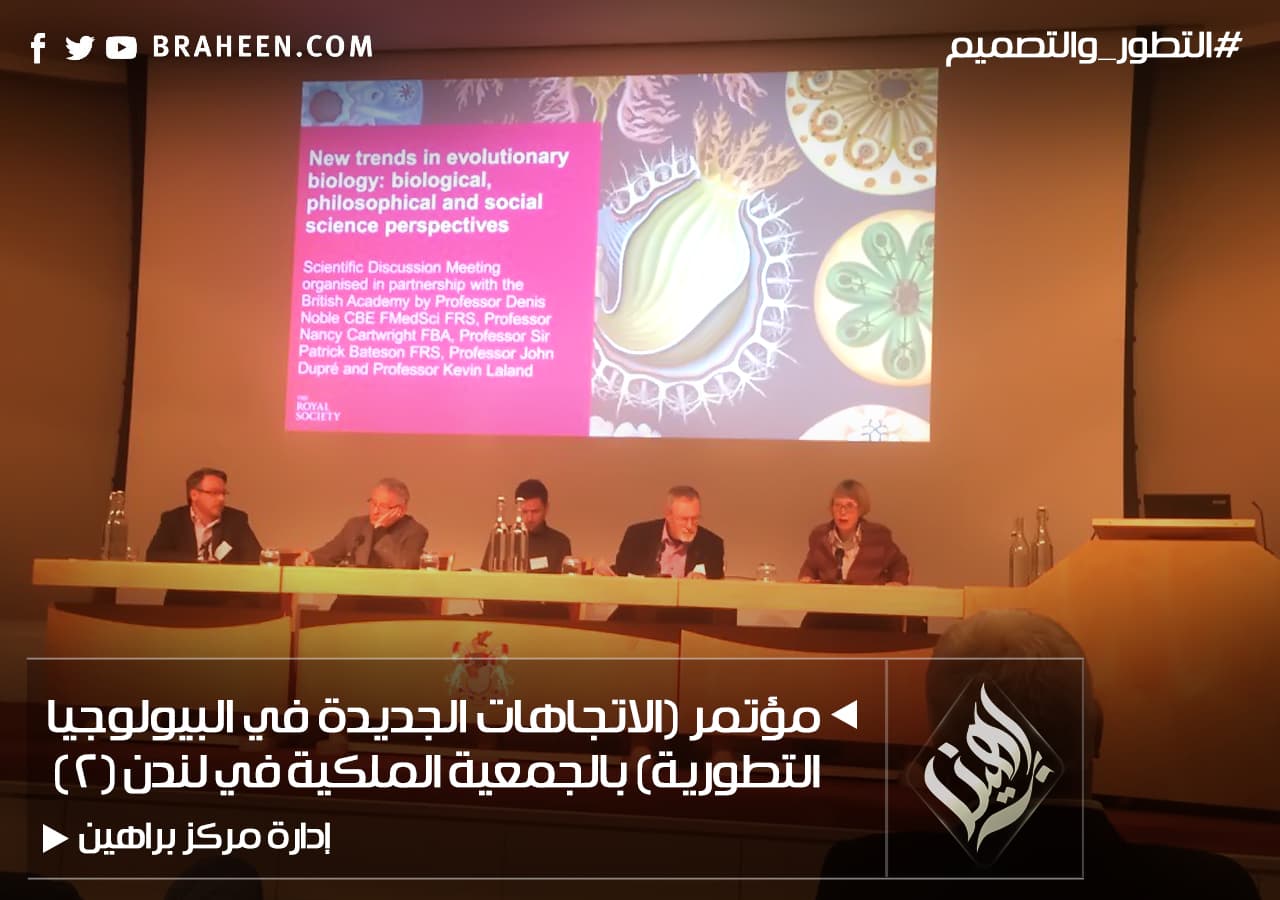
We are following the events of the second day of the conference (New Trends in Evolutionary Biology), which is conveyed to us by some scientists who are supportive of intelligent design who attended the conference, but of course without revealing...
(New Directions in Evolutionary Biology) Conference of the Royal Society of London (2)
Together, we follow the events of the second day of the conference (New Trends in Evolutionary Biology), which some scientists supporting intelligent design who attended the conference, but of course without revealing their identities for the known reasons.
After a brief introduction by Dr. Denis Noble, the first lecture by James Shapiro was on natural genetic engineering (reading and writing genetic creations). The most interesting finding in his talk was that non-coding DNA elements are associated with organic complexity, not functional junk.
He replied that he had once asked Francisco Ayala on the centennial of Darwin’s death about transmutable elements, which Ayala considered unimportant. That is, he tactfully told Ayala, Dobzinsky’s disciple and former AAAS president; and other modern Darwinists and leaders to speak for her.
None of the phenomena Shapiro mentions (such as endosymbiosis, hybridization, horizontal transfer of HGT genes, genome replication, and MGEs) can explain the origin of complex new information. Yet some are already challenging modern Darwinism, and others have been ignored, not as easily as Land claims.
The second lecture was by Dr. Paul Griffiths on the genetic paradox of biological information. He proposed a simple and practical concept of biological information, but without any analogy to communication, meaning or intent. Based on the Crick sequence hypothesis (about assignment), Griffiths considers biological information to be the exact determination of sequence (such as Morse code), so it is a way of talking about causal control rather than precise.
This concept of biological information, which combines the reduction of alternatives and causality, can be useful for research on intelligent design, although we are of course opposed to the exclusion of intent.
The third lecture was by Dr. Eva Jablonka on epigenetics. She talked about the fact that the modern (modern Darwinism) formula reduced the importance of plasticity, group selection, etc., and she explicitly excluded "soft inheritance".
Karl Popper already recognized this error in one of his recent lectures and predicted the basic elements of the extended evolutionary structure. We now know that phenomena such as epigenetics are widespread.
Unfortunately, Jablonka ran out of time before she finished her talk. Only in the question-and-answer period did she briefly address the crucial question of the epigenetic importance of macroevolution, which she defines as any evolution beyond the species level. But it was clear that this would not help explain the emergence of major innovations in the history of life.
Dr. Greg Hurst’s fourth lecture was on holobionts (a collection of hosts and microbial species living in their vital environment) as selection units. The talk was fun and had some hilarious points, but had nothing to do with the crucial problem of creating new complex information.
The fifth lecture by Dennis Noble was about evolution from the point of view of other scientific disciplines. He compared the reductionist approach of the twentieth century to the integrative approach of the twenty-first. His main point was that organisms could harness randomness to generate functions so that evolution could have a destination.
As usual Russell Land came out to repeat that this had been known for a long time, even before the modern composition, etc., etc.
Nobel replied: No, this involves an integrative vision, a conceptual change that results from the accumulation of many new evidence.
Then he was asked by a computer scientist: Random changes can’t optimize a near-optimal program, but they inevitably degrade it.
Nobel’s answer: This would be true if there were no three layers of error correction that reduce the error rate to one per cloned genome.
This Nobel answer is good for explaining why random mutations in the genome don’t degrade quickly, but it doesn’t explain how they can create new information and functions.
The sixth was Andy Gardner, speaking in his lecture on anthropology in evolutionary biology, and finally mentioning intelligent design.
He made the surprising statement that it was William Paley who made the book clear in explaining the meaning of adaptation. It is not perfect or perfect, but it is an invention of a purpose, and the relations of the parts to each other for the same purpose.
Darwin claimed to have encountered the problem of clear design and provided explanations for it, while Bali did not. Gardner made the curious argument that from the perspective of intelligent design, a deer must be designed to run towards leopards, and then presented a silly slide in which he twisted the idea of intelligent design as if its summary was "God did it".
Based on the work of Brian Charlesworth and Patrick Moran, Gardner claimed that population geneticists generally disliked the idea of adaptation in terms of being a massive fitness boost (Russell Land disagreed strongly in the later discussion).
Patrick Bateson's seventh lecture was on adaptability and evolution, and was based primarily on Baldwin-related phenomena (which Bateson prefers to call "adaptability driver") and genetic assimilation. He quotes West-Eberhard's explanation that "genetics are followers, not leaders, in evolution."
The talks were followed by a panel discussion between Cartwright, Futoima, Euler, Feldman and Gardner.
Cartwright made a brief introduction and stated that she had always believed Darwinian evolution to be a viable research program, and wondered; "Do we have here a viable evolutionary research program?"
Sonia Sultan said: There must be room for different ways of seeing without abandoning one model to another, as this leads to different questions being asked.
Jablonka asked Futwema: What can you, apart from the idea of God, consider a major extension and not just makeup?
Futoima replied: There was a good assimilation of new ideas (in modern Turkish). But really new will be an adaptation mechanism not based on the idea of election. This will be really surprising.
Abstract; all the elements of the extended evolutionary synthesis failed to provide sufficient explanations of the intrinsic explanatory deficit of the modern synthesis (also known as neo-Darwinism) explicitly highlighted in the first talk of the meeting by Gerd Muller; phenomenological complexity and phenotypic creativity.
Source (acting):
- David Klinghoffer, From a Confidential Informant, Notes on Day 2 of the Royal Society Meeting, Evolution News, November 11, 2016. https://evolutionnews.org/2016/11/from_a_confiden/
- Management of the Brahin Center
—
Source: Braheen Center website — Published on 2016-11-11 (copy preserved in the Internet Archive)
https://www.braheen.com/articles/evolution-design/مؤتمر-الاتجاهات-الجديدة-في-البيولوجيا-التطورية-بالجمعية-الملكية-في-لندن-2