
Acquired resistance Different strains of bacteria that were sensitive to antibiotics before can become immune and lose their sensitivity to them either through the transfer of genetic material from one of the resistant strains to one of the non-resistant strains.
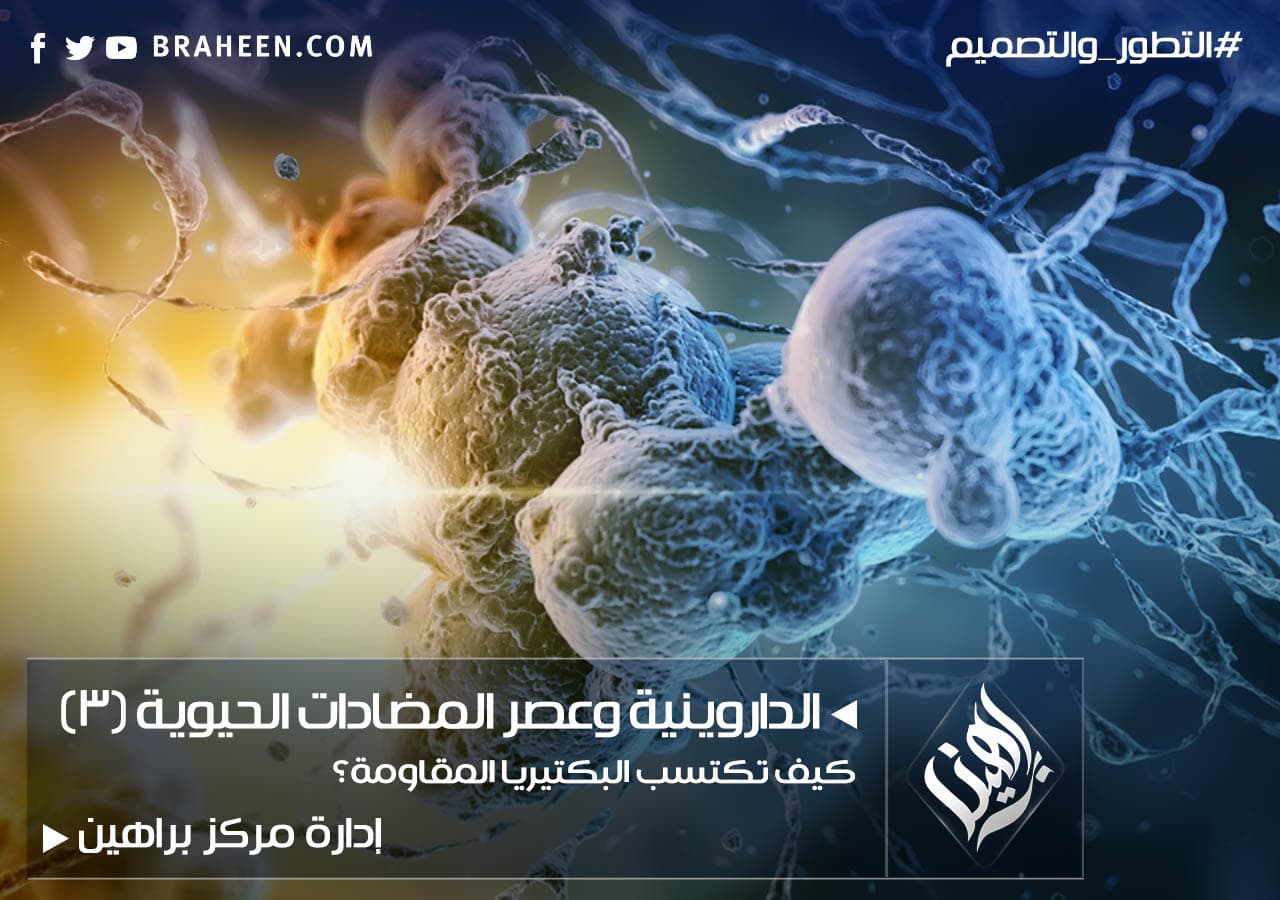
Darwinism and the Age of Antibiotics: How Do Bacteria Acquire Resistance? (3)
Acquired resistance
Different strains of bacteria that were sensitive to antibiotics before can become immune and lose their sensitivity, either through the transfer of genetic material from a resistant strain to a non-resistant one, or through mutations that produce that effect. But, as we will see, even those mutations can never be inferred to evolve in a general sense (common decline through working natural selection through random changes).
1) Horizontal transfer of genes: the transfer of the genetic material responsible for the resistance of bacteria to the antibiotic from one bacteria to another in a way other than division, this property is common in bacteria than in higher organisms, such as plants and animals, and this property allows the rapid spread of resistance between different types of bacteria. The genetic information responsible for the resistance is carried on a small molecule of DNA known as Plasmid, and through some mechanisms it is acquired by these base plas from other bacteria.
Transduction
It is the process of transferring some bacterial (donor) cell genes to another bacterial cell (received) by the bacteriophage in which some species of bacteria are infected with certain viruses called phages. During the process of multiplying viruses, part of the bacterial cell DNA gets trapped in the new phage formed and results in an infectious infection.
Transformation Transformation
In that process, the bacteria pick up parts of the DNA from the surrounding environment, which were originally parts of other bacteria that decomposed and excreted genetic material.
Conjugation
Pairing is the most common means of horizontal gene transfer between bacteria, and pairing is a highly complex process in which a circular DNA molecule, a plasmid, is transferred from the donor bacterial cell to the recipient. This is done by capillaries of bacteria that extend between bacterial cells such as a bridge, allowing them to pair and transfer the genetic material. One example is the encoded gene of the enzyme penicillinase, which is found in the resistance of the penicillinase.
The horizontal transfer of genes cannot tell us much about the evolution of resistance genes. All it offers is an explanation of how resistance genes were originally transferred from resistant bacteria to non-resistant bacteria, and how these genes originally appeared, this question does not answer it, and therefore horizontal transfer cannot be inferred on the occurrence of evolution. What is needed to prove evolution is to prove the emergence of new information, not its transfer from one organism to another.
2) Mutations: These are known as DNA changes that often occur as a result of a DNA replication error, or as a result of exposure to an external effect. Mutations often cause damage to the cell and damage its functions, but from time to time, despite the low probability, they may cause a beneficial change, and therefore, mutations are the only mechanism that have the ability to explain the origin of antibiotic resistance in bacteria.
Therefore, the immunity resulting from a certain mutation in bacteria is perfectly valid to be a realistic example of the validity and integrity of the theory of evolution; because in the presence of a certain antibiotic, any mutation that protects bacteria from the harmful or deadly effect of this antibiotic will be considered as a useful new trait or feature, and then the role of natural selection to maintain the strains of bacteria carrying this mutation, and get rid of other bacteria are quite old-fashioned. This is the scenario that evolutionists tell us to prove that the emergence of resistance.
To try and get an answer to the limits of mutagenicity, follow up with us next part...
- Management of the Brahin Center
—
Source: Brahin Center website - Published on 2018-01-13 (archived at the Internet Archive)
https://braheen.com/articles/evolution-design/الداروينية-وعصر-المضادات-الحيوية-كيف-تكتسب-البكتيريا-المقاومة؟-3