
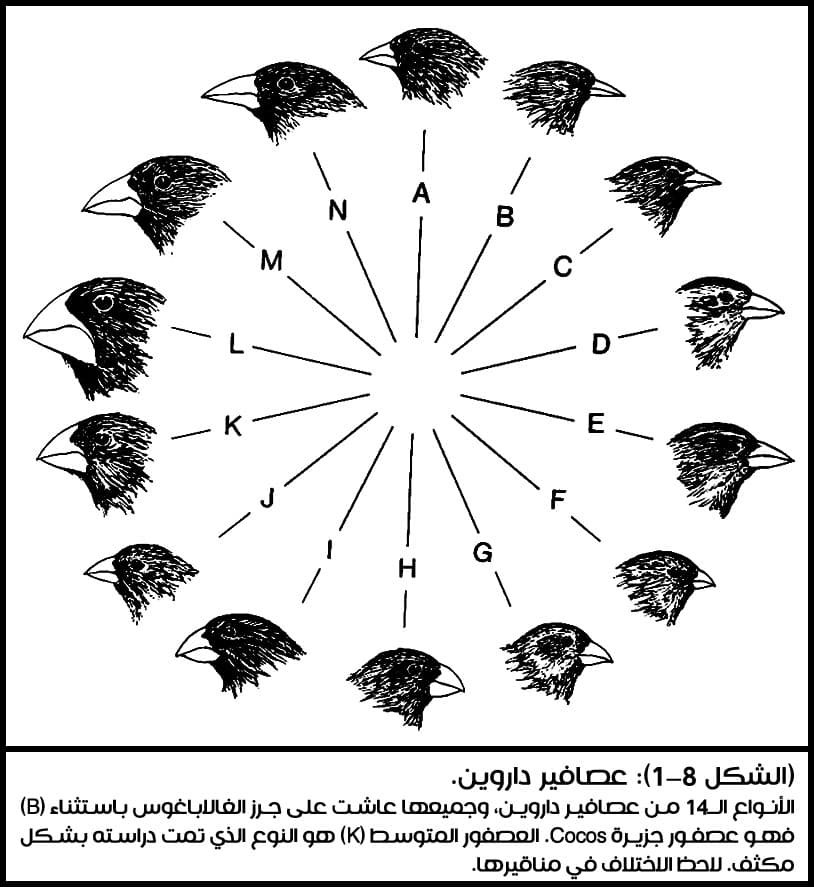
*Note: This article is from the book Icons of Evolution: A Science or a Myth? For more see the book. When Darwin was in the Galapagos Islands he managed to collect nine of the species that bear his name today - out of thirteen species - and then classified only six...
The Myth of Darwin’s Finches
*Note: This article is from Evolution Icons: Science or Myth?
When Darwin was in the Galapagos Islands, he collected nine of the thirteen species that bear his name today, then classified only six of them as Finches. Darwin failed to notice any change in the type of food eaten by these birds except for two, and even in these two species he failed to find any relationship between the type of food and the shape of the beak. Darwin was not so concerned with these birds that he did not make any effort during his stay on the island to divide them.
After Beagle's voyage back to Britain, ornithologist John Gould began classifying it by its geographical relationship, and most of Darwin's information about it seemed to be wrong, or inaccurate; eight out of fifteen local specimens recorded by Darwin were highly questionable and most of these specimens needed to be corrected by looking at the classified collections prepared by Darwin's colleagues on his voyage.
In fact, Darwin did not become an evolutionist until months after his return to Britain; many years after his return he began to look again at these birds, trying to understand them in the light of his new theory, and he wrote in the second edition in 1845 of his journal called (Researchers): "The most curious fact is that the beak sizes of these different species of birds are completely accurate.
The confusion surrounding the geographical classification of the specimens Darwin collected made it impossible for him to use them as evidence for his theory, and Darwin had no clear idea about (what was this origin?), and today we know that these 13 species are very similar to each other than to any other bird in Central or South America, suggesting that they descended from a common ancestor that colonized these islands.
But Darwin did not visit the west coast of South America north of Lima, Peru, so everything he knew about these birds was identical to the species that still lived on land.
It was not until the advent of modern Darwinism in the 1930s that the bird was first called "Darwin's Birds" by Percy Lowe in 1936 that the name became popular, but it was not until a decade later that it was popularized by ornithologist David Luck.
In his 1947 book, Lach stated that Darwin’s sparrows showed us the link between the variety of beaks’ shape and the variety of food sources, and then tried to prove that these beaks are adaptations caused by natural selection. In other words, it was Lach, not Darwin, who gave these sparrows such fame as evidence for the theory of evolution.
Darwin's sparrows are an icon of evolution.
When Lach elevated these birds to an icon of evolution, Darwin's meager contribution to our knowledge increased as this story was brought back to us, to the point that we imagined it to be Darwin's product. According to Solloway, "Darwin became famous after 1947 for birds he had never seen and for observations he never made." The legend reached its greatest size by claiming that Darwin had collected species and observed their behavioral traits such as the habit of digging at a woodpecker bird, which had not originally been discovered in Darwin's day, and then turned stones into Although Solloway destroyed this myth 20 years ago, many modern biology books still claim that Galapagos Island birds inspired Darwin's idea of evolution, such as his 1996 book Biological Science, which tells students that birds played a key role in guiding Darwin to formulate his theory of evolution. Based on a 1999 book of biology by Raven and Johnson, "The convergence of the beaks of these 13 species and their food sources immediately suggested to Darwin that evolution was behind it."
George Johnson's 1998 book Biology: Visualizing Life insisted that Darwin attributed differences in the size of the beaks and the way they ate to the evolution that occurred after the migration of their ancestors to the Galapagos Islands.
Moreover, Darwin’s involvement is highly unlikely. The existence of Darwin’s word in the name of “Darwin’s Birds” is a myth that did not emerge until a century after his death; when they began to assume it as an icon of evolution.
Evidence of evolution!
If Darwin’s theory is correct, the origins of these birds that colonized the Galapagos islands in the distant past should have been spread over different islands where they were exposed to different environmental conditions, and it is possible that these birds on different islands have experienced changes in the supply and quality of the food they feed on, leading to natural selection in their beaks.
The differences in the beaks of these birds are related to different types of food, and the distribution of birds on different islands – although it is not true that each island had its own species – seems appropriate for Darwin’s theory, but perhaps his position would have been stronger if there had been some direct evidence for this process.
From this direct evidence is the genetic evidence, but far from knowing that the beaks of these birds are strongly inherited, "the beaks of these birds look very similar to the beaks of their biological parents," we know nothing about the inheritance of these beaks, nor did chromosomal studies show a difference between the different types of these birds, and DNA studies to determine the development of molecular phylogeny have relied on unrelated forms of the gene.
Another type of direct evidence is the observation of natural selection in the wild, provided by the couple (Peter and Rosemary Grant) who went to the Galapagos Islands in the 1970s to observe the mechanism of evolution.
Bird beaks.
The worldly couple made their first trip to the Galapagos Islands in 1973, and with the help of other biologists starting to hunt and gather birds from seven of these islands, each bird is measured in weight, length of wings, legs, fingers, length, breadth and depth of its beak. There were variations and differences between these birds in all of these qualities, especially the beaks.
In 1975, these scientists focused their attention on one of the small islands, Daphne the Greater. Its small size made it a typical natural laboratory, where they could hunt birds and tie them to tapes and measure the members of a particular species, the birds that live in the middle lands (figure 8.1 K), as well as record mating, and tied and measured the new generations - offspring or sons - and tracked rainfall and the number of seeds produced by plant species on the island.
In the early 1970s, the Greater Daphne Island experienced moderate rains, which increased food – plants, etc. – resulting in a significant increase in the numbers of these birds. In the natural seasons of rain, such as 1976, the island experiences five inches of rain, but in 1977 only one inch of rain fell, resulting in drought, which caused a severe shortage of seeds, as well as the number of birds, especially those living in the former medium-rises.
Then the scientists noticed that those who survived the drought tend to have rather large bodies and larger beaks, and they also noted that the supply of small seeds has decreased significantly this year, concluding that natural selection has been able to strongly favor those birds that can break the large hard seeds that remain.
As a result of the drought, the average depth of beaks, especially for middleland birds, increased by about 5% from its previous depth (the depth of the beak is the distance between the top and bottom of the beak at its base), which is equal to a half-millimeter increase (the thickness of the thumb fingernail in humans), which may not seem like much to us, but for the birds of the Greater Daphne in 1977, this meant a matter of life and death. That's why these beaks for Fenier are an icon of evolution.
The couple and other scientists at the time also realized that natural selection may have oscillated between dry and wet years, making longer-year beaks and shorter beaks the following year. But what if the depth of the beaks continues to increase?
The difference in beaks is the main distinguishing factor between the different species of Darwin sparrows, so the couple proposed the following explanation: if natural selection can produce changes in beaks, it may also explain the origin of these species of sparrows. Peter Grant in Scientific American (1991) gave the explanation for how this happened, at least in theory, by calling the increase in depth of the beak during a severe drought (the species of selection required). The successive selections directed at this rate, taking into account the absence of selection in another period between dry seasons, will take, on average, about 200 years to convert a species to another, and even if we assume that this number is ten times the number put forward, about 2000 years to form new species, this time is very small when compared to the hundreds of thousands of years after the arrival of birds to these Galapagos Islands.
Grant's extrapolation was based on the hypothesis that the increase in beak depth was cumulative from one drought to another, but Grant and their colleagues knew that this was not the case.
When the rain returns.
People on the west coast of North and South America are known to expect El Nino every few years, a change in winter weather pattern caused by unusually warm air passing through the Pacific Ocean. In the winter of 1982-1983, El Nino caused heavy rains to the Galapagos islands ten times more than normal, and fifty times more than the previous drought, plant life was destroyed as well as very few birds.
In 1987, Peter Grant and his graduate student Leslie Gibbs wrote in Nature that they noticed a reversal in natural selection due to climate change: "Adults with large sizes are preferred when food is scarce because the supply of small, soft seeds runs out quickly, and only those birds with large beaks can break down and open the large, hard seeds.
So the evolutionary change that the Grants and their colleagues observed during the drought of 1977 was reversed again by the torrential rains that fell in 1983. As Viner wrote, “Selection, then, has turned around,” and Peter Grant wrote in 1991, “Birds have taken a giant step back, after a giant step forward, numbers exposed to natural selection fluctuate in magnitude with each climate change.”
Some types of long-term trends must overlap on top of each other, causing oscillations that advance and are delayed until permanent change occurs, but that is not what the pair and their colleagues have witnessed. This trend can actually take much more than a decade or two to measure if it exists. The climate in the Galapagos Islands will certainly change in the future and will change the patterns that have been formed, but all of these – invisible trends and future changes – will only remain a theory.
The observations of the Grants and their colleagues did not provide direct evidence for this, but they discovered in the course of their work that several species of Darwin sparrows merge rather than branch and diversify.
Split or merge.
Darwin’s theory requires that one species be divided into two types; the opposite is that two different species merge with hybrids to produce a single species (Figure 8 4). This opposite – fusion – is now happening to multiple species of Darwin sparrows, where at least half of the species of Darwin sparrows found in the Galapagos Islands, though rare, have been observed to hybridize.
The Grants and their colleagues also observed in the years after El Nino in 1983 that several species of birds on one island mate to produce hybrids that survive, reproduce, and produce successful generations. These hybrids live better than the parents who actually produced them, as the Grants noted: "This process, if not prevented, may lead to the fusion of species into a single species", and this does not happen overnight, when extrapolating the rates of hybridization observed by the Grants estimated that it may take 100 to 200 years for two species to fully integrate. Thus, if we extrapolate from the processes observed in the present, we get two contradictory predictions:
Unrestricted natural selection of large beaks will produce new species in 200 to 2000 years.
Unrestricted natural hybridization can result in the species merging within 100 to 200 years.
Clearly, the Sun notes that the tendency to merge modifies and rewards the effect of separatism, and the oscillating climate of the Galapagos will keep this balance going indefinitely, so Grant concluded that there must be a balance between selection and hybridization in the long run. "The invisible pendulum oscillates very much back and forth in the Darwin Islands, oscillating between these two stages where birds are always forced to move forward a little bit, and then drift back and forth again," says Vinier. So the Darwin birds will not merge and will not separate, but will oscillate back and forth. Given their success in hybridization, we must ask: are these birds different species or are they one?
Fourteen species... or six!
Most of these 14 species of Darwin sparrows, or at least 13 of them that live on the Galapagos Islands, appear to remain separate primarily because of their mating behavior. But the evidence suggests that these birds choose their mates based on their beak shape and melody pattern. But what is expected for the right diversity should be more separate and distinct than just a beak shape or even a tone of voice; we observe in humans the inheritance of races while languages are transmitted by learning, just like birds, but no doubt they are one species even if such differences make mating uncommon.
As the Grants wrote in Science in 1992, "Alternatively, hybrids are reduced to Darwinian species, which raises the question of their classification as separate species." The following year, Peter Grant admitted that if we defined the species conclusively as being able to mate only with the species' offspring, we would have only two Darwinian species on Daphne Island, rather than four.
In other words, Darwin’s sparrows may not be fourteen separate species, and may be on their way to becoming one, but then we will realize that their tendency to divide through natural selection is stronger than their ability to merge through hybridization, which the evidence does not show. We may be used to consider Galapagos sparrows as separate species, but they are now on their way to becoming less diverse, which would be contrary to Darwinian evolution, which predicts the separation of a single species into species.
The increase in the average size of beaks in multiple species of Galapagos sparrows after a severe drought and their return to normality after a drought has ended is direct evidence of natural selection in the wild. Only within this limited understanding can these sparrows provide evidence for Darwin’s theory, and although Darwin’s birds lack much of the foundations required to be an example of evolution by natural selection, this has not prevented any evolutionist from employing this evidence anyway.
Exaggeration of evidence
Thanks to years of research by the Grants and their colleagues, we know a lot about natural selection and how Darwin's sparrows interbreed, and the evidence is clear:
First, natural selection fluctuates based on climatic fluctuations, and does not lead to far-reaching evolutionary changes.
Second, highly efficient hybrids mean that different species of Galapagos sparrows may be on their way to merging rather than splitting.
Grant’s remarkable work has provided us with much better evidence of natural selection in the wild than the dotted Cattwell moth. If Grant’s work had stopped there, it would have been an example of real scientific work. In articles published in 1996 and 1998, Grant explained that Darwinian theory suited the facts shown by the evolution of Darwin's birds in the Galapagos Islands and that the driving force was natural selection.
This claim was echoed by Mark Ridley in his 1996 textbook Evolution, in which Ridley extrapolated, like Grant, the increase in beak size after the drought of 1977, the time it took to produce new species: "This shows how natural selection in one species can explain the diversity in birds from one common ancestor."
But an argument of this kind is an exaggeration of facts, and these exaggerations seem to be a central feature of many claims about the theory of evolution; the claim that the change in dotted moths is evidence of natural selection, although the selective factor was not apparent, and the claim that natural selection oscillates is evidence for evolutionists of these birds’ early origins.
In 1999, Darwin's Sparrows were described by the National Academy of Sciences as "the ultimate example" of the origin of the species, and then continued to explain that Grant and their colleagues showed that one year of drought on the islands could lead to evolutionary changes in sparrows to the extent that if drought occurred once every ten years on the island, a new species would appear to us in just 200 years.
That’s it! Instead of confusing the reader with the reflection of natural selection after the end of the dry season, Johnson’s essay creates evolutionary changes that are not far-reaching, and the pamphlet simply decides to ignore the embarrassing fact. Like the one who promotes stock sales at the stock exchange and loudly claims that a certain stock will double in 20 years because it increased 5% in 1998, but it doesn’t mention a 5% decrease in the next year. The stock market promoters are in jail, so you know how in trouble they are.”
References:
Sulloway's quotations ate from Frank J. Sulloway, "Darwin and His Finches: The Evolution of a Legend," Journal of the History of Biology 15 (1982), pp. 1-53; Sulloway, "Darwin and the Galapagos," Biological Journal of the Linnean Society 21 (1984), pp. 29-59. See also Sulloway, "Darwin's Conversion: The Beagle Voyage and Its Aftermath,"Journal of the History of Biology 15 (1982), pp. 325-396; and Sulloway, "The legend of Darwin's finches," letter to Nature 303 (1983), p. 372.
The first edition of Darwin's journal mentions that "in the thirteen species of ground-finches, a nearly perfect gradation may be traced, from a beak extraordinarily thick, to one so fine, that it may be compared to that of a warbler. I very much suspect, that certain members of the series are confined to different islands; therefore, if the collection had been made on any one island, it would not have presented so perfect a gradation." Charles Darwin, Journal of Researches into the Geology and Natural History of the various countries visited by H. M. S. Beagle, (1839), Facsimile Reprint of the First Edition (New York: Hafner Publishing, 1952), p.475. The fact that Darwin referred to "thirteen" species, the number currently recognized, is mere coincidence; his thirteen "species" are not the modern thirteen. The expanded quotation from the second edition of the journal is from Charles Darwin, Journal of Researches into the Natural History and Geology of the Countries Visited during the Voyage of H. M. S. Beagle Round the World, under the Command of Capt. Fitz-Roy, R. N, Second Edition (London: John Murray, 1845), p.380.
The finches were first called "Darwin's" in Percy Lowe, "The Finches of the Galapagos in relation to Darwin's Conception of Species," Ibis 6 (1936), pp. 310-321. The name was popularized by David Lack, Darwin's Finches (Cambridge: Cambridge University Press, 1947).
Darwin's sparrows are an icon of evolution.
Sulloway's quotations are from Frank J. Sulloway; "Darwin and His Finches: The Evolution of a Legend," Journal of the History of Biology 15 (1982), pp. I-53.
Textbook selections are from James L. Gould and William T. Keeton, Biological Science, Sixth Edition (New York: W. W. Norton, 1996), p. 500; Peter H. Raven and George B. Johnson, Biology, Fifth Edition (Boston: WCB/McGraw-Hill, 1999), p. 410; George B. Johnson, Biology: Visualizing Life, Annotated Teacher's Edition (Orlando, FL: Holt, Rinehart & Winston, 1998), p. 174.
Evidence of evolution!
On the genetics of finch beaks: There have been several studies on the heritability of beaks, meaning the likelihood that offspring will closely resemble their parents in this trait. Heritability of beak depth in Geospiza firth, the species most intensely studied by the Grants, is about 80 percent. Although this may point to a strong genetic (Le., DNA-encoded) component, it does not identify which genes might be involved. See Peter T. Boag, "The Heritability of External Morphology in Darwin's Ground Finches (Ceospiza) on Isla Daphne Major, Galipagos," Evolution 37 (1983), pp. 877-894; Peter R. Grant, Ecology and Evolution of Darwin's Finches (Princeton: Princeton University Press, 1986), pp. 180-182; Peter T. Boag and Arie J. van Noordwijk, "Quantitative Genetics," pp. 45-78 in E Cooke and P. A. Buckley (editors), Avian Genetics: A Population and Ecological Approach (London: Academic Press, 1987).
A 1984 genetic study of Darwin's finches found little or no genetic difference among several species; see James L. Patton, "Genetical processes in the Galapagos;' Biological Journal of the Lin-near' Society 21 (1984), pp. 91-111. A 1984 study which did not identify any genes involved in determining beak morphology was T. D. Price, P. R. Grant, and P. T. Boag, "Genetic Changes in the Morphological Differentiation of Darwin's Ground Finches," pp. 49-66 in K. Wolsrrnann and V. Loeschcke (editors), Population Biology and Evolution Springer-Verlag, 1984). See also Peter R. Grant, Ecology and Evolution of Darwin's Finches, pp. 177, 198-199, 281-283, 395, 399, 405-406.
On the lack of observable chromosome differences among the finches, see Nancy Jo, "Karyotypic Analysis of Darwin's Finches," pp. 201-217 in Robert L Bowman, Margaret Berson, and Alan E. Leviton (editors), Patterns of Evolution in Galapagos Organisms (San Francisco, CA: Pacific Division, AAAS, 1983).
There have been a number of molecular phylogenetic studies of Darwin's finches, but molecular phylogeny must, by its very nature, rely on genes that are not subject to natural selection—otherwise mutations would not accumulate merely as a function of time and DNA sequence differences would not reflect divergence times. For some recent studies, see Kenneth Petren, B. Rosemary Grant, and Peter R. Grant, "A phylogeny of Darwin's finches based on micnDsatelte DNA length variation," Proceedings of the Royal Society of London B 266 (1999), pp. 321-329; Aide Sato, Cohn O'hUigin, Felipe Figueroa, Peter R. Grant, B. Rosemary Grant, Herbert Tichy, and Jan Klein, "Phylogeny of Darwin's finches as revealed by mtDNA sequences," Proceedings of the National Academy of Sciences USA 96 (1999), pp. 5101-5106.
Peter and Rosemary Grant concluded in 1997: "The knowledge base from which to generalize about the genetics of bird speciation is precariously thin." Peter R. Grant and B. Rosemary Grant, "Genetics and the origin of bird species," Proceedings of the National Academy of Sciences USA 94 (1997), pp. 7768-7775.
Bird beaks.
For the details of this famous story see Jonathan Weiner, The Beak of the Finch (New York: Vintage Books, 1994); the quotations are from pp. 9, 112. The Grant quotation is from Peter R. Grant, "Natural Selection and Darwin's Finches," Scientific American 265 (October 1991), pp. 82-87. See also Peter T. Boag and Peter R. Grant, "Intense Natural Selection in a Population of Darwin's Finches (Geospizinae) in the Galapagos," Science 214 (1981), pp. 82-85; Peter R. Grant, Ecology and Evolution of Darwin's Finches (Princeton: Princeton University Press, 1986).
When the rain returns.
Quotations about the reversal of selection are from H. Lisle Gibbs and Peter R. Grant, "Oscillating selection on Darwin's finches," Nature 327 (1987), pp. 511-513; Weiner, The Beak of the Finch, pp. 104-105, 176; Peter R. Grant, "Natural Selection and Darwin's Finches," Scientific American 265 (October 1991), pp. 82-87. See also Peter R. Grant, Ecology and Evolution of Darwin's Finches, pp. 184, 375, 395; Peter R. Grant and B. Rosemary Grant, "Predicting Microeyolutonary Responses to Directional Selection on Heritable Variation" Evolution 49 (1995), pp, 241-251.
A reversal of drought-induced selection after the rains returned was also observed in the large cactus finch on Isla Genovesa; see B. Rosemary Grant and Peter R. Grant, Evolutionary Dynamics of a Natural Population (Chicago: The University of Chicago Press, 1989).
According to paleobiologist Robert Carroll, oscillating natural selection is the rule rather than the exception. See Robert L. Carroll, "Towards a new evolutionary synthesis," Trends in Ecology and Evolution 15 (2000), pp. 27-32: "Over the duration of most species, the intensity and direction of selection change repeatedly, either in an oscillating manner or in what appears to be a random walk... for much of the duration of the majority of species there is relatively little net change, even over hundreds of thousands of years."
Split or merge.
The Grant quotations are from B. Rosemary Grant and Peter R. Grant, "Evolution of Darwin's finches caused by a rare climatic event," Proceedings of the Royal Society of London B 251 (1993), pp. 111-117; Peter R. Grant and B. Rosemary Grant, "Hybridization of Bird Species," Science 256 (1992), pp. 193-197. Weiner's quotations are from his The Beak of the Finch, pp. 197,176. See also B. Rosemary Grant and Peter R. Grant, "High Survival of Darwin's Finch Hybrids: Effects of Beak Morphology and Diets," Ecology 77 (1996), pp. 500-509; B. Rosemary Grant and Peter R. Grant, "Hybridization and Speciation in Darwin's Finches," pp. 404-422, in Daniel J. Howard and Stewart H. Berlocher (editors), Endless Forms: Species and Speciation (New York: Oxford University Press, 1998); Peter R. Grant and B. Rosemary Grant, "Speciation and hybridization of birds on islands," pp. 142-162, in Peter R. Grant (editor), Evolution on Islands (Oxford: Oxford University Press, 1998).
Fourteen species... or six!
The Grant quotations are from Peter R. Grant and B. Rosemary Grant, "Hybridization of Bird Species," Science 256 (1992), pp. 193-197; Peter R. Grant, "Hybridization of Darwin's finches on Isla Daphne Major, Galapagos," Philosophical Transactions of the Royal Society of London B 340 (1993), pp. 127-139. See also P. Grant, Ecology and Evolution of Darwin's Pinches, p. 206; B. Rosemary Grant and Peter R. Grant, "Hybridization and Speciation in Darwin's Finches," pp. 404-422, in Daniel J. Howard and Stewart H. Berlocher (editors), Endless Forms: Species and Speciation (New York: Oxford University Peen, 1998).
Exaggeration of evidence
The Grant quotations are from Peter R. Grant and B. Rosemary Grant, "Speciation and hybridization in island birds," Philosoph-ical Transactions of the Royal Society of London B 351 (1996), pp. 765-772; Peter R. Grant and B. Rosemary Grant, "Speciation and hybridization of birds on islands," pp. 142-162 in Peter P.. Grant (editor), Evolution on Islands (Oxford: Oxford University Press, 1998), p. 155. The Ridley quotation is from Mark Ridley, Evolution, Second Edition (Cambridge, MA: Blackwell Science, 1996), pp. 570-571. National Academy of Sciences, Science and Creationism: A View from the National Academy of Sciences, Second Edition (Washington, DC: National Academy of Sciences Press, 1999), Chapter on "Evidence Supporting Biological Evolution," p. 2; except for the "compelling example of speciation" hyperbole, the same story was presented in the National Academy's booklet, Teaching About Evolution and the Nature of Science (Washington, DC: National Academy Press, 1998), Chapter 2, p. 10. The Johnson quotation is from Phillip E. Johnson, "The Church of Darwin," The Wall Street Journal (August 16, 1999), pp. A14.
- Dr. Jonathan Wells.
—
Source: Brahin Center website - Published 2018-05-21 (archived at the Internet Archive)
https://braheen.com/articles/evolution-design/أسطورة-عصافير-داروين