
*Note: This article is from Nature Destiny: The Laws of Life Reveal the Existence of Purpose in the Universe. In this chapter, I will demonstrate that the cell is uniquely and optimally suited to its function as the basic unit of built life...
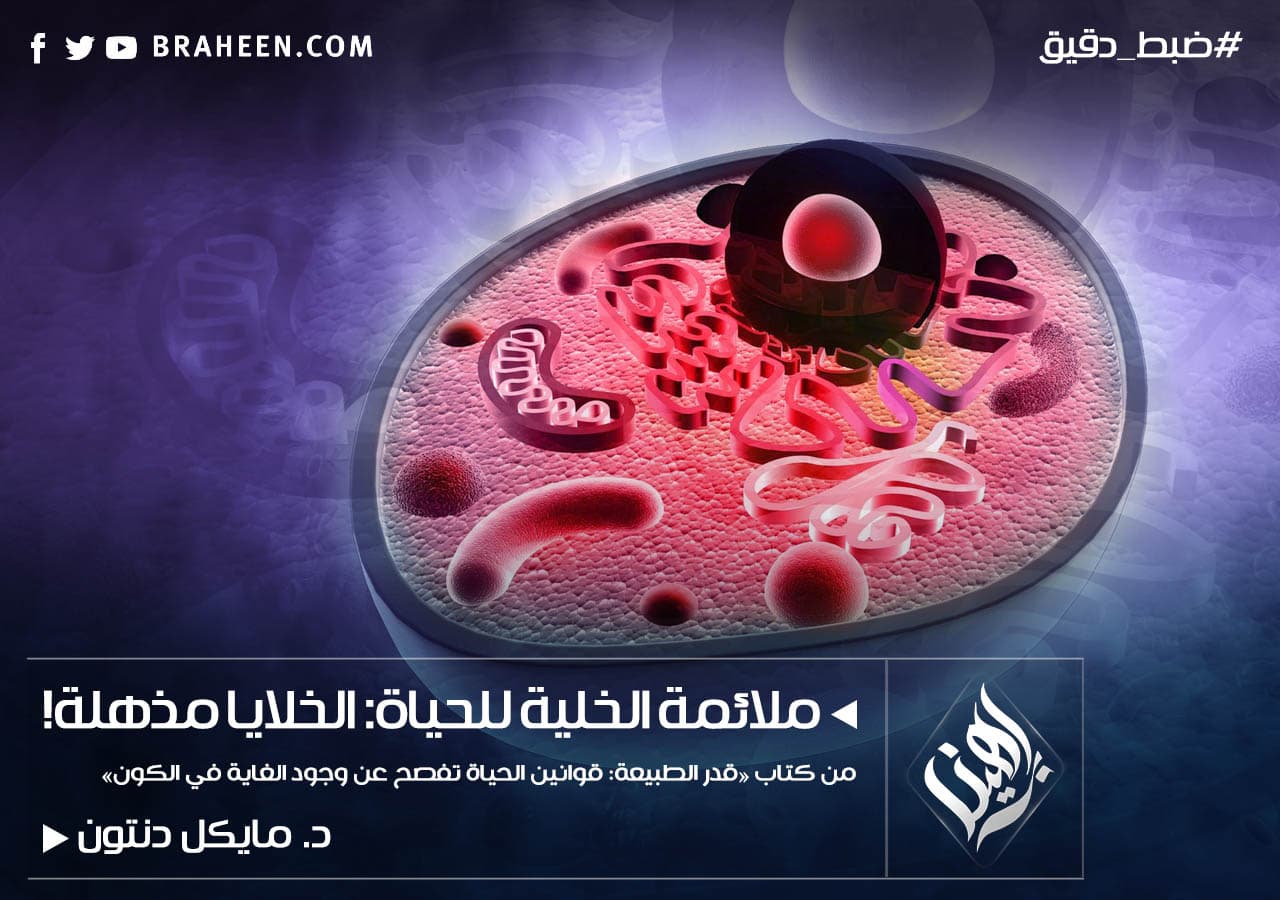
Cell Fit for Life: The cells are amazing!
*Note: This article is from The Fate of Nature: The Laws of Life Reveal the Existence of Purpose in the Universe.
In this chapter I will demonstrate that a cell is uniquely and optimally suited to its function, as the basic unit of life built from carbon, cells are able to carry out any instruction, take any form, generate an enormous diversity of multicellular organisms, and ultimately generate the entire world of life. I will examine the evidence that the cell membrane is uniquely suited and ideal for its role in enclosing cell contents, giving cells of high-end organisms the ability to translocate and selectively attach to another cell, as these important properties also depend on the size of the average cell and the viscosity of the cytoplasma at their present values. I then come to the membrane's suitability for life, where its selective impermeability to charged particles gives it additional electrical properties, to serve as a basis for neurotransmission. I will discuss a different set of adaptations underlying the cells' ability to move and selective adhesion. After that, there’s still a lot to learn even though the known properties of the cell are really amazing, and I’ll mention the possibility that the cells have strong computational abilities, and maybe even smart acting abilities.
The cells are amazing!
Not only is this felt by biologists, but there is an impression even among non-biologists that cells are very special and unique things, with tremendous potential.
Given their achievements, it's hard to believe that there is any other regular type of light matter, or any other kind of nanoscale oxygen-free structure that even remotely resembles a cell. These tiny things from organized matter are amazing, and they build every multicellular organism that has existed on Earth since the dawn of life, and they're the cells that gather in the human brain to make a million connections every minute for nine months during pregnancy, and they are also the cells that build blue whales, butterflies, birds and grasses.
The cell shows the evidence that it is uniquely and wonderfully suited to its mission. The diversity of the cellular form of a wonder, and no less amazing than the diversity of carbon compounds or proteins. The diversity is not limited to the many types of cellular form, but also includes the diversity of functional and behavioral abilities that surprise us with their richness, they are nanotechnological miracles, some of which can be changed by blasphemous or motor movement in bacteria. To form a multicellular organism, to communicate with each other by chemical and electrical signals, to cover itself with different shells resembling shields, to multiply itself very easily, and even, as we have mentioned in Chapter VII, to rebuild itself from precise parts of its mass.
In short, they can do anything, take any form, obey any command, and seem ideally suited, in every respect, to their particular task of creating a biosphere filled with multicellular organisms such as humans.
Cells turned out to be very complex entities, and from our current knowledge of the molecular machine responsible for some of these super-capabilities, in all cases the average cell must use nearly a million unique structures and processes, more than the number of processes in a jet. In this sense, the cell seems to represent the ultimate expression of adaptive complexity compressed into a physical form, like a jet compressed into a dust atom that the human eye cannot easily see, and it is hard to imagine anything more complex that can be compressed into this compact.
The cell's suitability for its biological role, from building multicellular life and carrying out its functions, provides every indication that it is unique, as are many components of life. It is very difficult for many of its basic properties and capabilities to imagine how these capabilities and properties can be achieved in a physical form with precise properties other than this one. In other words, if we are designing, from the basic principles, a nanostructure with a diameter of 30 microns, and has the capabilities of a cell i.
1. V. Tartar (1961) The Biology of Stentor (London: Pergamon Press): see chap. 7, "Regener- ation," pp. 105-135.
- Dr Michael Denton.
—
Source: Brahin Center website - Published 2018-05-22 (archived at the Internet Archive)
https://braheen.com/articles/fine-tuning/ملائمة-الخلية-للحياة-الخلايا-مذهلة