
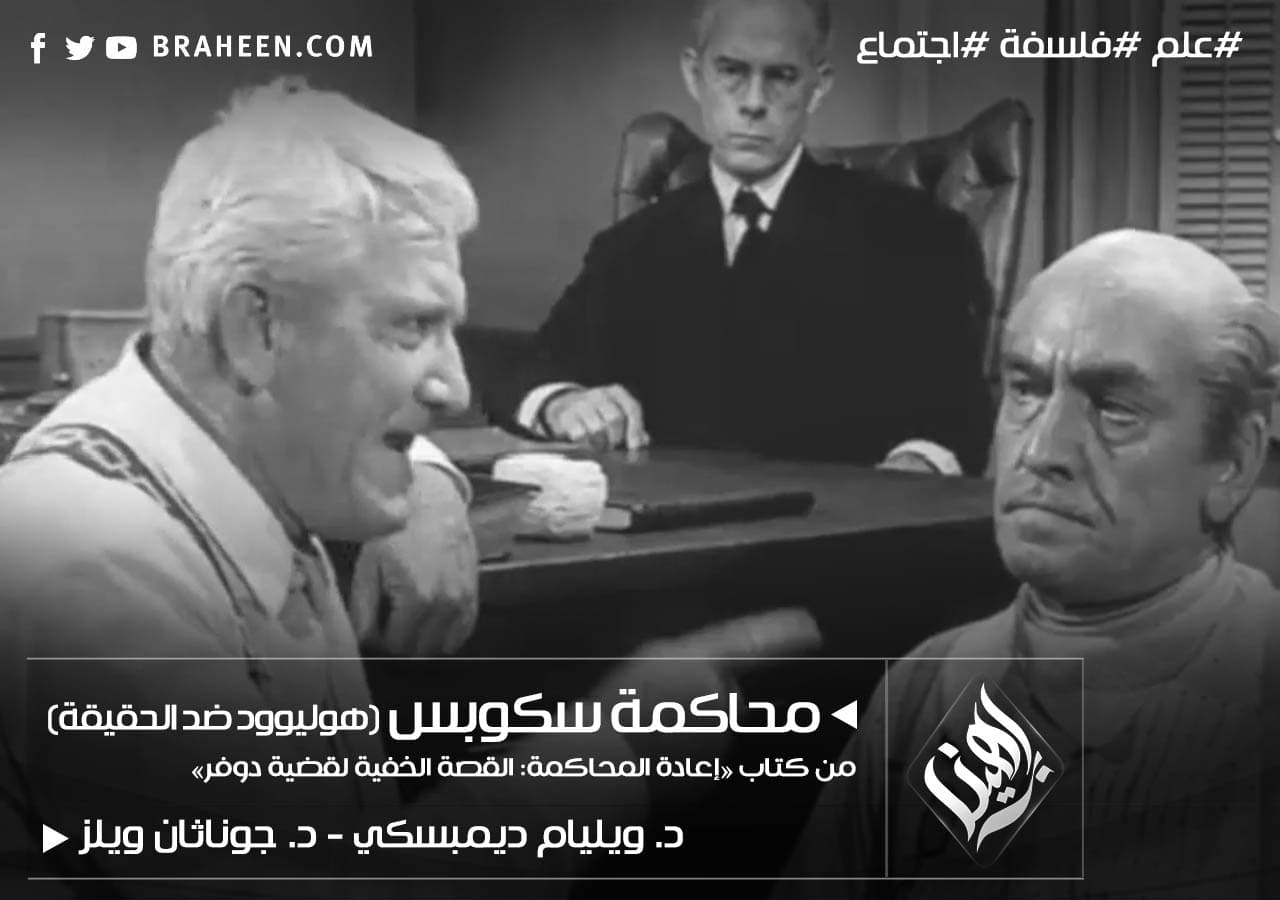
*Note: This article is from the book Retrial: The Hidden Story of the Dover Case. For more, check out the book. The Hollywood version of the Scopus trial depicts critics of intelligent design as anyone trying to find alternatives to Darwinian evolution as moving...
The Scopes Trial: Hollywood Versus the Truth
*Note: This article is from the book Retrial: The Hidden Story of the Dover Case.
Hollywood version of the Scopus trial
Critics of intelligent design portray anyone who tries to find alternatives to Darwinian evolution as being driven by religious motives opposed to science. Using the stereotype of Inherit the Wind, a fictional depiction of the 1925 Scopus trial, many academics and media outlets treat any critique of Darwinism as a critique of facts and a rejection of rationality.
The play was written by Jerome Lawrence and Robert Lee in the 1950s, and produced in 1955 on Broadway. The novel became famous through its introduction as a 1960 film in black and white, and was starring Spencer Tracy and Frederick March. The film was again produced in 1999 by Jack Lemmon and George C. Scott, but the film's 1960 section could find greater influence.
The novel begins in 1925 with the depiction of Bert Keats (representing Scoops) as a stalker by the ultra-Orthodox in Hillsborough because he studies Darwin's theory of evolution. Henry Drummond (representing the famous lawyer Clarence Darrow) makes a courageous offer to defend Keats, and Matthew Brady (a fictional character expressing famed politician William Bryan) sues Keats for his ideas of evolution.
Keats is at risk of being imprisoned and distanced from his fans (especially his wife, who loves him) simply for believing in evolution, but the real story is not that dangerous. Keats is on trial for his noble defense of truth and logic against hard-liners and fanatics, but the truth has other motives behind his defense of evolution.
The True Scopus Trial
John Scoops agreed to go to trial because his local backers paid him to do so. Their goal was to make Dayton, Tennessee public through the trial, which they achieved! Scoops was a physics teacher and a biologist as a part-timer. The local attorney general agreed to take on this charade, but things got out of hand when Darrow offered to defend Scopus, and William Bryan volunteered to speak on behalf of the prosecution.
Brian was neither a reactionary nor a hard-liner as the film portrayed him (as Brady); he was a three-time Democratic presidential candidate, and a progressive politician who sought to protect farmers and hard-working workers from corporate exploitation. Unlike Brady, Brian did not interpret Genesis literally (he did not believe that Earth was a few thousand years old or that the universe was created in 6/24 hours).
Not only was Darrow a renowned lawyer, but he was also a renowned lecturer in the country on the development of agnosticism. He had public debates against religions based on evolution. In 1924, the year before the trial, Darrow was the leading advocate in the terrible case of the killers Leopold and Loeb. During the trial, Darrow made Darwinian arguments for the crime, and the educated undergraduate students of the University of Chicago (Nathan Leopold and Richard Loeb) confessed to killing the 14-year-old Bobby Franks for wanting to commit a full-blown crime, believing they were too smart to be caught. Darrow protested against the death penalty by stating that "this strange and sad crime has occurred because something has gone wrong during the infinite processes of human evolution".
Leopard and Loeb, as Daro always calls them, were just as guilty as the miserable truths written in their evolutionary history: “Nature is powerful but ruthless; it works in its mysterious way and we are only its victims. We have little choice to control ourselves, nature has done it alone, and we are nothing but puppets that are born of nature.”
Machines work automatically and blindly, and they are not morally responsible elements and cannot be legally blamed for their actions. For Darrow, evolution determined the biological determinism that turned humans into dolls controlled by their evolutionary history. In 1997 history professor Edward Larson of the University of Georgia published a critical reassessment of the trial. Larson named the book (his Scoops trial and the ongoing controversy in America over science and religion) and the Inherit the Wind film was heavily misrepresented.
Evolution and its evidence were not discussed in Scopus's trial. Scopus's lawyers gave extensive written statements by seven scientists that evolution was the true explanation for the diversity of life on Earth. (2) I read the scientists' statements (Metcalf, Nelson, Lipman, Judd, and Newman) in the courtroom, while the other five statements (Cole and Curtis) were submitted in writing.
The most prominent aspect of this trial was Darrow’s questioning of Brian about the Bible. But this raises a clear question: If Darrow had the right to ask Brian about the Bible, why shouldn’t Brian have the right to ask Darrow about evolution? Brian accepted to answer Darrow’s question about the Bible if he had answered his own question about evolution, and the court allowed Brian to ask Darrow about the Bible after Darrow asked Brian about the Bible.[4]
What Darrow actually did was to change the case to guilty. By not entering directly into a guilty plea, Darrow benefited from a technical rule of procedure that reserved for him the right to appeal the court’s ruling; his guilty plea would not be able to appeal the court’s ruling.
Darrow could easily and directly take the jury’s opinion against his client(6) before questioning Brian (they would not then write Brian’s Bible Questioning in the trial report), or after questioning him (and then Brian’s Bible Questioning would be written in the trial report). It seemed from this act that Darrow and his admission that his client was guilty immediately after Brian’s Questioning – and his reluctance to accept Brian’s Questioning of Evolution – that Darrow was almost running away from the beginning.
The evolutionary theory has a long history of evading critical scrutiny. Fred Hoyle, founder of the Institute of Astronomy at Cambridge, did not exaggerate when he stated that scientific criticism of evolution was not given a fair chance to testify, given that the growing system of popular education culture – from Darwin to the present day – has provided an ideal opportunity to prevent discussion of transcendental arguments.”
The importance of keeping science honest
The development taught in 1925 was worthy of intense criticism and experimentation. Darrow accused the opponents of Darwinian evolution in his day of being “fanatical and ignorant,” trying to “control education in the United States.”8 Either way, the likes of Darrow will succeed. According to Harvard law professor Alan Dershowitz, proponents of evolution in 1925: "Those who include racists, nationalists, and militarists use evolution to propagandize their terrible programs; Such as the "Sterilization of Dons and Failures to Adapt" program, "Prohibition of Immigration" programs that call for immigration to be prohibited for people of "Done race" and laws that evolutionists have enacted against blacks "on the basis of being a Done race."
Dershowitz continues that the curriculum that Scopus taught students in school – Hunter's book On the Biological Phenomenon – divides human beings into five races that are progressively classified by their superiority, concluding that "the Caucasian race is the most superior race, and represented by the white population in America and Europe." This book also advocates that crime and corruption are inherited from families, and that "these families are easily parasitic families in society." Emotionally for the serious lessons embedded here."
There is no doubt that the scientific community today rejects all this racism based on biology, but some prominent modern Darwinists such as Daniel Dennett are so confident of Darwinism's rightness that they now embrace the idea of an elite culture; which assumes that anyone who opposes the Darwinist belief is a lowly person (culturally), and must be isolated from people who believe in Darwinism. Dennett, for example, defends the idea of "forcing children to learn the way."
Note well! The scientific community today insists on the absolute right of Scopus to teach this book in his high school, the same book that contains information that the scientific community rejects today emotionally. Imagine the existence of a law in the state in 1925 that allows the teaching of the principle of improvement of human offspring based on the desire of the scientific community at the time, but it demands the teaching of objections that hover around the theory. Wouldn't everyone applaud him today for this insight of the state's enactment of such a law? Listen!
This hypothetical example of state-binding legislation criticizing the “science” of eugenics shows that it is appropriate for those who oversee school science curricula not to be submissive to everything the scientific community espouses in its time. The general public – free from institutional rewards and expert aberrations that often distort the scientific community – has the right to examine scientific theories no matter how much the scientific community trusts them.
Indeed, if the history of science is any indication, every scientific theory is flawed and will eventually be abandoned to a better and more accurate theory; why should we believe that the theory of evolution is an exception? The world’s confidence in the theory is no guarantee that it is true.
Prominent scholars and celebrity scientists insist on demonizing opponents of the teaching of Hunter's 1925 book, claiming that they were motivated by purely religious considerations. Dershowitz stated that the U.S. Supreme Court approved the evolutionary eugenics program by enacting a mandatory sterilization law as "three generations of idiots is enough."[15] Fortunately for civil rights in America, sensible people of good will (who were not "religious fanatics" or "anti-science") questioned the teachings of the book. Hunter (civic biology) is odious. Fortunately, they also received enough popular support to maintain the status of science on the one hand and respect for minority rights on the other.
It is therefore reasonable nowadays for well-meaning people (who are not opponents of science and are not as culturally inferior as Daniel Dennett would like) to question Darwinian education and other forms of Darwinian evolution. It is perfectly legitimate, both scientifically and intellectually, to question whether evolution operates under mechanisms that are as unintelligent and materialistic as natural selection.
Amended Act submitted by Santorum
In 2001, 91 senators voted to make rational scientific questioning of Darwinism legal in the United States. The bill introduced Senator Rick Santorum into the Education Bill. The wording of the bill ruled that a good science education should: “Equip the student with the ability to distinguish testable scientific data and theories from religious and philosophical claims made under the mantle of science, and that the curriculum should help students understand why it is developing.”
The Joint Juridical Committee for Consultation in the U.S. Senate presented the version of the law for publication, and the reports of the Congress explained the annexed bill. Senators and House of Representatives participating in the Congress announced in their reports, in the same words as Santorum, that “a good scientific education should help students distinguish between testable scientific data and theories from philosophical and religious claims made under the cloak of science, and the curriculum should help students understand the full range of scientific views on the topics in which arise.”16
91 senators and members of the joint committee of the Senate and the House of Representatives support the teaching of all scientific views on the subject of biological evolution, and intelligent design is one of the scientific views. Proponents of intelligent design do not advocate the prohibition of teaching and evidence of evolution because of its incompatibility with evolution, but rather argue that the theory of Darwinian evolution, represented by evolution that occurs only by non-directed means of light such as natural selection and random variation, should be held accountable because the scientific evidence used to support it is weak.
Where does the evidence in biology lead us? Does it lead us to undirected evolution or to intelligent design? Through its presentation of evidence and arguments for intelligent design, this book provides students with the information they need to answer this question. Providing this information is not only educationally correct but legally valid. In 1987, the U.S. Supreme Court ruled in Edwards and Aguilard v. Aguillard states that "several scientific theories about man can be taught to school students but with the obvious secular intent of improving the effectiveness of science teaching."[18] Telling science teachers about the evidence and arguments for intelligent design will help achieve the Supreme Constitutional Court's order, and will foster the right scientific spirit of questioning and criticism.
Conclusion: Smart Design Trial in Dover
On 20 December 2005, during the final review of this book, Judge John E. Jones III issued a judgment in the Court of First Instance against intelligent design; Judge Jones introduced the policy of the Dover School Board, declaring that intelligent design is unscientific, and has religious origins, and concluded that the teaching of intelligent design in the curriculum of public school science is a violation of the law, and therefore unconstitutional.
It is hard to imagine how the court’s decision came to pass against intelligent design, but it is wrong to consider it a fatal blow to intelligent design.19 The judge has placed restrictions on some schools that want to support the idea of intelligent design, but this is not a Supreme Court ruling; he will not appeal to the Supreme Court, because the faculty supporting intelligent design at Dover School fell to the vote within the school, and the school received a new body in November 2005.
In the absence of a declared Supreme Court decision against design, public pressure to open the debate about intelligent design in public schools and criticism of Darwinian evolution will increase. With this court decision, faculty and state legislators will tread carefully, but no court ruling can end the debate about evolution.
Even if the courts ban the circulation of intelligent design in primary and secondary schools – and Internet censorship does not prevent a prophet student from learning the truth – its power is weaker at the undergraduate level. Intelligent design is gaining momentum rapidly among college students. Three years ago, there was only one IDEA center at UC Berkeley, and now there are more than thirty at UCLA and UC Berkeley.
The significance of a court ruling in a case like Kitzmiller v. Dover does not depend on the judge’s decision, but on the cultural forces behind the decision-making. Given Scopus’s trial, it represents a decisive victory for Darwinian evolution.
Yes, Judge Jones’s decision may have clouded the lives of proponents of intelligent design for some time, but the work on intelligent design will continue, even stronger, than if the court ruling were in support of it; the verdict may turn out to be a complacency, and thus to suggest that design has won the round while it needs to continue to develop an intellectual and scientific program.
(1) This and the other quotes by Darrow from The State of Illinois v. Nathan Leopold & Richard Loeb are drawn from his closing argument, delivered August 22, 1924 in Chicago, Illinois. It is available online at http://www.law.umkc.edu/faculty/projects/ftrials/leoploeb/darrowclosing.html (last accessed February 22, 200G).
(2) See The Scopes Trial, 229–280. The verbatim transcript of the Scopes Trial was published in 1925 by the National Book Company and then reprinted 1990 by Gryphon in their Notable Trials Library series. The transcript is available at http://www14.inetba.com/gryphon/item43.ctlg (last accessed 6 February 2003).
Ibid., 206, 220-221, 223.
The prosecution is partly responsible for the failure to account for the development in the Scopus trial. According to the prosecution, Tennessee state law criminalized the teaching of evolution regardless of its validity, and therefore all evidence supporting the validity of the development is irrelevant and must be excluded. The judge agreed and initially removed the scholars from testifying, meaning that the prosecution lost its initial opportunity to hold witnesses accountable, and the judge then allowed the scholars to write their testimony to be read in an open trial.
Ibid., 284, 288.
5 Ibid., 306 307.
6 Ibid., 308.
(7) Fred Hoyle, Mathematics of Evolution (Memphis, Tenn.: Acorn Enterprises, 1999), lOG.
(8) The Scopes Trial, 299.
(9) The Scopes Trial, introduction by Alan Dershowitz.
(10) Civic Biology offers a study of two families: the Juke family and the Alcolic family. The Juke family is attributed to Margaret (the mother of criminals) and has cost the state of New York in a period of 75 years to care for more than a hundred deranged insane addicts or criminals. The Alcolic family is attributed to two deranged Alcolics and one deranged girl. These and other quotes about civics are available online here: http://www.eugenics-warch.com/roots/chap08.html Here and http://www.iit.edu/departments/humanities/impact/colloquium/ongly_2001f.html
(11) Hunter, Laboratory Problems in Civic BioLogy, 182.
Ironically, in light of this conclusion, the practical book contains nothing about evolution. Hunter and his publishers seem to have felt the importance of indoctrination of 1925 students from a young age into eugenics rather than evolution.
(12) Daniel Dennett, Darwin's Dangerous Idea (New York: Simon & Schuster, 1995), 519.
13 Ibid.
(14) Peter B. Medawar, Advice to a Young Scientist (New York: Basic Books, 1981), 39.
(15) So wrote Justice Oliver Wendell Holmes in 1927 in the case of Buck v. Bell; 274 U.S. 200 (1927).
(16) See Bruce Chapman and David De Wolf, "Why the Santorum Language Should Guide State Science Education Standards," available online at http://www.discovery.org/articlePiles/PDFs/santorumLanguageShouldGuide.pdf (last accessed September 14, 2004).
(17) Tbeodosius Dobzhansky, "Nothing in Biology Makes Sense Except in the Light of Evolution," The American Biology Teacher35 (1973): 125–129.
(18) Edwards v. Aguillard, 482 U.S. 578 (1986), 594.
19 For details of the resolution, see:
(http://www.pamd.uscourts.gov/kitzmiller/kitzmiller_342.pdf (Last Accessed February 22, 2006.
(20) For a thorough examination of this case, see David De Wolf, John West, Casey Luskin, and Jonathan Witt, Traipsing into Evolution: Intelligent Design and the Kitzmiller vs. Dover Decision (Seattle: Discovery Institute Press, 2006).
- Dr. William Dembski - Dr. Jonathan Wells
—
Source: Brahin Center website - Published 2018-05-25 (archived at the Internet Archive)
https://braheen.com/articles/science-scientism/محاكمة-سكوبس-هوليوود-ضد-الحقيقة