
*Note: This article is from Darwin's Doubt: The Sudden Emergence of Life and the Argument for Intelligent Design. For more see the book. The third element of the neo-Darwinian triad is the transmission and inheritance of genetic information. It is not surprising...
Neo-Lamarckian Epigenetic Inheritance
*Note: This article is from Doubt Darwin: The Sudden Rise of the Life of Beings and the Argument for Intelligent Design.
The third element of the neo-Darwinian triad concerns the transmission and inheritance of genetic information. Unsurprisingly, a new model of evolutionary theory calls into question the understanding of neo-Darwinism of heredity as well.
Darwin himself did not find a precise theory to explain the transfer of traits between organisms from one generation to the next, believing that changes during the life of the organism passed to the atom as a result of the principle of (use and neglect) of different organs and anatomical systems through reproduction.49 In this regard, his theory of heredity resembled that of Jean-Baptiste Lamarck (1744 to 1829), one of the first evolutionary biologists – who also believed the inheritance of acquired traits.
The Lamarckian mechanism also lacked supporting evidence at the time, but it played an increasingly important role in Darwin’s way of thinking, as the growing criticism of natural selection led Darwin to add more importance to the direct influence of the environment on evolutionary changes. Indeed, when he published the sixth edition of his book The Origin of Species (1872), Darwin emphasized the importance of these models in heredity.50
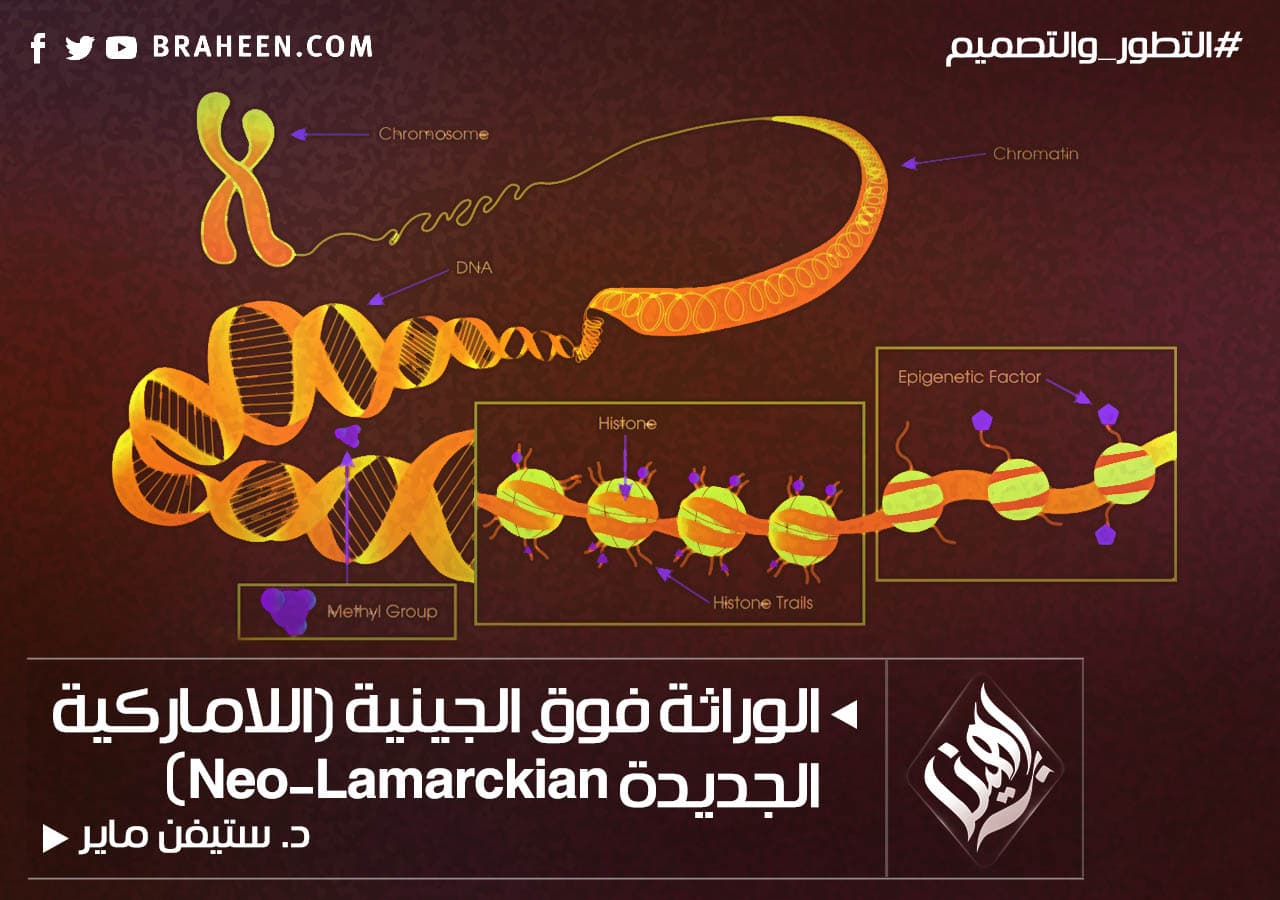
But with the discovery of Mandel’s laws in 1900 and the identification of chromosomes as the physical entities responsible for genetic transmission, Lamarckian theories lost their advantage. After the advent of the new Darwinian synthetic theory, most evolutionary biologists argued for the fact that genes are the locus of all inherited changes in an organism. The discovery of the susceptibility of epigenetic information to direct and independent DNA has attracted much subsequent attention, and this discovery in turn led to the formulation of the contemporary neo-Lamarckian theory51, which envisioned that changes in the epigenetic structure of the organism affect subsequent generations.
One of the most famous defenders of Lamarckism today is Eva Jablonka of Tel Aviv University and Massimo Pigliucci of the City University of New York. Of course, Lamarck knew nothing about the important role of genes, and he believed that the inheritance of acquired traits was an important driving force in evolution, but the new Lamarckians knew what genetic inheritance really was.
Jablonka has collected a lot of evidence to support what she calls the epigenetic system:
In the first place, environmentally induced changes in the metabolic pathways of certain single-celled organisms, such as yeasts and coli germs, can be passed on to the next generation independently of any changes in cellular DNA.
Second, I have already observed the passage of structural information that gives the shape and functions of an organism from parent to offspring independently of DNA across membranes and other three-dimensional cellular patterns.
Third, Jablonka has discussed the process of DNA stranding – a process in which a special enzyme adds methyl groups of CH3 to the nucleotide base within the double helix, and such a process can change the gene regulation and chromatin structure – and Jablonka has stated that changes introduced through modified gene regulation processes are often passed on to the next generations of the cell without any change in the DNA base sequence.
Finally, Jablonka cited a process called epigenetics, a newly discovered phenomenon, here small RNA molecules work again in concert with special enzymes, affecting gene expression and chromatin structure, and those modifications seem to be inherited independently of genes.
Can any of these mechanisms help explain the origin of animal forms in the Cambrian explosion?
In essence, macroevolution requires constant changes, but what Jablonka's evidence shows is that wherever epigenetic inheritance occurs in animals, it involves either:
Unchanging, such as membrane patterns and sustainable templates of structural information.
It doesn’t go on for many generations.
In either case, there is no significant evolutionary innovation in animal forms; instead, for evolutionary change to occur in a particular direction in the populations of organisms, these changes must be not only heritable, but permanent. Stability – the inheritance of traits invariably and inversely – is an inescapable imperative of any evolutionary theory.
Jablonka's evidence of epigenetic stability here is ambiguous at best, according to her own direct admission. A review of the data Jablonka collected from animals does not reveal any case in which epigenetic changes are always stable in any population. The genetic transmission of those changes is transient and only, depending on the species in which we are investigating them, persists from a few generations to 40 generations.
(49) Darwin, On the Origin of Species, 134–38.
Darwin's theory of genetics has been called pangenesis, which postulates that a collection of fine genetic particles (called germules) accumulates in the genitals of organisms, carrying information about the father's life history, environment, and circumstances. This information is then passed on to offspring, allowing the inheritance of acquired traits.
(50) Darwin. The Illustrated Origin of Species (6th edition), 95.
Darwin wrote, "I think there is no doubt that the use of specific parts in domesticated animals has enhanced and amplified them, and that their neglect removes some of them, and modifications like these are inherited."
51 There are some questions about the historical exactitude of naming emerging ideas in the 21st century “New Lamarckism” in light of the true content of Jean-Baptiste de Lamarck’s vision in comparison with the enormous cognitive growth in the heir over the past two centuries. Given Jablonka’s adoption of the term “Lamarckism” for her current position, she followed in that practice, with the caveats of disagreement mentioned.
(52) Jablonka and Raz, "Transgenerational Epigenetic Inheritance," 168.
(53) Jablonka and Raz, "Transgenerational Epigenetic Inheritance," 138, emphasis added
(54) Jablonka and Raz, "Transgenerational Epigenetic Inheritance,"162
- Dr. Steven Meyer.
—
Source: Brahin Center website - Published 2018-05-28 (archived at the Internet Archive)
https://www.braheen.com/articles/evolution-design/الوراثة-فوق-الجينية-اللاماركية-الجديدة-neo-lamarckian