
*Note: This article is from the book Zombie Science: Icons of Evolution Again. For more see the book. According to British biologist Ronald Jenner, without a good fossil record there is "little choice to resort to our fantasies...
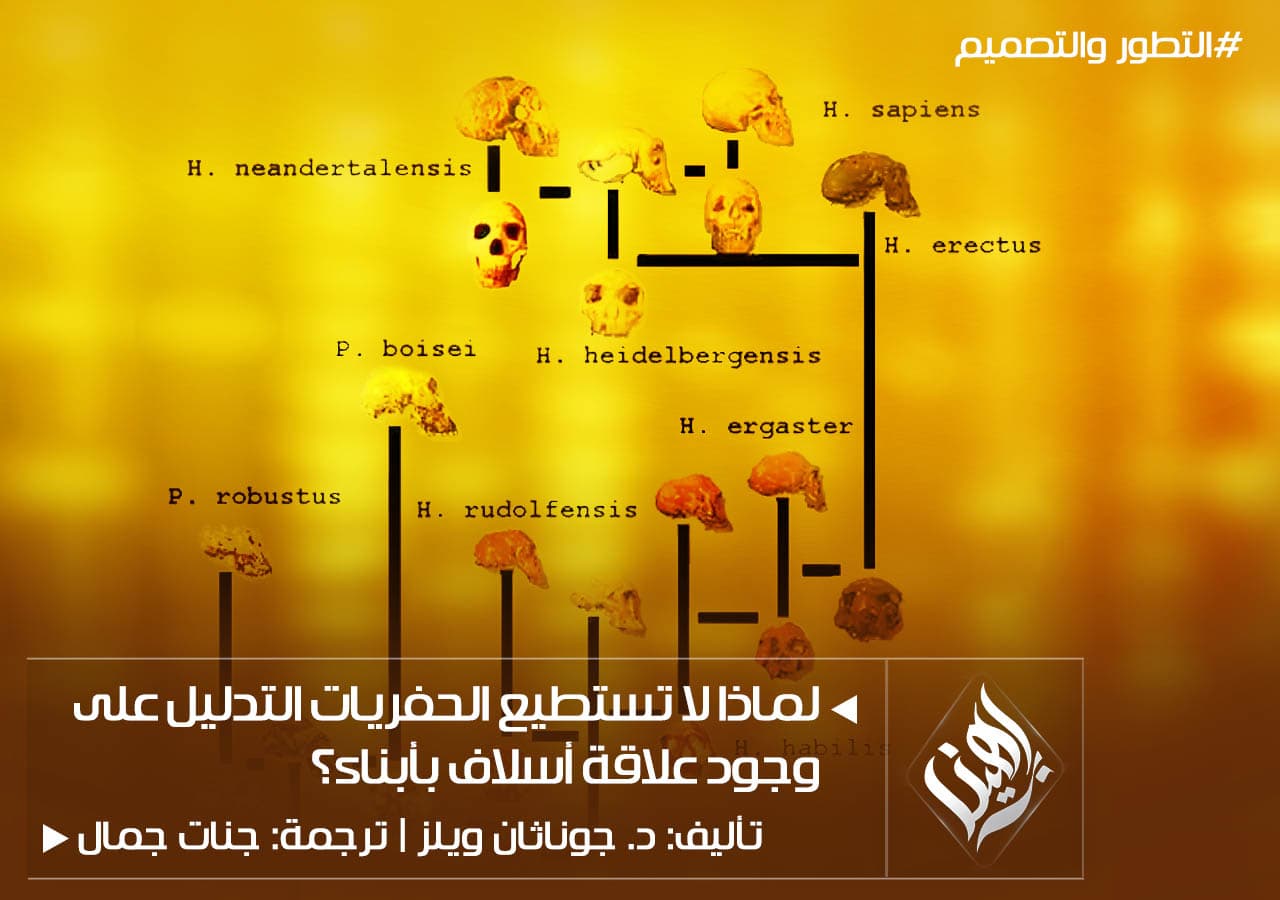
Why Can Fossils Not Demonstrate Ancestor–Descendant Relationships?
*Note: This article is from the book Zombie Science: Icons of Evolution Again.
According to British biologist Ronald Jenner, without a good fossil record there is "little choice to resort to our scientific imaginations, in one way or another, to produce historical mercies, which are the ultimate goal of our studies of animal evolution." Indeed, "our imaginations are the only way to repair the fractures of evidence and turn them into a seamless historical mermaid that connects what, how, and why."[17]
The situation for evolutionists is actually worse. Even if we had a good fossil record, we would still have to use our imagination to produce anecdotes about ancestral-son relationships.
Here’s why. If you find two human skulls buried in a field, how do you know which one was predestined to the other? Without specific markers and written records, or perhaps in some cases DNA, this would be impossible. Maybe you’re dealing with two skulls of the same modern species. Or with two different extinct species – often far away in time and space – there may be no way to prove ancestral ties to their offspring.
The American Museum of Natural History paleontologist Gareth Nelson wrote decades ago that "the idea that a person can go into the fossil record and expect to experimentally recover the descending sequence of ancestors, whether species, genera, families, or whatever, has been, and is, fatal."[18] In 1999, Henry Gee, editor of Nature magazine, wrote that "it is practically impossible to establish that" Pleasant, perhaps even useful, but unscientific."19 G (like Erwin and Valentine) believes in evolution, but his belief (like them) is clearly not based on fossil evidence.
Breed Evolution Trees
Despite the fact that ancestral relationships cannot be empirically restored from fossils, scientific papers in modern biology are full of evolutionary trees – called "dynastic evolution" trees – that supposedly show such relationships. Trees are usually accompanied by stories of how pre- and post-dynastic organisms evolved.
In 2013, a science education group produced a plan to teach college and high school students how to form a tree that develops strains with metal bands, pasta, or cakes. Although the material is abnormal, "the problems they encountered and the questions posed are similar to those posed by paleontologists when using fossil fragments."20
The first guiding principle is that "objects that resemble one another in multiple ways are more likely to be related to one another than objects that have little resemblance in common. That is, the more similar the structure (the more common the characteristics), the closer the possible relationship between two forms." Students were instructed to "choose the smaller, simpler form as the group's likely common ancestor, and then try to arrange the other forms as branches of the tree from a descent of ancestor."[21]
Of course, none of those forms requires or includes a common ancestor. In fact, we all know that metal bands, pasta or cakes are the product of a clever design. So what we have is just a training to choose qualities to compare and come up with a relationship between them. But the "relationship" is ambiguous. On the one hand, it may refer to the lineage, for example, "Charles Darwin is more closely related to Erasmus Darwin than to Geronimo." On the other hand, it may refer to similarity, for example, "iron is more closely related to aluminum than to daffodils." In the first place, therefore, the trees of dynastic evolution are formed using relationships in the former sense, but many evolutionists then equivocate, suggesting that they have proven relationships in the sense of a genealogy.
17. Ronald A. Jenner, “Macroevolution of animal body plans: Is there science after the tree?” BioScience 64 (2014): 653–664. doi:10.1093/biosci/biu099.
18. Gareth Nelson, “Presentation to the American Museum of Natural History” (1969), in David M. Williams and Malte C. Ebach, “The reform of palaeontology and the rise of biogeography,” Journal of Biogeography 31 (2004): 685–712. doi:10.1111/j.1365-2699.2004.01063.x.
19. Henry Gee, In Search of Deep Time: Beyond the Fossil Record to a New History of Life (New York: The Free Press, 1999), 32, 113–117.
20. John Barker and Judith Philip, “Phylogenetics of man-made objects: Simulating evolution in the classroom,” Science in School 27 (2013): 26–31. http://www.sciencein-school.org/2013/issue27/phylogenetics.
21. Ibid.
- Dr. Jonathan Wells.
—
Source: Brahin Center website - Published 2018-11-15 (archived at the Internet Archive)
https://braheen.com/articles/evolution-design/لماذا-لا-تستطيع-الحفريات-التدليل-على-وجود-علاقة-أسلاف-بأبناء؟