
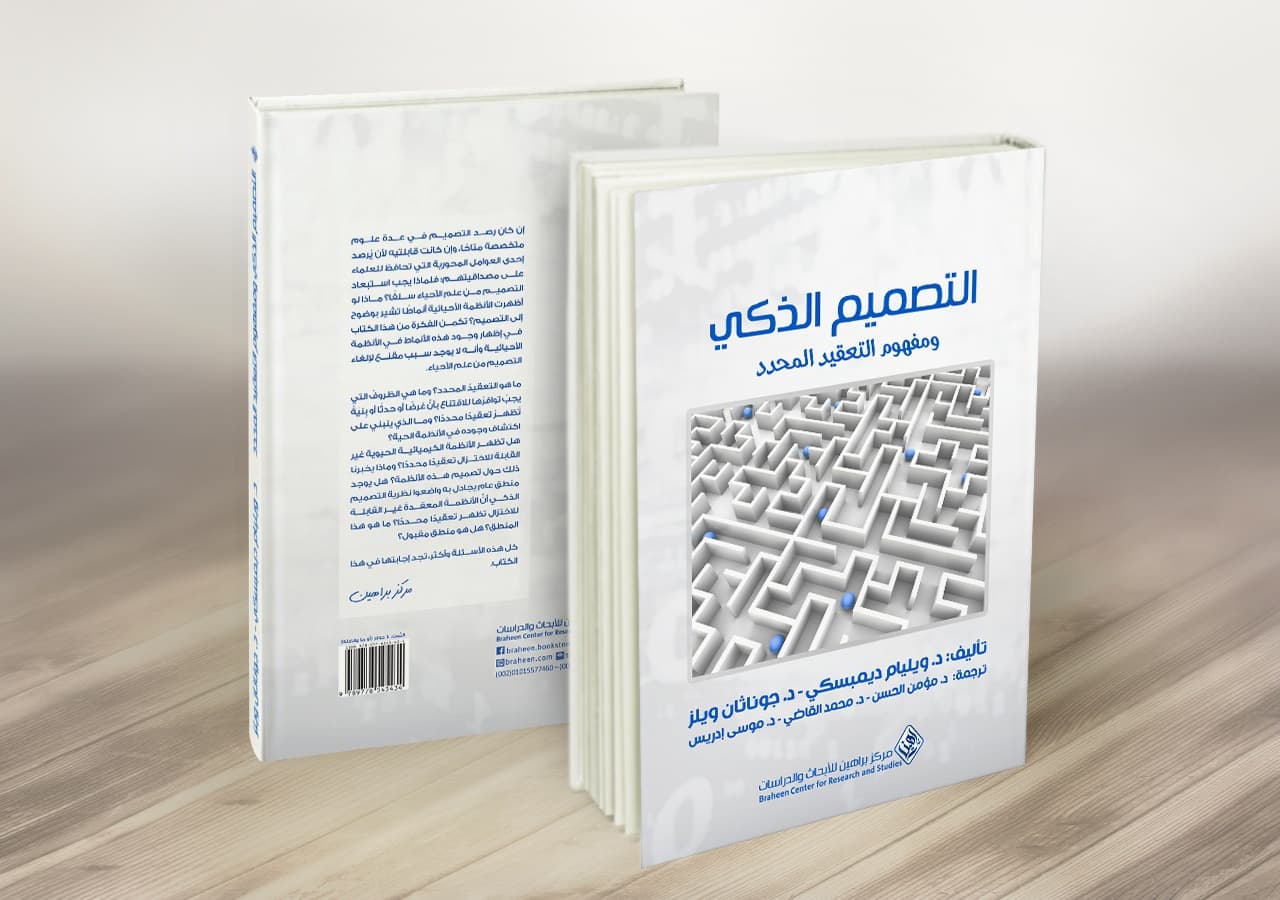
Disclaimer: This booklet is basically one of the chapters of the book Design of Life: Discovering the Signs of Intelligence in Biological Systems by Dempsey and Wells. The purpose of producing it this way is to provide a summary of the specific complexity argument for those who prefer to see the summaries. But not...
Intelligent Design and the Concept of Specified Complexity — Authors’ Introduction
Disclaimer: This booklet is basically a chapter of the book Design of Life: Discovering the Signs of Intelligence in Biological Systems by Dembesky and Wells. The purpose of this publication is to provide a summary of the specific complexity argument for those who prefer to read the abstracts. But the purpose is not at all the full and detailed presentation of the theory of intelligent design or even the idea of specific complexity, so who would like the full picture, we recommend to read the full research (such as the Darwin Black Fund for Behe and the design for Dembesky and the cell).
Is intelligent design a science?
Speaking about the importance of Darwin’s theory, evolutionary biologist Francesco Ayala says: “The functional design of living organisms and their features may suggest the existence of a designer. But Darwin’s greatest achievement is to prove that the directed system of living organisms can be explained as the result of a natural process (natural selection) without the need to assume a creator or any external factor.”
With this last comment Ayala clearly suggests that pre-Darwin biology was not as science-oriented as it should be, and given the importance that paleontological studies before Darwin came up with the idea of intelligent design, Ayala has rejected the possibility of explaining complexity and biodiversity by design as science. "Darwin put the idea of design aside, not because it is an incorrect scientific explanation, but because it is not a scientific explanation at all," explains Professor David Hull.
This cannot be true; many sciences employ the principle of design, and some cannot even be conceived without it. For example, archaeology assumes that humans in ancient times left clues to their lives and cultures, and these clues can be distinguished from the effects of blind natural forces.
The design does not always have to refer to human workmanship. Some psychologists study learning and behavior in animals. Animals display intelligence and have the ability to design objects. For example, dams built by beavers are designed. The design also does not have to be ground-based. The SETI project attempts to detect signs of intelligence in radio signals in outer space.
Biologists Francis Crick and Leslie Orgel also argue that life is too complex to appear directly on a planet like ours, and that it must have been planted here by intelligent aliens who traveled to our solar system via a spaceship. While the idea is far from believable, their theory, known as panspermia, is a well-established theory in the scientific community, as it lies within the confines of science.
If monitoring the design in several specialized sciences is available, and if it is possible for him to observe one of the key factors in maintaining the credibility of scientists, why should the design be excluded from biology in advance? What if biological systems show patterns that clearly indicate the design?
Definition of Specific Complexity
The term complexity is now thirty years old. The extraterrestrial intelligence researcher Leslie Orgel first used it in 1973 in his book The Origins of Life: "Living organisms are characterized by their specific complexity. Crystals, such as granite, are not worth the name of a neighborhood because they lack complexity, and a random mixture of polymers are not worth the name of a neighborhood because they lack specificity."[3]
- Probabilistic element of complexity and applied to events.
- Descriptive element of complexity and applied to models.
Probabilistic measure of opportunities to produce an event by chance.
Probability Complexity: Probability can be presented in the form of complexity. To understand this, we will take the harmonic lock as an example.[1] The more conformations there are in the lock, the more complex the unlocking task will be and the less likely the lock will be accidentally opened. For example, if the lock has a circular plate numbered from 0 to 39 and the arrow has to be pointed three times at the correct numbers to open the lock, then we have a probability of (40x40x40x64000). This number gives us an idea of the complexity of this lock, and it corresponds to the probability of 1x64000 that the lock will open by chance – that is, without knowing the code for the unlock. A lock with a plate numbered from 0 to 99 with the arrow having to be pointed to the right number five times is much more complicated as we have a possible probability (100 x 100 x 100 x 100 x 100 x 100), then the probability of opening the lock by chance is 1 x 10,000,000,000. This means that complexity and probability change inversely – the more complexity there is less probability – so complexity in the term “specific complexity” can be said to imply improbability.
Descriptive complexity as a model: Selections show different degrees of complexity consisting of how easy or difficult it is to describe this model. Let's see how far the descriptive complexity of these models ranges. We take an example from the results of my 10 times coin tossing experiments:
The first one is YYYYYY.
Second experiment: ص ص ش ص ش ش ش ص ش ص.
Which of the two outcomes is more likely to be accidental? Both outcomes have the same probability – one in a thousand is approximately 1 2 10 ; but the model that determines the first outcome is much easier to describe than the model that determines the second outcome. The model of the first outcome can be defined in simple terms with 10 "consecutive images", while the model of the second outcome can only be defined in long sentences.
If we want to judge something as having a specific complexity, the descriptive complexity must be weak – easily described as the sequence of successive images resulting from the first experiment – and the probability complexity is high – the probability is small. The combination of minimal descriptive complexity – a model or structure that is easy to describe in short terms – with the magnitude of the probability complexity – it is very difficult for the model to happen by chance – makes the specific complexity an effective concept in the expression of intelligence.
Probability data refers to the number of chances that an event will occur and be specific. An event that seems unlikely may become very likely with sufficient probability data or may remain unlikely even after all the probability data are available. Probability data has two forms, iterative and deterministic;
Repetitive data indicate the number of chances of the event occurring.
Deterministic data refers to the number of chances that an event will be specific.
To see how important these two types of probability data are, imagine that we are standing at a busy intersection, and 10 red Pontiacs with four doors pass by us in a row. Does this happen by accident? (5) Of course, you are lucky to witness such an event; but what we want to determine is if it is so rare that no one expected it to happen by accident. It’s not about being lucky, it’s about not getting lucky. To determine whether you’re lucky or not, we must first determine the number of chances that this event will happen. This requires knowing the number of cars on the road and knowing the types – if all the cars in the world are new Pontiac Brand and are all red with four doors, the passage of consecutive is normal and there is no coincidence needs to be explained because there are no others – and also requires knowing how many people stand in the corners of all the streets in the world a year and who are expected to see the successive passage of these cars. The number of opportunities to watch such an event is what is known as iterative data. Iterative data determines the probability that anyone, not just you, will see this column of cars you have seen.
But we need more determinants to know the probability of this event by accident. There is no doubt that seeing 10 new red Pontiac cars with four consecutive doors is surprising. But what if they were two doors? What if they were blue? Why only Pontiacs? What if they were all Honda Accord cars or Volkswagen Gita. These questions indicate the probability of one type of event being the same type of cars.
Listing the full details of the specific complexity is difficult and we leave it elsewhere.7 However, the basic idea behind this concept is made clear by explaining the three main elements that make it up. We will explain these three elements later.
The entered letters must correspond to the correct sequence to open the lock. It is circular, such as a safe lock or a small number, such as a bag lock or other forms.
[2] In a coin-throwing experiment the result is either an image (r) or a logo (u).
- Dr. William Dembski - Dr. Jonathan Wells
—
Source: Brahin Center website - Published on 2019-01-21 (archived at the Internet Archive)
https://braheen.com/publications/intros/التصميم-الذكي-ومفهوم-التعقيد-المحدد-مقدمة-المؤلفان