
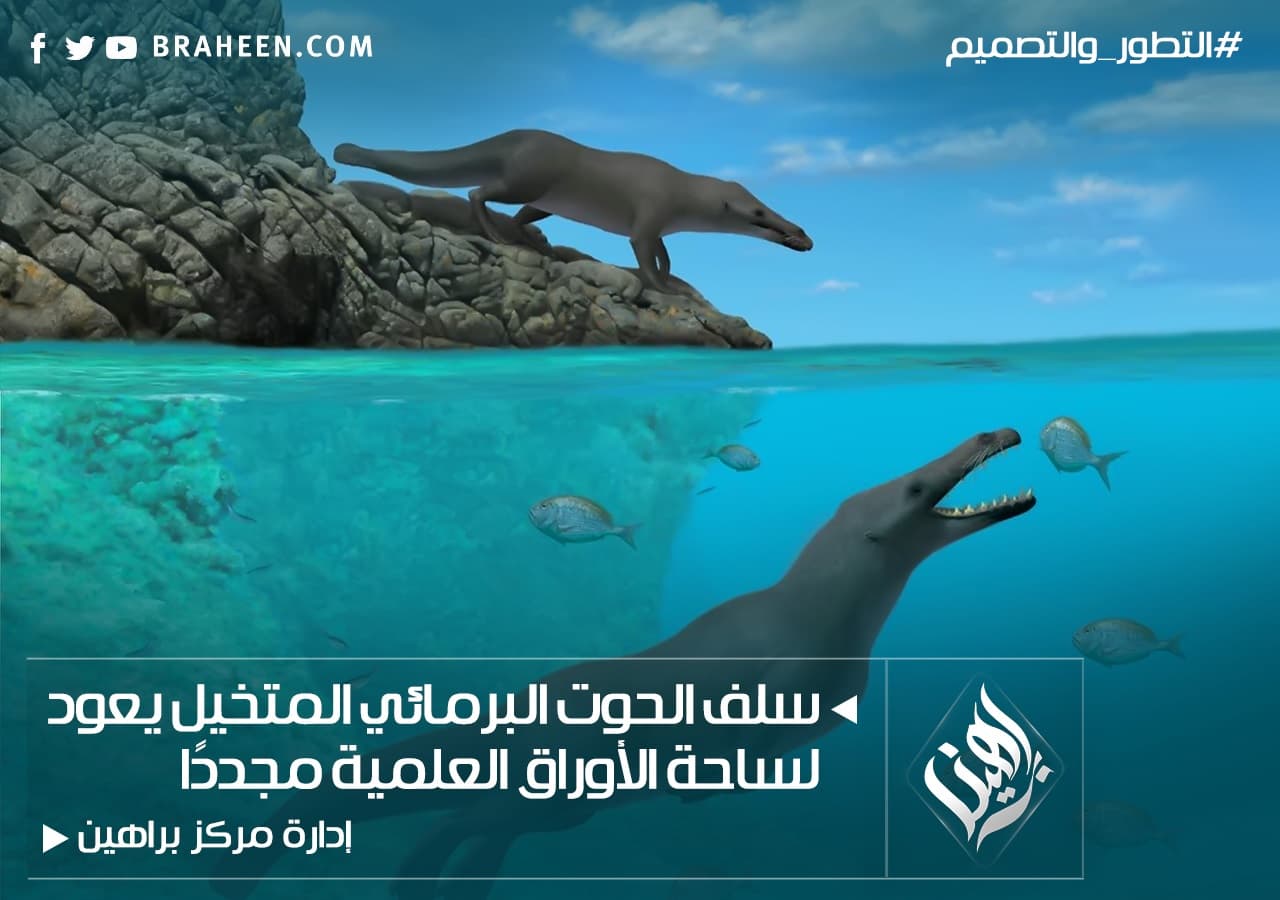
A few days ago, a paper by a group of researchers appeared in the journal Current Biology entitled "Amphibious whale from the Middle Eocene in Peru reveals an early spread in the South Pacific of tetrapods."
Imaginary amphibious whale's ancestor is back in the scientific papers.
A few days ago, a paper by a group of researchers appeared in the journal Current Biology, titled "Amphibious whale from the Middle Eocene in Peru reveals an early prevalence in the South Pacific of tetrapods."
And, as usual, evolutionists rejoiced, cheering their words; new evidence proves that evolution is real. But excuse me, what is new here? Isn’t the ancestor of the imaginary whale that has been walking on four legs in the evolutionary debate since the 1980s!
Importantly, evolution is a fact, as we all know, and the bones in the picture on the left – which have already been discovered – prove that the imagined object in the beautiful coloured image is one of the ancestors of the current whale (and of course, ironically if not obviously).
In any case, we are forced to cut off their joy, and explain to them that the subject is not that simple at all. We will continue with a fascinating exposition of the biological requirements for a transition from full life on Earth to full life in water, from the book (Zombie Science) by Dr. Jonathan Wells (Professor of Molecular and Cellular Biology).
What does it take to create a whale?
Excavations of fully aquatic whales such as the Dordon and Basilosaurus appeared in a geological period known as the Eocene, in rocks that geologists say date back 40 million years. Mayacetos, Coccitos, and Rhodesitos were found in Eocene rocks dating from 2-8 million years ago.
What changes does a mammal have to go through in eight million years to move from a terrestrial or amphibious mammal to one that spends its entire life in water? Quite a few. Many cetacean traits are very different from those of terrestrial mammals. The following is only a small sample of them.
Characteristics required for swimming:
The whale pushes itself through the water mainly through large outcrop movements – called "flukes" – which are at the end of its tail up and down. Except for the mid-tempo, the holes have no bones; they are made up of fibrous connective tissue defined by the long tissue.
In the blue whale in picture 5.1, the tail begins between the small dorsal fin and the perforators. The tail can bend up and down relatively with the body, but the perforators can move independently of the tail. According to Everhard Slijper's classic book on cetaceans, the perforators "can actually be moved to other parts, so the fact that - during the movement - the rest of the water is made".
The shape of the holes is similar to the wings of aircraft, with a circular front edge that steadily decreases until it reaches the other edge. The biologists who analyzed the holes in 2007 declared that "the radius of the relatively large front edge allows the generation of greater lifting force and delays downtime." In fact, calculations have shown that "the generation of lifting force in the holes is generally comparable to, and probably better than, the manufactured wings."(3)
Cetaceans also have dorsal fins, which protect them from slipping. Like perforators, dorsal fins are among the characteristics that distinguish cetaceans from terrestrial and amphibian mammals.
Characteristics required for breathing:
The whale breathes through the holes at the top of its head, which are called "blowholes," because when the animal appears on the surface, it blows moisture-laden air out of them. All living cetaceans have blast holes at the top of their heads, but in the sperm whale the location of the blast holes is farther forward than in other whales.
So for a terrestrial animal to evolve into a whale, it has to change where the holes are in it and move to the top of the head.
The blast hole is surrounded by thick "lips" made up of extremely elastic tissues. According to Slipper, these tissues "usually keep the culture closed with rubber even when the whale is on the surface. To open it while breathing, the whale has many muscles extending from the lips to the bottom of the skull.
Whales are known for their deep dives, although they breathe at the surface. (Sea lions and seals, although not entirely aquatic, are also famous for their deep dives.) Dolphins and porpoises can dive as deep as 300 meters, Weddell seals up to 600 meters, sperm whales up to 2,000 meters, and beaked whales up to 3,000 meters.[5]
The pressure on the animal in the water surface is one atmosphere (compression unit), and the pressure on an animal 10 meters below the water surface is 2 atmospheres, and the pressure increases at the rate of one atmosphere for every additional ten meters. So the sperm whale at a depth of 2.000 meters experiences pressure 200 times more than the pressure it encounters on the water surface. The bones are not strong enough to protect the lung from such high pressure, and therefore mammals that dive to those depths contain a folding chest cage and folding lungs.
The rib cage in cetaceans has several "floating lung ribs", ribs that are not connected to the sternum. These loose ribs greatly support the elasticity of the chest wall. (6) Cetaceans and other submarine mammals have a diaphragm oriented parallel to the spine rather than perpendicular to it.
Breast closure was observed directly in the dolphin at a depth of 50 meters, and was observed by underwater televisions at a depth of 300 meters.(8) Blood analysis showed that closed lung involves when the animal reaches a depth of 50 meters.(9) These same, and similar analyses in sea lions, reveal one reason why pneumoconiosis is a physiological necessity: the folds of small vesicles in which blood is normally exchanged produce a serious stress disorder.
The traditional sperm whale dives take about an hour. The beaked whale may last more than two hours. How can the cetaceans survive underwater all this? Thanks to another metabolic engineering marvel.
Whales have far more myoglobin in their muscles than other mammals. (11) However, as Slipper points out, "Not even large amounts of myoglobin can provide a sufficient explanation for their long underwater persistence ... During diving, fundamental changes in metabolism must occur." (12) Blood supply is redistributed to the brain and heart, the heart slows down, and muscles turn to anaerobic metabolism.
Long deep snorkeling is a challenge, but getting off the surface afterwards is also a challenge. When the whale returns to the surface after snorkeling, it must rapidly re-inflate the lungs to breathe. The lungs contain fluids called surfactants, which envelop the lining of small alveoli by exchanging gas between air and blood. Experimental results published in 2004 showed that the surface effects that come out of the lung in sea lions and seals have "a distinct compound from that found in terrestrial mammals and may be uniquely suitable for folding and repeated lung flattening."14 The same is true in almost all whales. Other evidence published in 2006 shows that surface effects such as these have "basically an anti-adhesive function to meet the challenges of continuous folding of the lungs".
Some of the breathing properties mentioned above are not unique to whales. Mammals that dive deep have the same properties as well. But blast holes are only found in cetaceans.
Required characteristics of reproduction:
In most mammals, sperm production requires temperatures many degrees lower than the normal body temperature. Hence most testicles in terrestrial mammals are suspended outside the body, but male whales have internal testicles, which must remain below body temperature despite the fact that they are surrounded by muscles that produce heat.
Cooling is achieved by an anti-current heat exchange system. Blood that is cooled in the dorsal fins and perforations is carried to an area close to the testicles, where it flows through a network of veins passing between the blood-carrying arteries in the opposite direction. Arterial blood is therefore cooled after it reaches the testicles (Figure 5.2).(16)
Figure 5.2: Simplified graph of blood flow around the dolphin's testicle: In the body diagram at the top, the white lines are veins. In the extended diagram below, the black lines are arteries that carry heat and blood from the heart. The grey lines are veins that carry cold blood from the dorsal fins and tail holes.
If these engineering arrangements were the result of evolution, the transfer of the cetacean testicle from its position to its interior could not have preceded the anti-current heat exchange system. Otherwise, the whale would become sterile, the end of the evolutionary path. But there is no adaptive advantage to developing an anti-current heat exchange system around the testicles unless they are inside the body.
Also, after birth, young cetaceans must nurse underwater, but their ability to survive underwater is less than that of adults; they must go to the surface much to breathe.
The mother's nipples in cetaceans are split into two segments on each side of the genital opening. According to Slipper, "When nursing their young, the cetaceans move very slowly, and the young one moves behind them and heads to the nipple from the back. The mother now turns slightly to the side, in order for the young one to make it easier for them to reach the nipple, which in the meantime is placed below the incision.
The mother then pumps the milk vigorously to her infant. Even after the infant is gone, he can see the milk being pumped from the nipple. The milk is three or four times more concentrated than cow’s and goat’s milk; it has the texture of condensed milk or liquid yogurt. The baby then gets much more nourishment in less time.(20)
Thus, many properties must arise in the eight million or less between the claimed "walking whales" and the whales that live entirely in the water; including the perforations (with their tendons and tail muscles assigned to them), the blast holes (with elastic tissue to keep them close and muscles set to open them), the inner testicles (with the countercurrent heat exchange system to cool them), the specific characteristics of the lactate (in addition to the strong thrust of the milk mentioned).
In fact, there's a growing body of evidence suggesting that it's a long chain that's impossible to develop.
Decades of experiments have shown that DNA mutations do not produce useful new anatomical properties. But down the line, let’s ignore this fact and walk as if evolutionary theory could be true. Let’s also ignore, just now, the criticism in chapter 4 of the new use of the word “gene.”
(1) Lambert et al., An Amphibious Whale from the Middle Eocene of Peru Reveals Early South Pacific Dispersal of Quadrupedal Cetaceans, Current Biology (2019), https://doi.org/10.1016/j.cub.2019.02.050
(2) Everhard J. Slijper, Whales, trans. A. J. Pomerans, 2nd ed. (Ithaca, NY: Cornell University Press, 1962), 100–101, 108.
(3) Frank E. Fish, John T. Beneski, and Darlene R. Ketten, “Examination of the three-dimensional geometry of cetacean flukes using computed tomography scans: Hydrodynamic implications,” Anatomical Record 290 (2007): 614–623. doi:10.1002/ ar.20546. PMID:17516428.
(4) Slijper, Whales, 151.
(5) Gregory S. Schorr, Erin A. Falcone, David J. Moretti, and Russel D. Andrews, “First long-term behavioral records from Cuvier’s beaked whales (Ziphius cavirostris) reveal record-breaking dives,” PLoS One 9 (2014): e92633. doi:10.1371/journal.pone.0092633. PMID:24670984.
(6) Slijper, Whales, 139–140.
(7) Richard E. Brown and James P. Butler, “The absolute necessity of chest-wall collapse during diving in breath-hold diving mammals,” Aquatic Mammals 26 (2000): 26–32.
(8) Sam H. Ridgway, B. L. Scronce, and John Kanwisher, “Respiration and deep diving in the bottlenose porpoise,” Science 166 (1969): 1651–1654. doi:10.1126/science.166.3913.1651. PMID:5360592.
(9) Konrad J. Falke, Roger D. Hill, Jesper Qvist, Robert C. Schneider, Michael Guppy, Graham C. Liggins, Peter W. Hochachka, Richard E. Elliott, and Warren M. Zapol, “Seal lungs collapse during free diving: Evidence from arterial nitrogen tensions,” Science 229 (1985): 556–558. doi:10.1126/science.4023700. PMID:4023700.
(10) Birgitte I. McDonald and Paul J. Ponganis, “Lung collapse in the diving sea lion: Hold the nitrogen and save the oxygen,” Biology Letters 8 (2012): 1047–1049. doi:10.1098/ rsbl.2012.0743. PMID:22993241.
(11) Shawn R. Noren and Terrie M. Williams, “Body size and skeletal muscle myoglobin of cetaceans: Adaptations for maximizing dive duration,” Comparative Biochemistry and Physiology A 126 (2000): 181–191. doi:10.1016/S1095-6433(00)00182-3. PMID:10936758.
(12) Slijper, Whales, 133.
(13) Per F. Scholander, “The master switch of life,” Scientific American (December, 1963): 92–106.
(14) Roger G. Spragg, Paul J. Ponganis, James J. Marsh, Gunnar A. Rau, and Wolfgang Bernhard, “Surfactant from diving aquatic mammals,” Journal of Applied Physiology 96 (2004): 1626–1632. doi:10.1152/japplphysiol.00898.2003. PMID:14688033.
(15) Natalie J. Miller, Anthony D. Postle, Sandra Orgeig, Grielof Koster, and Christopher B. Daniels, “The composition of pulmonary surfactant from diving mammals,” Respiratory Physiology and Neurobiology 152 (2006): 152–168. doi:10.1016/j.resp.2005.08.001. PMID:16140043.
(16) Sentiel A. Rommel, D. Ann Pabst, William A. McLellan, James G. Mead, and Charles W. Potter, “Anatomical evidence for a countercurrent heat exchanger associated with dolphin testes,” Anatomical Record 232 (1992): 150–156. doi:10.1002/ar.1092320117. PMID:1536461.
(17) Sentiel A. Rommel, D. Ann Pabst, and William A. McLellan, “Reproductive thermoregulation in marine mammals,” American Scientist 86 (1998): 440–448. doi:10.1511/1998.5.440.
(18) Slijper, Whales, 381–382.
(19) Genevieve Johnson, Alexandros Frantzis, Chris Johnson, Voula Alexiadou, Sam H. Ridgway, and Peter T. Madsen, “Evidence that sperm whale (Physeter macrocephalus) calves suckle through their mouth,” Marine Mammal Science 26 (2010): 990–996. doi:10.1111/j.1748-7692.2010.00385.x.
(20) Slijper, Whales, 382–383, 386.
- Management of the Brahin Center
—
Source: Brahin Center website - Published 2019-04-15 (archived at the Internet Archive)
https://braheen.com/articles/evolution-design/سلف-الحوت-البرمائي-المتخيل-يعود-لساحة-الأوراق-العلمية-مجددا