
This was not understood by anyone better than Darwin himself. Immediately after explaining that every living being “must struggle for life, and suffer to be destroyed,” Darwin ended this chapter with a reassuring observation: “When we think about this struggle, we can...
Darwinism is about life and death. This is what no one understood better than Darwin himself. Immediately after explaining that every living being “must fight for life, and suffer to be destroyed,” Darwin ended this chapter with a reassuring remark: “When we think about this conflict, we can console ourselves with the firm belief that this war of nature is not permanent, that we are not afraid of this war, and that death in general will come to pass.” It will lead their development, their reproduction, and their diversity, to let the stronger and the weaker live and die."[1] Despite his statement rejecting the existence of any goal or purpose behind evolution, Darwin could not resist the mid-Victorian doctrine of evolution, as these passages showed their view of increasing health, strength, and even happiness.
In fact, it gave Darwinians hope and motivation that pain and death would eventually produce evolution. Darwin considered both death and doom to be an engine of evolution, as we see in the penultimate sentence of his book The Origin of Species: “So the war of nature, famine, and death will be immediately followed by the appearance of the greatest organ we can conceive of.”
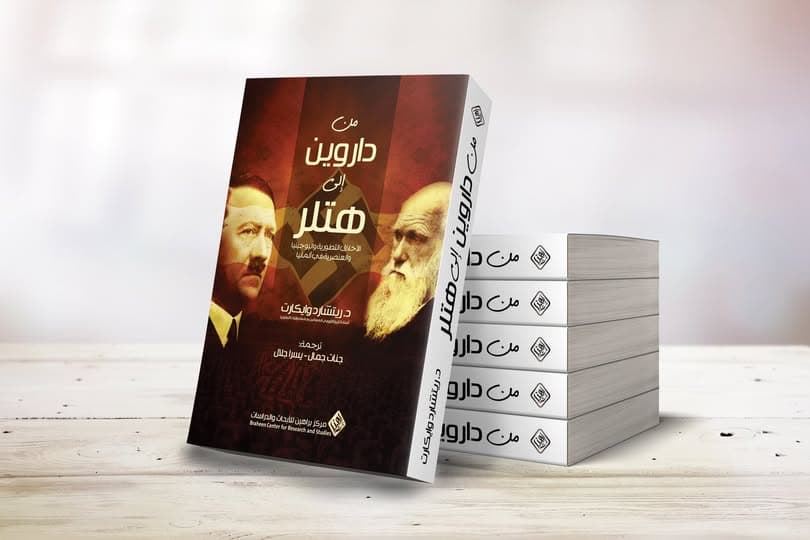
Dr. Richard Wyckart, From Darwin to Hitler: Evolutionary Ethics, Eugenia and Racism in Germany, Center for Evidence 2019, p.110.
—
Source: Published on Facebook's "Braheen Center" page
https://www.facebook.com/braheen.org/posts/pfbid02eXj5iYJ6sDUq9vAp5RUh31qKscfz5fBFyM6rmD9Sse2MmoPdgyFguRnpKvWx43pRl