
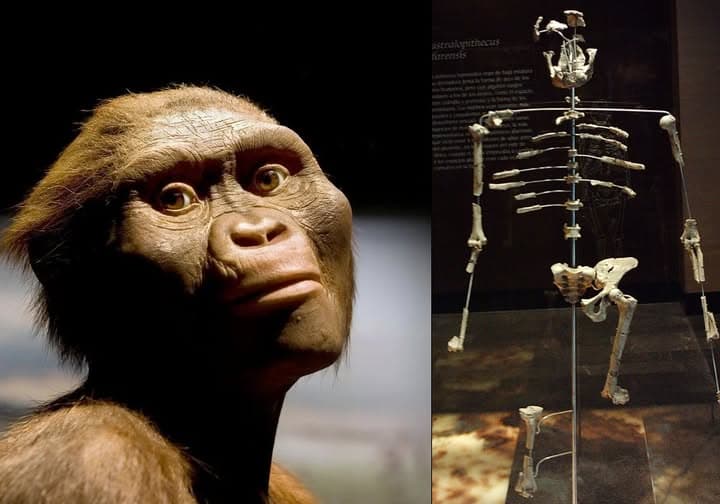
One of the most famous fossils of the southern apes known to date is the Lucy fossil because it is one of the most complete fossils of all hominids, and it seems to be a monkey-like creature walking on two legs and fit to be a ancestor...
Paragraphs from the book (Science and the Origin of Man) about Lucy:
----------
One of the most famous fossils of the southern apes known to date is Lucy because it is one of the most complete fossils of all hominids, and it seems to be a monkey-like creature that walks on two legs and is fit to be a typical ancestor of humans.
The fossil Lucy came to the Pacific Science Center in my hometown of Seattle in 2009, and once I entered the room where the fossil found a thick glass box containing these bones, and I was shocked by the incompleteness of the bones, 40% of the bones are only discovered, and the bulk of the structure is a supportive metal structure. (See Figure 3.4) It was possible to recover only a little useful from Lucy's skull, and yet it is the most important specimen so far.
...
Many researchers have stated that Lucy's pelvis supports the hypothesis that it travels on two legs, but Johansson and his team have stated that the pelvis is severely fractured when detected with fractures and deformities,83 and these problems have led one interpreter to suggest a new reason for the similarity of Lucy's pelvis bones to those of humans (very different from those of other southern apes), which is the error in the reconstruction of the pelvis, which gave the evolution of the human pelvis.
Another paper in the same journal concluded that the lack of clear fossil data about Lucy prevents human paleontologists from making firm conclusions about her movement pattern: "It is impossible to take a general idea of Lucy's position to resolve these differences, and new fossil anatomical evidence is needed, as the currently available data is open to much different speculation."
Leslie Aileau, head of the Department of Anthropology at the University of London, said: "When it comes to mobility, southern apes move like apes, while members of the human race move like humans.
The word “substantial” means the sudden appearance of the human body without evolutionary ancestors in the fossil record.
----------------------------
(83) Donald C. Johanson, C. Owen Lovejoy, William H. Kimbel, Tim D. White, Steven C. Ward, Michael E. Bush, Bruce M. Latimer, and Yves Coppens, “Morphology of the Pliocene Partial Hominid Skeleton (A.L. 288-1). From the Hadar Formation, Ethiopia,” American Journal of Physical Anthropology, 57 (1982): 403–51.
(84) François Marchal, “A New Morphometric Analysis of the Hominid Pelvic Bone,” Journal of Human Evolution, 38 (March, 2000): 347–65.
(85) M. Maurice Abitbol, “Lateral view of Australopithecus afarensis: primitive aspects of bipedal positional behavior in the earliest hominids,” Journal of Human Evolution, 28 (March, 1995): 211–29 (internal citations removed).
(86) Leslie Aiello quoted in Leakey and Lewin, Origins Reconsidered: In Search of What Makes Us Human, 196. See also Bernard Wood and Mark Collard, “The Human Genus,” Science, 284 (April 2, 1999): 65–71.
----------------------------
More about the book:
https://www.braheen.com/publications/العلم-وأصل-الإنسان
—
Source: Published on Facebook's "Braheen Center" page
https://www.facebook.com/braheen.org/posts/pfbid07rhFJJZbAFBrbog4wheu1prMrajzNgjmn1ni1qbi7Zjm6AZN9BkwWAuzfwGy4nXCl