
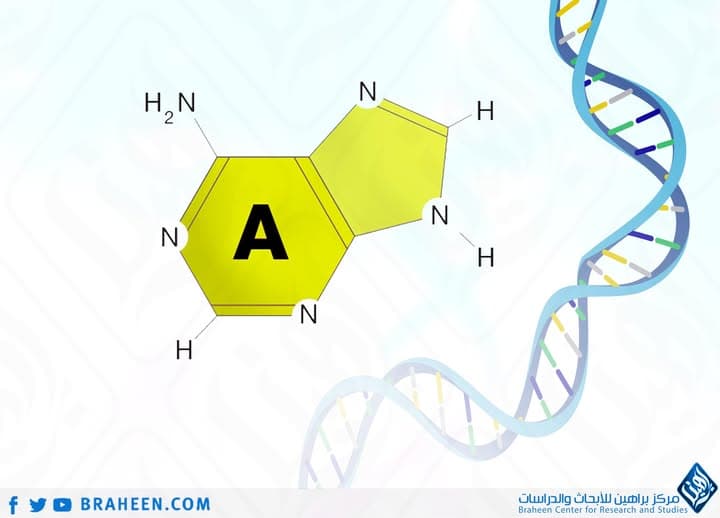
It is one of the four nucleotide bases in nucleic acids, and is commonly associated with thymine (T) in DNA and uracil (U) in RNA. Its chemical formula is C5H5N5 (consisting of 5 carbon atoms and 5 hydrogen atoms...
Adenine (A)
It is one of the four nucleotide bases in nucleic acids, and is commonly associated with thymine (T) in DNA and uracil (U) in RNA.
Its chemical formula C5H5N5 (consisting of 5 carbon atoms, 5 hydrogen atoms and 5 nitrogen atoms), is the main compound in the 6-aminopurines chain of compounds, consisting of purines (a heterogeneous ringed organic compound consisting of two combined pyrimidine and imidazole rings) containing an amino group in C-6. It is derived from purine hydride 9H.
Its molecular mass is 135.13 g/mol, and its density is 1.6 g/cm3, and its melting point is between 360 and 365 C (or 680 - 689 F, or 633 - 638 K).
Adenine acts as a metabolite in humans, mice, Escherichia coli, Daphnia magna, and Saccharomyces cerevisiae, for example, adenine enters riboflavin (vitamin B2) metabolism in humans.
When adenine binds to penta-sugar, it forms adenosine, a nucleoside, and when it binds to deoxyadenosine, it forms a deoxyadenosine, a nucleotide. When three phosphate groups are added to adenosine, it forms adenosine triphosphate (ATP).
The liver is where adenine is made in the human body. Because biological systems like to conserve energy, adenine is usually obtained through food, where the body breaks down nucleic acid chains to obtain individual bases and reassembles them across the mitosis. The manufacture of adenine requires folic acid (vitamin B9).
—
Source: Published on Facebook's "Braheen Center" page