
Neurons contain two types of synapses, the electrolytic synapse and the chemical synapse. Our paragraph today is about the chemical synapse When the action voltage reaches the end of the axon, it depolarizes the membrane and...
Neurons contain two types of synapses, the electrical synapse and the chemical synapse.
Our segment today is about the chemical synapse.
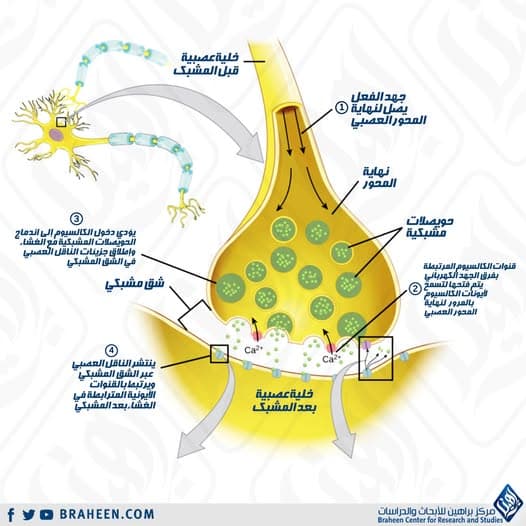
When the action voltage reaches the end of the axon, it depolarizes the membrane and opens the Na-channels associated with the voltage difference. The sodium ions thus enter the cell, then further depolarizes the pre-clamp nerve cell membrane.
This depolarization causes the Ca2 ion channels associated with the voltage difference to open. The calcium ions entering the cell then begin to open a stream of signals that cause small membrane-associated vesicles to fuse with the pre-synaptic membrane. These vesicles are called synaptic vesicles and contain neurotransmitter molecules.
The fusion of the vesicle with the presynaptic membrane leads to the release of a neurotransmitter in the synaptic fissure, which is the extracellular space between the membranes that is presynaptic and postsynaptic, as shown in the figure. The neurotransmitter then spreads through the synaptic fissure and binds to receptor proteins on the postsynaptic membrane.
—
Source: Published on Facebook's "Braheen Center" page