
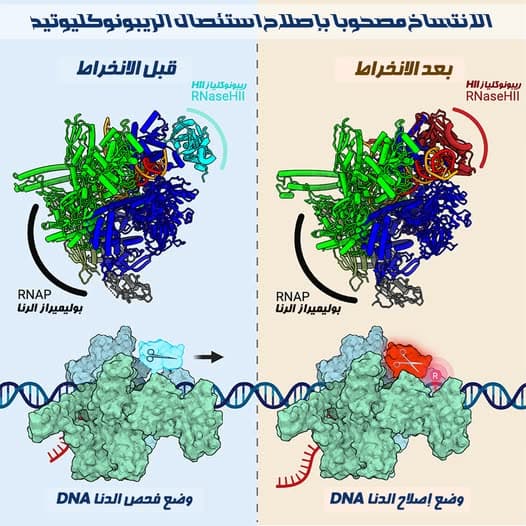
A radically different new picture has recently emerged of how bacterial cells are constantly repairing the wrong parts of DNA. In mid-May, a new study in the journal Cell for a research team from the Grossman School of Medicine at the University of New York...
Recently a radically different new picture has emerged of how bacterial cells constantly repair the wrong parts of DNA. And in mid-May a new study in the journal Cell for a research team from the Grossman School of Medicine at the University of New York, added an important part to this picture.
The research describes the molecular mechanism behind the DNA repair pathway that resists the misincorporation of a particular type of molecular building block, ribonucleotides, within the genetic code. Such errors are repeated in the process of cloning the code in bacteria and other organisms. Given that the wrong interference of ribonucleotides can lead to harmful changes in the DNA code (mutations), all organisms have a DNA repair pathway that fixes ribonucleotide resection.
Last year, a team led by Dr. Evgeny Nodler and Professor Julie Wilson Anderson at the University of New York Langone Health Medical Center published two DNA repair analyses of live E. coli cells. They found that most repair of certain types of DNA damage (large lesions are identified by polyly lysions) – such as those caused by UV radiation – can occur because the DNA is damaged.
Nudler and his colleagues found that during this cloning process, RNA polymerase also finds DNA lesions, and then acts as a platform to assemble a DNA repair machine called a nucleotide deletion repair complex (NER). NER then cuts the faulty DNA found and replaces it with an accurate copy. Without RNA polymerase, few nucleotide deletion repair processes will occur, if any, in living bacteria.
The new study in the journal CELL now provides the first evidence that, as in the NER repair pathway, the RER pathway is closely related to the transcription process. The study's authors found evidence that the main enzyme involved in a process of ribonucleotide resection repair; the ribonuclease HII enzyme, also cooperates with RNA polymerase while scanning for ribonucleotides embedded in living bacterial cell DNA sequences.
Ribonucleotides (RNA components) and nucleotides (DNA components) are closely related compounds. Because cells copy and construct DNA chains in bacterial cells, they often accidentally incorporate ribonucleotides into DNA chains rather than nucleotides, because they differ by increasing only one oxygen atom.
In bacterial cells, DNA polymerase III is known to make about 2,000 of these errors each time it copies the cell's genetic material. To maintain the integrity of the genome, the bulk of the rare ribonucleotides that came in error are removed by the repair pathway of ribonucleotide resection.
As they did in their 2022 studies, the researchers in this study used a quantum mass spectrometer and a synaptic binding of protein-protein in the biosphere to map the distances between chemically bound proteins, thus identifying the main surfaces of RNA polymerase and HII ribonuclease as they interacted in living bacterial cells. In this way they knew that most of the HII ribonuclease molecules were coupled to RNA polymerase.
In addition, they used cryoEM to capture the structure of ribonuclease HII associated with RNA polymerase in high resolution images, to detect protein-protein interactions that determine the repair complex of ribonucleotide resection.
Dr. Zhitai Hao, a postdoctoral researcher at Nodler's lab, says: "This work supports a model in which HII ribonucleases DNA for misplaced ribonucleotides by riding on RNA polymerase as it moves along the DNA strand," and adds, "This work is vital to our fundamental understanding of DNA repair and has far-reaching clinical implications."
Source:
Hao Z, Gowder M, Proshkin S, Bharati BK, Epshtein V, Svetlov V, Shamovsky I, Nudler E. RNA polymerase drives ribonucleotide excision DNA repair in E. coli. Cell. 2023 May 25;186(11):2425-2437.e21. doi: 10.1016/j.cell.2023.04.029. Epub 2023 May 16. PMID: 37196657.
—
Source: Published on Facebook's "Braheen Center" page