
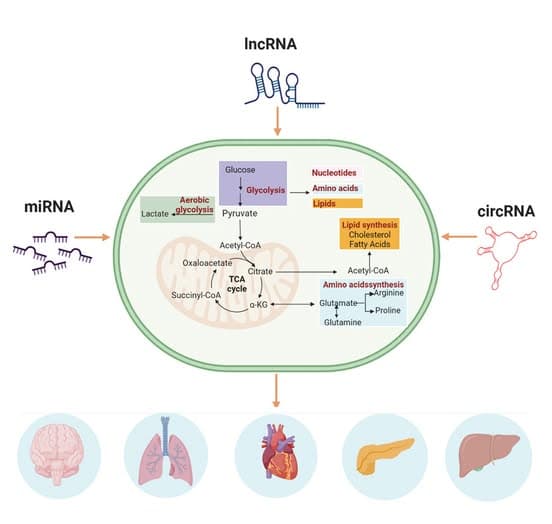
At the beginning of June, a team from the University of Texas in collaboration with a team from Capital Medical University in Beijing published a comprehensive review of ncRNAs and their regulatory roles in cellular metabolism and their relationship to disease in the journal CELL.
At the beginning of June, a team from the University of Texas in collaboration with a team from Capital Medical University in Beijing published a comprehensive review of the ncRNAs and their regulatory roles in cellular metabolism and their relationship to disease, in the journal CELL Molecular Therapy.
Recently there has been an expansion of the study of non-coding RNA elements of ncRNAs, including long non-coding RNAs (lncRNAs), microRNAs (miRNAs), and circular RNAs (CircRNAs), in a variety of fields. Their roles in metabolism have received increasing attention in recent years, but we have not been able to learn to understand them yet.
Regulating the metabolism of glucose, fatty acids and amino acids is a necessary physiological process that occurs in living organisms, as well as being involved in cancer and cardiovascular diseases. In their paper, the researchers summarize the important roles that unencrypted RNA elements play in glucose metabolism, fatty acid metabolism, amino acid metabolism, as well as the mechanisms involved. They also summarize therapeutic developments of non-encrypted ribosomal DNA and certain metabolic diseases.
In general, non-coding RNA elements of ncRNAs are indispensable factors in metabolism and have an important role in the three main metabolites, which can be exploited as therapeutic targets in the future.
Zong Y, Wang X, Cui B, Xiong X, Wu A, Lin C, Zhang Y. Decoding the regulatory roles of non-coding RNAs in cellular metabolism and disease. Mol Ther. 2023 Jun 7;31(6):1562-1576. doi: 10.1016/j.ymthe.2023.04.012. Epub 2023 Apr 27. PMID: 37113055; PMCID: PMC10277898.
—
Source: Published on Facebook's "Braheen Center" page