
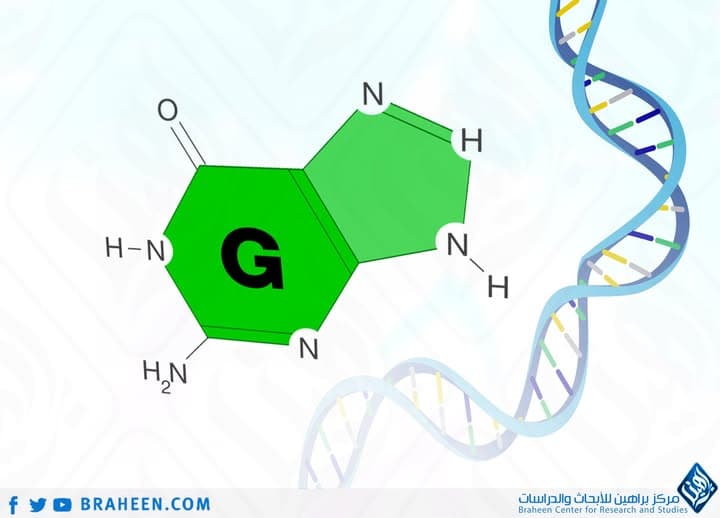
It is one of the four nucleotide bases in DNA, the other three being adenine (A), cytosine (C), and thymine (T), and is commonly associated with cytosine, so we often see pairs of CG; on each of the two DNA strands...
Guanine (G)
It is one of the four nucleotide bases in DNA, the other three being adenine (A), cytosine (C), and thymine (T), and it is commonly associated with cytosine, so we often see pairs of CG; on each strand of DNA.
Within the double-stranded DNA molecule, the guanine is based on a single strand with cytosine bases on the opposite strand. It is the sequence of the four nucleotide bases that encodes the information in the DNA.
Guanine and cytosine CG pairs bind more tightly than adenine and thymine AT pairs, so long stretches of CG make a stronger double band of AT extensions.
Its chemical formula C5H5N5O, and remember that the chemical formula for adenine is C5H5N5, and in general nucleotide bases consist of carbon, hydrogen, nitrogen, and sometimes oxygen.
Guanine consists of two rings that are connected to each other: a pentagonal ring and a hexagonal ring.
The five-atom ring contains two nitrogen atoms and three carbon atoms. One nitrogen atom is connected to two carbon atoms, which are also part of the pentacycle with hydrogen. The other nitrogen atom is connected to two carbon atoms which are also part of the ring, one of which is a double bond. Including the double bond of nitrogen and carbon, there are two double bonds in the ring of five atoms.
The six-atom ring contains two nitrogen atoms and four carbon atoms (two of which are common to the five-atom ring). The nitrogen atoms again contain one atom attached to two carbon atoms in the ring and one hydrogen atom. The other atom is also attached to two carbon atoms, one of which is double bonded.
The structure of the guanine makes it a purine. The purine is an aromatic compound with two rings fused together. The four DNA bases are either purines or pyrimidine. The purine is always paired with pyrimidine in the structure of DNA. For guanine, it mates with pyrimidine cytosine.
—
Source: Published on Facebook's "Braheen Center" page