
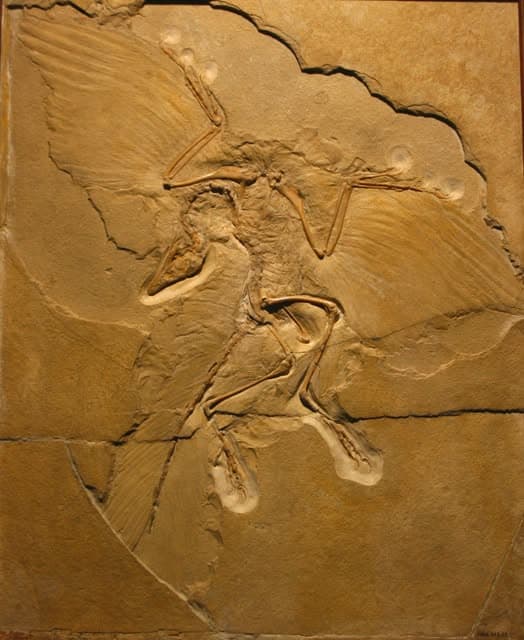
Two years after Darwin first published his book The Origin of Species, a bird fossil was discovered in Germany, with lizard-like teeth and long tails and hooves in its wings. His discoverer called it Archaeopteryx, which means ancient wing.
Two years after Darwin first published The Origin of Species, a bird fossil was discovered in Germany, with lizard-like teeth and long tails and hooves in its wings. Since Archaeopteryx had the characteristics of reptiles as well as birds, some people considered it the missing link between the two groups and confirmation of Darwin's theory. In 1998, anthropologist Pat Shipman wrote that Archaeopteryx was "an icon, a sacred trace of the past, that became a powerful symbol of the evolutionary process itself. It is the first bird."[55]
But there are many, many structural differences between Archaeopteryx and modern birds if the latter are descendants of the former. In 1985, anthropologist Larry Martin wrote that "archaeopteryx is not an ancestor of any group of modern birds." Instead, it is "the oldest known member of a fully extinct group of birds."[56] If animals evolved in a branching pattern like a tree, as Darwin believed, Archaeopteryx was a long branch.
But if Archaeopteryx is not a precursor to modern birds, who was the ancestor? This question ignited the debate among evolutionary biologists. Some (the most famous being Kevin Padian) believed that birds evolved from dinosaurs, while others (the most famous being Alan Feduccia) believed that they evolved from an entirely different group of extinct reptiles. The ancient reptiles first jumped from the trees, then slid, then grew feathers and flew.
Dinosaur bird advocates base their vision on an analysis of the taxonomic model of many of the structural characteristics shared by modern dinosaurs and birds. But, as we have seen, there are no ancestors in branching drawings, so the idea that birds evolved from dinosaurs is only a hypothesis.
When a fossil of a fine-fibre-covered dinosaur was discovered in China in 1996, the fibers were called "protofeathers" and declared to be "feathers."[57] Many such fossils have been found since this time, and scientific consensus has claimed that they are all evidence that birds evolved from dinosaurs. descended from previously flying birds, not feathered dinosaurs.
In 2016, a part of the tail with fossilized real feathers was found in a piece of amber.[61] Although only two vertebrae were visible, the fossil's discoverers felt that it must have been much larger.
In 2009, a bird fossil was discovered in China that clearly predates Archaeopteryx, so Archaeopteryx is not even the oldest bird, and is less than a precursor to modern birds.
Meanwhile, both sides in the dinosaur bird debate must invent ghostly breeds to connect the fossils to each other. Neither side has found the ancestor of modern birds. But one thing is certain; Archaeopteryx is not the ancestor.
However, in the 2014 edition of Raven & Johnson’s Biology, Archaeopteryx is still called the “First Bird” and Bruzzo’s 2013 (Resurvey for Life) called Archaeopteryx “the missing link between reptiles and birds.”
More: https://braheen.com/publications/العلم-الزومبي-أيقونات-التطور-من-جديد
—
Source: Published on Facebook's "Braheen Center" page
https://www.facebook.com/braheen.org/posts/pfbid0qo2F8825oedLAC5CpR68rFEJ4enhLj3tJTUyV9Yxnc3XoQsVnjUAjGZCUwZa1VNjl