
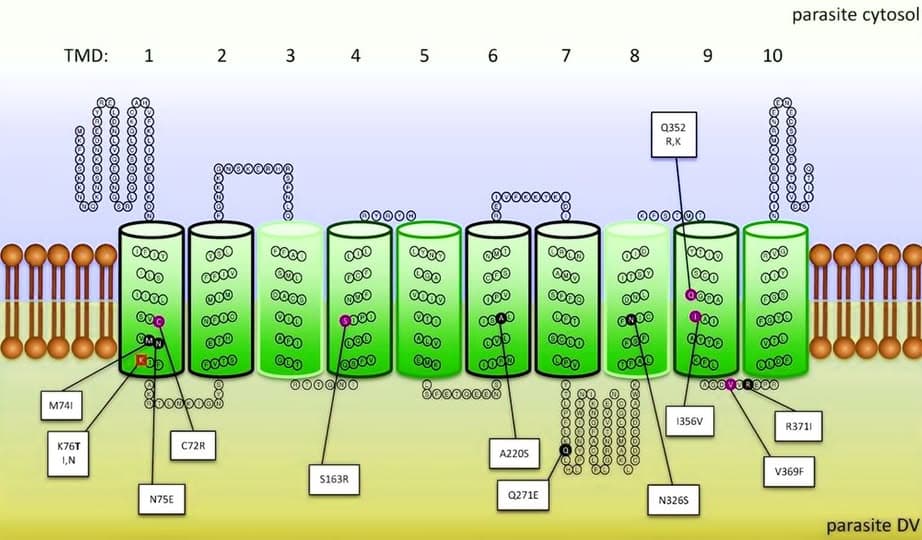
The incredible complexity of modern biology is an obstacle for anyone who wants to understand it, but to find the edge of evolution, we have to dive deep into it, and we are not there yet. The PfCRT protein consists of 424 amino acids.
The incredible complexity of modern biology is an obstacle for anyone who wants to understand it, but to find the edge of evolution, we have to dive deep into it.
The PfCRT protein consists of 424 amino acids. Just as sickle-cell hemoglobin shows a change from normal hemoglobin, the mutated PfCRT protein is different from the sequence of its natural amino acids.
As different hemoglobin mutations can be found in different regions of the world (e.g. HbC in Africa, HbE in Asia, and Tlassemia around the Mediterranean), different mutations in PfCRT have also been found in different regions of the world, where scientists analyzed the sickle cell protein from patients in South America, Asia, and Africa, and the PfCRT mutation showed a range of changes affecting at least four amino acids.
However, the same two amino acid changes are almost always present; one at site 76 and another at site 220. Other mutations in the protein are different from each other. A group of mutations are common in chloroquine-resistant parasites in South America, and a second group of mutations in malaria appear from Asia and Africa. This suggests that resistance to chloroquine in malaria may have originated at least twice, separately in South America and Asia, and that Asian resistance was later transferred there.
Due to two specific amino acid variations occurring in almost all of these cases, both appear to be required for the underlying activity that gives the protein resistance. Other mutations appear to "make up" for the side effects caused by these two underlying mutations.
But sickle cell syndrome greatly outnumbers humans, reproduces more rapidly, and therefore has far more chances than humans of having a lucky genetic event. According to the basic Darwinian theory, the parasite should take the next step in the arms race earlier.
So are the changes to the PfCRT mutation an improvement?
Does the parasite strengthen in the absolute sense, developing new "sophisticated and complex mechanisms" as Richard Dawkins might expect?
It doesn't look like it!
When chloroquine is no longer used to treat malaria patients in an area, the mutated strain of sickle cell disease recedes and the original strain returns, indicating that the mutated strain is weaker than the original in the absence of toxic chloroquine.
Apparently, as in thalassemia, sickle-cell hemoglobin, or G6PD deficiency in humans, the mutant malaria protein is an intermediate benefit only in desperate conditions, i.e. in trench warfare.
- Dr. Michael Behe.
More: https://braheen.com/publications/حافة-التطور-البحث-عن-حدود-الداروينية
—
Source: Published on Facebook's "Braheen Center" page