
This fascinating research is lost amid the unfortunately busy paperwork, please review it by David W. Snook, Jeffrey Cox, Donald Beecher, "The Complexity and Sub-Ideality of Evolution," Complexity Magazine, Part 21(1): 322-327 (September, 2015). David W...
This wonderful research is lost amid the traffic of papers, unfortunately, we ask those interested to review it
David W. Snook, Geoffrey Cox, Donald Beecher, "Complexity and Suboptimism in Evolution," The Journal of Complexity, Part 21(1): 322-327 (September, 2015).
David W. Snoke, Jeffrey Cox, and Donald Petcher, “Suboptimality and Complexity in Evolution,” Complexity, Vol. 21(1): 322-327 (September/October, 2015).
These three physicists begin by noting that, in order to create a new system, evolution must attempt to produce many changes in natural selection to find something useful that it can maintain, but this comes with a fatal cost, since most new changes will not work, leading to the accumulation of "junk".
As the authors put it: “There is an additional cost of energy to increasing complexity... In real systems, building new systems is expensive, and the cost of continuing to contain failed or redundant systems dictates that existing biological systems abandon redundant components.
This problem can be circumvented by providing a reward system for new desirable varieties, which is a contradiction in Darwinian evolution: if the reward is not large enough, nothing new will ever develop. On the other hand, if the reward is large, a lot of new things will be tried, most of which will not yield anything useful and a lot of harmful waste will accumulate in the system. The authors explain:
“There are two competing processes; first, the cost of energy to maintain nonfunctional archaeological systems will expose them to deletion rather than retention and their numbers will be reduced. Second, without the seeds of any new systems that can create new jobs that they don’t currently have, nothing new will be created and complexity will increase.
Evolutionary biologists often attempt to solve this dilemma by claiming that new structures can easily be developed, but with much junk accumulating. The authors note that historically these claims "have led evolutionary theorists to expect that living systems carry an important part of archaeological or nonfunctional elements, as well as semi-archaeological elements that operate with less than optimal efficiency".
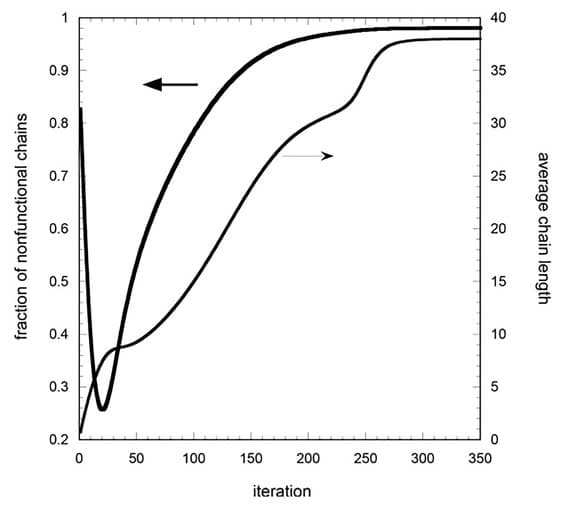
To test these evolutionary expectations, they built a model that offered a reward when developing a new function, but required a price for sophisticated systems that needed the pre-existence of many parts before they could provide a benefit; they found that adjusting the model to reward the development of new features would actually lead to the development of new features.
But there is a cost to being able to develop something new: Before the simulation ended, the test population collapsed due to the accumulation of so much genetic waste – the new features were nothing more than useless burdens – that they quickly fell into disrepair.
That’s why the authors went on to spot another problem: “Nature doesn’t reward complexity automatically, it rewards jobs that improve survival and reproduction” and “There may be many ways to get the same job, some simple and some complex, and all of them will receive the same reward whether the implementation is perfect or not, and only the total energy cost will hinder some of the ways the job appears.”
The researchers’ model attempts to reconcile these facts by considering “(1) the energy cost of increasing the number of elements produced and (2) the multiple ways to useful functions.” There is a ratio between the reward of something new and the cost of trying it:
1) When the ratio is too low, it will be expensive to try new things, and they will be eliminated. No new features will develop.
2) If the ratio is high, new features will develop quite easily. First, a new complexity will be formed, and expensive or highly damaging non-functional qualities will be removed.
But experimenting with so many new varieties means not being able to sift through minor damage. Over time, useless ones accumulate, and these mutations eventually accumulate to the point where the community reaches disaster and collapse, and the waste becomes an unbearable load, leading to the extinction of the organism.
Depending on these simulations, Darwinian evolution either: 1) leads to nothing new, or 2) leads to the production of huge amounts of deadly waste, in the second case the reward is high for trying new things for the cost of building new structures.
New traits multiply, but with them the proportion of nonfunctional traits eventually overwhelms the organism, killing it with their harmful effects. But when trying to avoid the problem (2) by making the reward-cost ratio lower, we reach the case (1) and nothing new will ever develop, and real biological organisms are closer to the situation (1), because there are effective ways to get rid of nonfunctional traits that require cost, and because we do not see biological systems full of excess scrap.
"The breakdown of the suitability of existing living systems seen in this model may prevent rapid elimination of non-functional elements and leave functional elements intact. This mechanism prevents any dormant seeds of any size, and therefore prevents any increase in complexity."
When we talk about the production of viable systems, Darwinian evolution is faced with the dilemma summed up by the saying “damned if you do, cursed if you don’t.” Whatever produced the complex biological functional features we’ve seen, it’s not unguided Darwinian evolution.
—
Source: Published on Facebook's "Braheen Center" page