
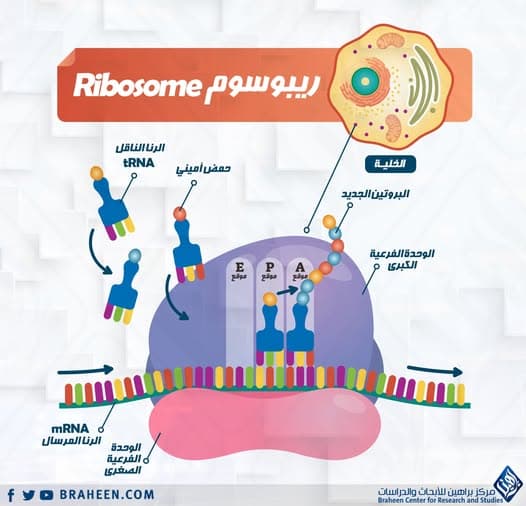
The ribosome consists of three RNA molecules and a set of proteins, and each ribosome consists of two subunits, known as a small subunit and a large subunit. The large subunit is located at the top and the...
The ribosome is the molecular machinery responsible for protein synthesis.
The ribosome consists of three RNA molecules and a set of proteins, and each ribosome consists of two subunits, known as a small subunit and a large subunit.
The large subunit is located at the top and the small subunit at the bottom, and RNA RNA is trapped between the two.
In eukaryotes, ribosomes receive orders to synthesize protein from the nucleus, where parts of DNA (genes) are copied to form mRNA.
The mRNA is transferred to the ribosome, the tRNA transporter comes with the corresponding amino acids, and by aggregating the amino acids the protein is formed.
This process is called translation. Since prokaryotes do not have nuclei, the mRNA molecules are copied into the cell cytoplasm, and can then be translated by ribosomes.
Since protein synthesis is a central function in all cells, ribosomes are found in practically every cell type of multicellular organism, as well as in prokaryotes such as bacteria. However, eukaryotic cells that specialize in producing proteins have large numbers of ribosomes. For example, the pancreas, since it is responsible for producing and secreting large amounts of digestive enzymes, the pancreatic cells that make these enzymes contain an unusually large number of ribosomes.
—
Source: Published on Facebook's "Braheen Center" page