
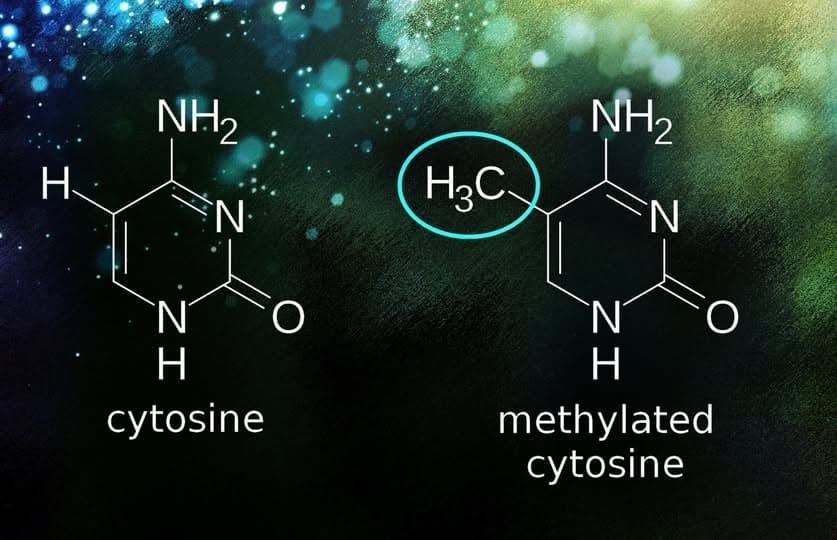
DNA methylation is one of the most active epigenetics research areas at the moment... In epigenetics, scientists are trying to study the non-genetic factors that control the genes themselves and the ways in which they turn into...
DNA methylation is one of the most intense areas of epigenetics research today.
In the field of epigenetics, scientists try to study the non-genetic factors that control the genes themselves and the ways in which they are converted to proteins, the ways in which proteins are arranged in protein systems, the order of protein systems in cell patterns, and the order of cell patterns in tissues and then in different organs with their different functions.
What happens in the methylation is the addition of methyl groups to parts of DNA, causing a difference in their shape and structure! Without changing their nucleotide sequence; this then modifies gene interactions with molecular mechanisms that contribute to transcription in the cell nucleus.
For those without a biological background, the gene is made up of a group of codons, the codon is three nucleotides, and the nucleotide is the basic unit for building DNA, a molecule with an overlapping chemical structure, and has four types in DNA; Adenine A, Cytosine C, Joanine G, and Thymine T.
Until recently, it was thought that mammalian DNA methylation was confined to the sites of cytosine nucleotides adjacent to CpGs, leading researchers to confine themselves to analyzing CpG sites; sometimes even to subdomains.
Between 2012 and 2014, research teams came up with findings that cytosines can be replicated in mammalian cells, whether followed by adnin A, cytosine C, or thymine T, and that the methylation of these sites other than CpG sites is associated with gene discontinuation.
This is particularly important for neuroscience, as neurons account for the largest share of non-CpG processes in all known mammalian cells so far, we are talking about about 50% of almost all DNA methylation processes in adult human neurons, and about 25% in adult mouse neurons.
The bottom line, then, is that scientific research is moving rapidly towards knowledge of the factors that control genes, which are really above genes, and the affected person, who is still living in the era of gene dominance (most notably Dawkins) to raise his complaint to the judiciary!
Aisha Mohammed
—
Source: Published on Facebook's "Braheen Center" page
https://www.facebook.com/braheen.org/posts/pfbid0249spRCTdnWNsxRSEfn5gPPBghz1p9FP3nt4uRr9tg7hVBE7DFTvtg6XqMD4cb5i6l