
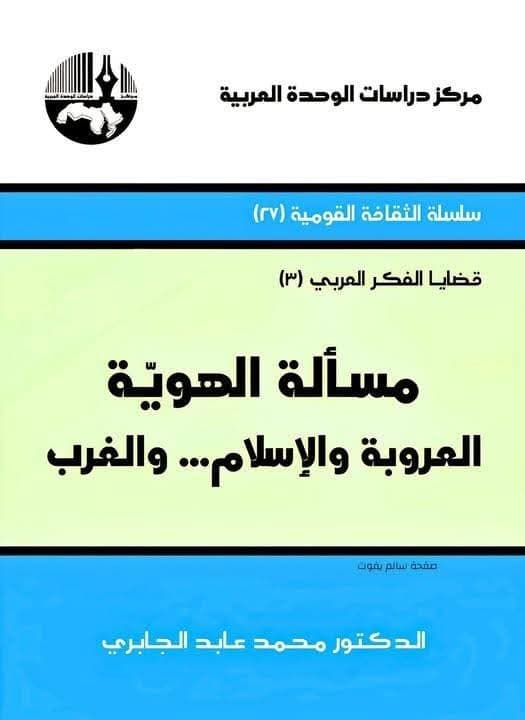
At a time when transformations are accelerating, when minds and identities are being reshaped through mass media, education and culture, the question of identity is emerging as a crucial issue, not merely an elitist cultural debate. Identity is not only a question of reflection, but a battleground...
Arabism, Islam, and the West: Can Identity Be Rebuilt Outside the Reference of Revelation?
At a time when transformations are accelerating, when minds and identities are being reshaped through mass media, education and culture, the question of identity is emerging as a crucial issue, not just as an elitist cultural debate. Identity is not only a question of reflection, but a battleground between those who want the nation to resume its renaissance on its own, and those who want it to be reshaped in the Western system.
In this context, the Moroccan thinker Mohammed Abed al-Jabri wrote his book, “The Question of Identity: Arabism, Islam... and the West,” within a series of “ideological issues,” in an attempt to establish a modern understanding of Arab identity in the light of contemporary transformations.
But the fundamental question is: can Arab identity be reconstructed from outside the Islamic reference?
Arabism and Islam: The Controversy of Complementarity or the Removal of Reference?
Al Jabri provided a reading that is considered:
* That Arabism is a national cultural belonging,
Islam is an all-embracing spiritual reference,
Try to combine them without subjecting one to the other.
Although this proposition seems balanced on the face of it, it carries a fundamental problem: Islam is not only a cultural or spiritual dimension, but a normative origin, and a higher frame of reference.
When Islam is made a follower of the national project or a moral reference rather than a legislative one, we have replaced the authority of revelation with the method of positivist rationality. This is where Jabri falls, when he makes the "Arab self" the center, and reinterprets religion within this framework, not vice versa.
Identity and the West: Absence of Quranic Sunnism
In his analysis of the relationship with the West, al-Jabri criticizes Western media prejudice against Islam and the Arabs, attributing it to colonial ideological backgrounds. But he offers a soft solution of “speech rationality” and “self-criticism,” as if the current battle is just a cultural misunderstanding.
The Qur’anic dimension is absent, which admits that the conflict between truth and falsehood is a year leading up to the Day of Judgment, and that the confrontation is not only by argument and reason, but also by insight, wisdom, and readiness: “Prepare for them what you can of strength.”
Reducing the conflict to a cultural dimension removes the divine years from its meaning, and turns the confrontation into an elitist controversy rather than a full-fledged civilizational battle.
Self-criticism or de-referencing?
One of al-Jabri's most important points was his call for Arab self-criticism and the dismantling of its historical mental structure. But in this criticism he relied on the tools of Western methods (structuralism, archeology, historicalism), without subjecting them to the balance of Sharia or the purposes of Islam.
The result was that Islam was introduced into the space of national interpretation, and the revelation was treated as heritage material and not as a transcendent reference. This leads – unconsciously – to the secularization of identity and its transformation into a non-religious cultural project, remodeled according to the times, not according to the revelation.
---
In the Balance: Between Problem Consciousness and the Danger of the Path
Al-Jabri's questions raised the relationship between inheritance and reality, and between originality and contemporary, by removing holiness from reference, and subjecting Islam to a secular national balance.
What has united the nation over the centuries is not race, nor language, but Islam as a religion and a way of life, and every renaissance project that attempts to separate Arabism from Islam, or to interpret religion within the borders of nationalism, is destroying identity and it believes that it is rebuilding it.
Conclusion
Identity is not a cultural slogan, nor a modern project that separates the tools of the West, but it is an issue of inspiration and existence, and from the ram of building it without the authority of Islam, he demolished it with his own hands, although he thinks that he is building an edifice of thought.
If they believe in the like of what you believe in, then they are rightly guided; and if they turn away, they are only in dissension: but Allah will suffice for them; and He is the Hearer, the Knower.
We live a period when Islam is subjected to a fierce attack at all levels, and it remains my role and your role within this conflict to show the truth in black and white and without colors, and you may have touched this in my orientation in general, because many of those who left their ominous imprint in our Islamic society, used several aspects to undermine Islam through its tools, and if you enter the link that presents the article, you find one of them says: Fifty years after Al-Jabri presented his vision as the basis of identity based on Islam.
1. The failure of the national project: to achieve unity or face external challenges, and the disintegration of the Arab world into conflicting entities.
2. The rise of political Islam: As a competing reference (and indeed prevalent in some societies) within a national framework, which reflected the problem of separation between religious and national that his approach did not solve.
3. The continuation of Western hegemony: culturally and politically without achieving the desired parity, but with the deepening of the civilizational conflict despite attempts to rationalize the discourse.
Thus, the combined ijtihad solution between originality and modernity – outside the sacred or imported dichotomies – remained inoperative.
One of them responded with the following:Ismail Aldawebe You have done well in diagnosing the manifestations of the faltering vision presented by Mohammed Abed Al-Jabri on the issue of identity, by saying:
Fifty years after Jabri put forward his vision of identity based on the integration of Arabism and Islam as the basis for an Arab renaissance project, reality today shows that this vision is stalled because of:
1. The failure of the national project: to achieve unity or face external challenges, and the disintegration of the Arab world into conflicting entities.
2. The rise of political Islam: As a competing reference (and indeed prevalent in some societies) within a national framework, which reflected the problem of separation between religious and national that his approach did not solve.
3. The continuation of Western hegemony: culturally and politically without achieving the desired parity, but with the deepening of the civilizational conflict despite attempts to rationalize the discourse.
Thus, the combined ijtihad solution between originality and modernity – outside the sacred or imported dichotomies – remained inoperative.
Through monitoring the failure of the national project, the rise of political Islam as an alternative reference, and the continuation of Western hegemony culturally and politically despite attempts to rationalize the discourse.
I do, however, reserve your last words:
"The jurisprudential solution between originality and modernity - outside the sacred or imported dichotomies - remained inoperative."
Because, despite its noble purpose, it suggests that the Islamic reference (revelation) is just a party to an intellectual dualism that should be transcended, and imported concepts should be transcended.
This is, in my estimation, a confusion between “transcendental reference” and “positivist ideological choices.” Revelation is not an intellectual dualism that we choose or devolve according to the requirements of the times, but rather a ruling balance that is used to establish all diligence, whether in originality or in modernity.
The ijtihad solution was not disrupted because it remained locked up "binaries", but because it was stripped of its legitimate reference, and Islam was treated as a cultural or heritage field, not as a Rabbinic guidance system.
Any attempt to reconstruct the identity away from this normative origin falls - from the point of view of not feeling - in the project of the secularization of identity, even if it raises the slogan of diligence or rooting or reconciling the heritage and reality.
The real way out lies in an effort based on revelation, and aware of the laws of God in the human meeting, an effort to do the purposes of Islam in the light of developments, not to subject the revelation to external interpretations, and then ask it to adapt to reality, even if it is contradictory to it in essence.
If they believe in the like of what you believe in, then they are rightly guided; and if they turn away, they are in dissension; then Allah, the All-Hearing, the All-Knowing, will suffice them.
[The Cow: 137]
Finally, I emphasize my methodology in dealing with black and white people like these because they are misleading.
Dr. Mohamed Bourbab
President of the Scientific Miracles Commission in the Kingdom of Morocco
Member of the International Association of Miracle Scientists
General editorial supervisor of Ijaz International Journal for Scientific Research and Reflection
President of the International Conference on Miracles in Tetouan, Kingdom of Morocco
—
Source: Posted on Dr. Mohammed Bourbab's Facebook page on 2025-07-31
https://www.facebook.com/bourbab.m/posts/pfbid05ARQ2p8cFpZouWkvKoaCCaEEajK7w1Dqqino7rGKJpA3YNEegT37TC15CsULz4XTl