
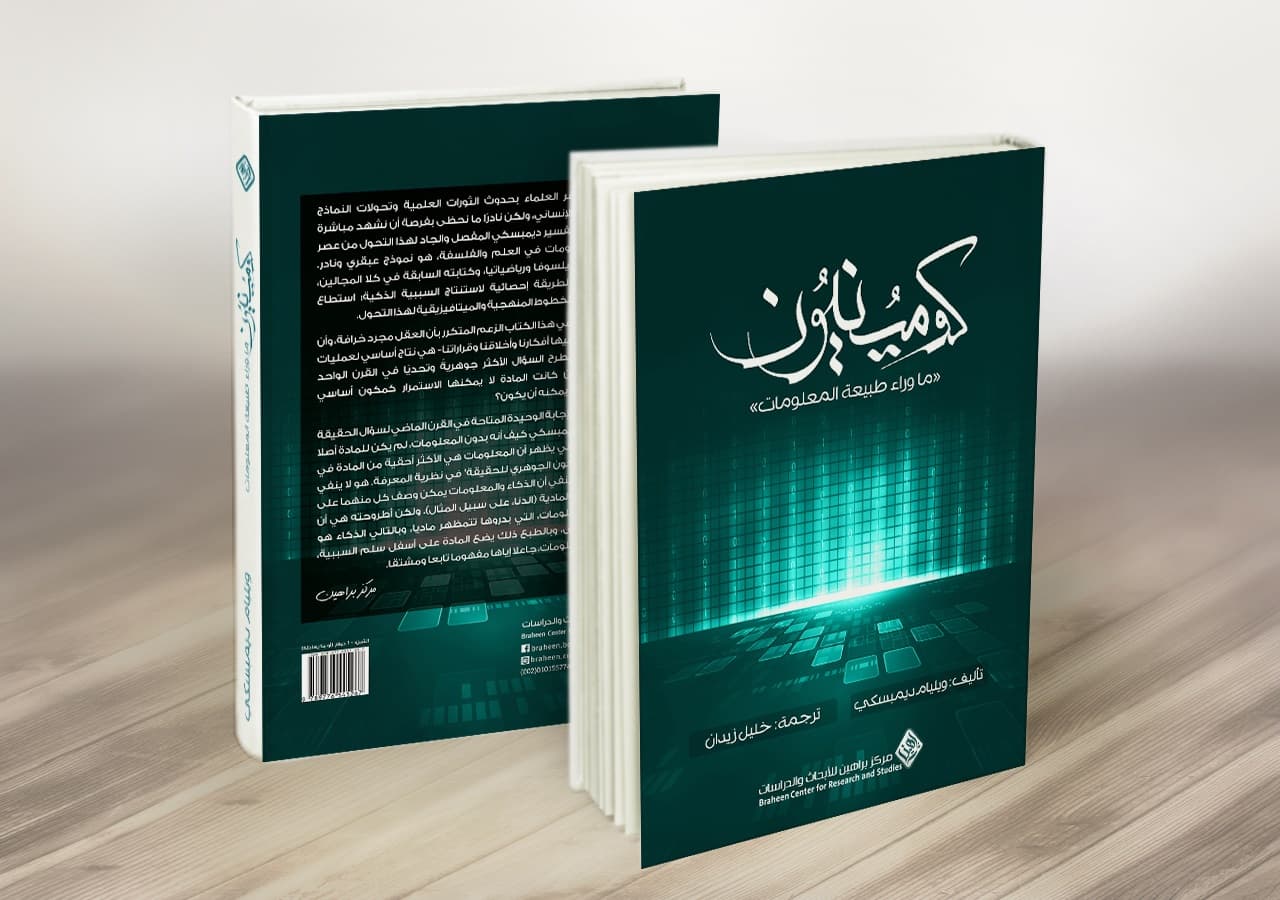
Why this book? In this book, William Dembski starts from the fact that materialism is embedded in Western secular culture, and strongly demonstrates that matter is not the essential component of reality, but information. The denial of the first sentence does not necessarily imply...
Communion: Beyond the Nature of Information - Publisher Introduction
Why this book?!
In this book, William Dembski starts from the fact that materialism is embedded in Western secular culture, and strongly demonstrates that matter is not the essential ingredient of reality, but information. Denying the first sentence does not necessarily involve proving the second, Dembski did not attempt to mobilize responses to materialism, nor to support an old alternative, idealism, but to focus attention on presenting information as an alternative.
However, Dembski did not refrain from pointing out the most important criticisms of materialism, highlighting the possibility of the most important contradictions, and also exposing systematic materialism as a research organizing principle. For example, he mentioned the most important criticisms of materialism; its logical incoherence.
As for the demonstrative part, or alternative to materialism, Dembeski went on as follows – regardless of the order of the chapters –: Dembeski considers the essence of nature to be informational, nature – including humans[1] – achieves some facts without others by excluding other possibilities and realisations, i.e. starting with more and then reaching fewer, Dembeski argues vertically whether or not nature is capable of creating all the information we find in it.
This teleological conception of nature is only compatible with the fact that nature is informational, i.e., moves by means of the clarification of probabilities towards certain goals.[2] How can nature bypass the normal laws that blindly search for information to become teleological? Or, in other words: can matter provide us with this information? Is matter itself a form of information? Here Dembski relates probabilities to epistemology and philosophy of science, in which he will reconsider the problem of induction in a probability. This brings us to the position of science on the existence of God, and to the extent that Dembski's proposition is particularly relevant to Christianity.
Science does not prove or deny the existence of God; this is the position of Dembski and the design movement and our position as well. Rather, it is the one that should never be jumped at. Experimental science should remain locked into experience, and does not turn into a cognitive platform that gives a perception of everything and proves or negates theses completely out of its circle, such as the existence of God. This is what Dembski and other intelligent design theorists say.
This book in particular, and Dembski's project in design and information in general, is one of the best theses that establish a cognitive perception compatible with science and religion. Although Dembski is a Christian, his production in this project, depends on the establishment of the concept of the Creator God; which is common to most religions. However, he does not refrain from trying to link his inferences from the Creator to his Christian conception of the Creator, but he himself believes that this will not be the case easily. In Judaism and Islam, the Creator is the one God, but in Christianity it takes much more than just the philosophical proof of creation and the Creator. To prove that the Creator is one triune God, you need to overcome the dilemma that there is already a so-called Trinity! This will not stand up at all, or in the words of some theologians "an unfathomable mystery", and there is no way to accept it except through faith and belief.[3]
We hope that this book will raise the level of exposure to issues related to science and religion in our Arab world, and push thinkers and researchers towards more serious presentation and treatment. We also hope that this book will change the map dealing with metaphysics and material mythology.
Braheen Center Management
[1] Here Dembski traces the philosophical separation between matter and information since Aristotle, and shows his ambiguity and how the materialists used it to their advantage, a debate reminiscent of the debate that took place between the two conflicts, so the philosophers of Abu Hamid al-Ghazali presented a certain perception of the rational actor and described his effectiveness linguistically, while Ibn Rushd responded with an Aristotelian perception contrary to the nature of the perception of the actor in al-Ghazali.
[2] Dembski therefore introduced some chapters on information theory and probability in advance of what he says should not be concerned with the difficulty of one or two chapters of the book, but rather that they can be easily transcended.
[3] A.W. Tozer, The Knowledge of the Holy, p17; Merrill F. Unger, The New Ungers Bible Dictionary, 2006, TRINITY.
- Management of the Brahin Center
—
Source: Brahin Center website - Posted on 2017-01-20 (archived at the Internet Archive)
https://braheen.com/publications/intros/كومينيون-ما-وراء-طبيعة-المعلومات-مقدمة-الناشر