
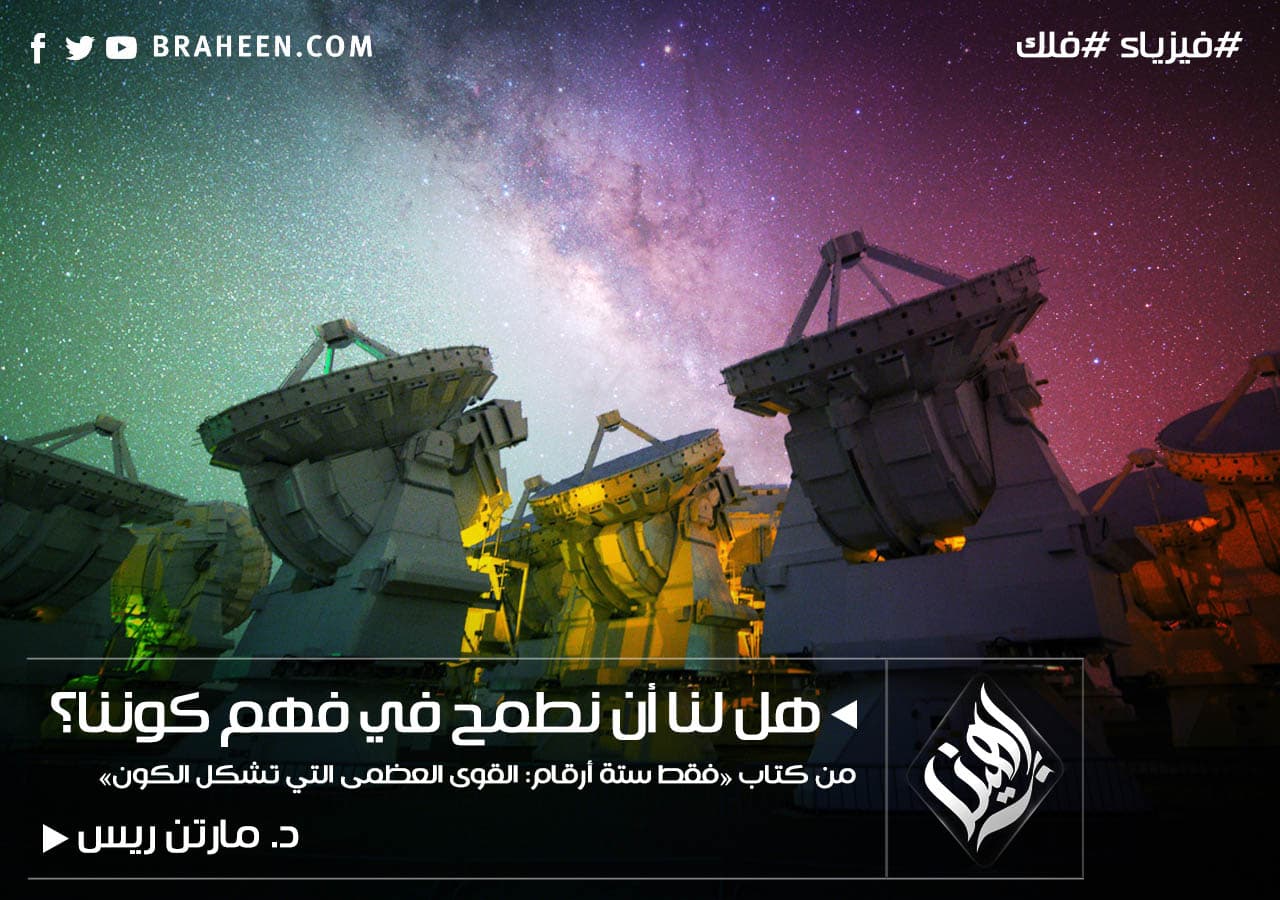
The physicist Max Planck saw that theories are abandoned only after all their supporters die, and that science is advancing in the way of successive funerals, but this is a view full of bitter irony.
Can we hope to understand our universe?
Physicist Max Planck argued that theories are abandoned only after all their proponents have died, and that science is advancing in the way of successive funerals, but this is a view full of bitter irony; many controversial cosmological issues have been settled, and some older ones are no longer controversial. Many of us have changed our minds, including myself. Now, there are no more fragile cosmological ideas than our theories about the history of our planet. Geologists point out that continents are crawling on the surface of the Earth as fast as your nails are growing, and that Europe and North America have been fused for 200 million years, and we believe them, even though such long periods of time are hard to put into perspective. We also believe the story of the evolution of our biosphere – at least in its outlines – that of humans. The concrete evidence to support a large explosion 10 to 15 billion years ago is as strong as the evidence put forward by geologists about the history of the Earth, and this is an amazing shift, our ancestors were spinning theories without any interest in facts, and until very recently the science of the universe has shown nothing but speculative mathematics.
A few years ago, I was ninety percent sure that there was a big explosion, and that everything in our universe began as a ball of fire, much hotter than the center of the sun. Now, the evidence is much stronger, and the incredible advances in observations and experiments have highlighted the vast cosmic picture during the 1990s, and I am now raising my certainty to ninety-nine percent.
“The most incomprehensible thing about the universe is that it can be understood,” this is one of Einstein’s most famous reigns, which expresses his astonishment that the laws of physics – which somehow have adjusted our minds to understand them – apply not only to Earth, but also to the farthest galaxy.
Newton taught us that it is the same force that causes apples to fall that holds the moon and planets in their tracks, and now we know that the same force governs the bond of galaxies, attracts some stars to black holes, and may eventually lead to the collapse of the Andromeda galaxy on our heads. The atoms in the most distant galaxies correspond exactly to the atoms we can study in our laboratories, and all parts of the universe seem to develop in a similar way, as if not for anything.
Some recent developments shed new light on the origin of our universe and the laws that govern it, and even its ultimate fate, which is assigned to the first small fraction of the first second after the Big Bang, where the circumstances at the moment of its occurrence were so extreme that we could not understand the physics related to it, through which we wonder about the nature of time and the number of dimensions and the origin of matter. At that first moment everything was so compact, that the problems of the universe and the small world overlap.
Space can't be extended indefinitely, yes, the details are still a mystery, but most physicists think there's some sort of graininess on a scale of 10 to 33 centimeters, which is 2210 times smaller than an atomic nucleus, which is a big drop in scale by moving from an atomic nucleus to a major city - in terms of the number of years we've pictured in the example of a zoom lens - to hit a hurdle.
There is simply no direct evidence, but no theoretical boundary as to how far our universe is in relation to space and future time, and as to what might appear to be a multiverse view, perhaps the universe extends not just millions of times beyond the space currently seen, but millions of exponents of the number ten beyond the space seen. That's not all, our universe that spans vast distances beyond the horizon we currently see, may already be one of a potentially infinite number of universes.
- Dr. Martin Rees.
—
Source: Brahin Center website - Published 2018-05-04 (archived at the Internet Archive)
https://braheen.com/articles/physics-cosmology/هل-لنا-أن-نطمح-في-فهم-كوننا