
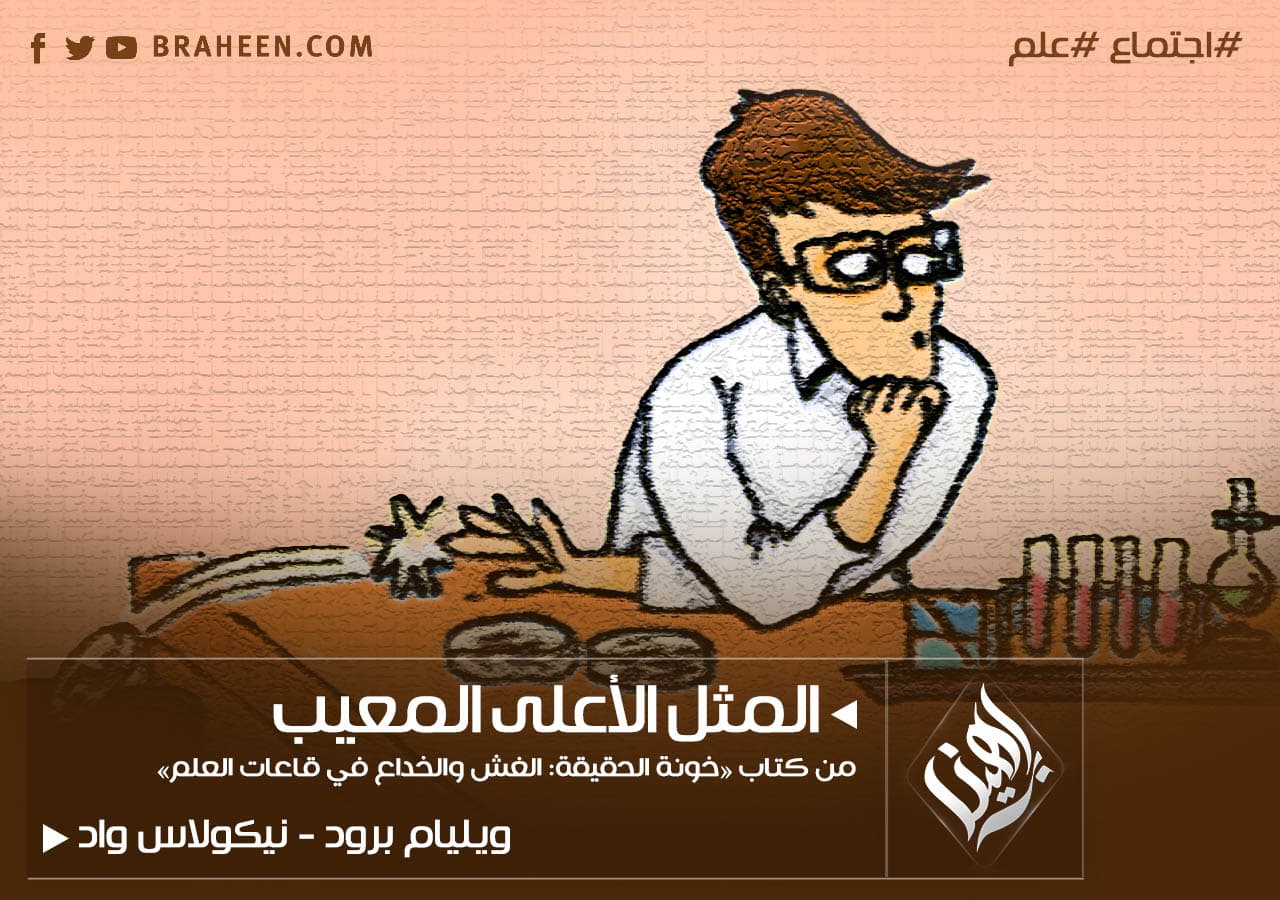
*Note: This article is from the book Traitors of Truth: Cheating and Deception in the Halls of Science. The young Tennessee congressman struck with his hammer to silence the audience in the lavish listening room, saying: “I can’t avoid...
Defective Ideal
* Note: This article is from the book (Traitors of Truth: Cheating and Deception in the Halls of Science) for more please check out the book.
The young Tennessee congressman struck with his hammer to silence the audience in the lavish auditorium, saying, "I cannot avoid the conclusion that one of the reasons this kind of problem persists is the reluctance of people in the field of science to take things seriously."
As a member of the House Committee on Science and Technology, Gore was alarmed by the acceleration of a series of incidents that had recently come to light. As chairman of the subcommittee on investigations, Gore Jr. was determined to do something about the problem.
The first was Philip Handler, then president of the National Academy of Sciences, and a prominent spokesman for the scientific community. Rather than open up to the professional tradition of being asked to appear before the committee, Handler immediately declared that he felt “a little pleasure and satisfaction to testify about scientific cheating.” He added that the press had dealt with the problem “in a big way.”
Two of the most spectacular recent cases of fraud have occurred in elite institutions, Harvard and Yale, and cannot be waved away as exaggeration by the press. On a more personal level, the members of Congress themselves have been forced into self-censorship if Abscam’s recent bribery case is to benefit, as six members of Congress have been found wanting.
Members of Congress also recognized another fact about scientific fraud, which scientists seem to have been unable to understand: “No matter how small the testimonies may be, it only takes one case to surface every few months or so for the public credibility of science to be severely damaged.” As witnesses one by one relayed Handler’s words that the existing scientific mechanisms were adapting to the problem, Congressmen were increasingly upset. "The scientific community is that we know, so we ask questions, and if we don't ask questions, no one else will."
Clearly, there was a fundamental disconnect in the vision at the end of the impasse: both sides viewed the same situation in completely different ways. Members of Congress saw a group of professional colleagues who apparently preferred to banish an existing problem rather than confront it. Trusting existing self-correcting mechanisms that have made fraud a pointless risk, scientists have been unable to acknowledge that it is a problem that may transcend mental dysfunction in a small number of individuals.
However, the rational testimony of Harvard medical researcher John Long, who admitted to fabricating an experiment, undermined their position that day. (2) Long was remorseful, but also not polite, and clearly more self-controlled than the committee. President Albert Gore noted that “in one short hour, the Subcommittee went from the Olympic highlands with no problem to the depths of potential false testimony.” He added that “this kind of experiment can produce scientific schizophrenics.” Gore’s point seems to be that if mental disorder has anything to do with it, it lies in what he called the scientific community’s “double stand” on fraud.
Barely a few weeks after Congressman Gore’s hearings, another major case of scientific fraud began to unravel, this time at the heart of the American Biomedicine Foundation, Harvard Medical School.3 The most recent case appears to have been designed to embody the psychopathia observed by Congressman Gore.
The foundation of the Harvard case is that Eugene Braunwald, one of the nation’s leading independent cardiologists and chief physician at two of Harvard’s most prestigious hospitals, had only the highest hopes for his brilliant young student John Donald Darsee. Darsey, tall and social, worked relentlessly at the forefront of research in the field of vascularity. An upgrade of this kind in Boston's competitive world of biomedical research at Darcy's early age would ensure an impressive career.
Although Darcy worked hard, they could not understand how he had accomplished all the research that had underpinned the startling number of his medical articles. By secretly observing him one night in May 1981, they saw him glaringly crafting the raw data for an experiment that was soon to be published. Darcy admitted when confronted, but insisted that these were the only data he falsified. His colleagues, however, were less inclined to agree. One of Darcy’s colleagues later observed that “this thing didn’t come overnight, you’ve suspected it for months.” They told Brownwald that they believed Darcy was systematically falsifying his work.
Brownwald could not believe, however, that the disturbing event was anything more than an isolated incident. He later remarked: “At that moment we had an intelligent person. He was clearly one of the most distinguished people, or the most distinguished person, of the 130 research fellows I had the privilege of working with. Darcy was stripped of his Harvard appointment, but he was allowed to work in the lab. Other researchers were not told of the fake experiment, and no steps were taken to inform scientists who might rely on Darcy’s many published findings that there was a question mark around the entire structure.
The behavior of Harvard officials during the first five months of the case seems to be based on the argument made by Handler at the Congressional hearing. Scientific fraud rarely happens, and when it does, “it falls into a system that operates in a way that is efficient, democratic, and self-correcting,” making its discovery inevitable.
Among the experiments that Darcy was working on was a $724,154 project funded by the National Institutes of Health. Things went on as before for five months. But in October 1981, authorities at Harvard were told by an official at the National Institutes of Health that there were problems with Darcy’s data.
A high-level committee appointed by the dean of Harvard Medical School three months later confirmed that the NIH study contained “extraordinary and highly questionable results.” Moreover, a study Darcy conducted with another researcher appears to have been “manipulated.” The high-level panel of senior medical officials did not see much of a flaw in the way their Harvard colleagues handled the case, despite criticism from a senior National Institutes of Health official on national television over delays in reporting the forgery. (4) As this book continues to emphasize, one year after Darcy was arrested in flagrante delicto, the extent of fraud in his published works has not been assessed or publicized by the authorities at Harvard Medical School. What is the concept of a science in which scientists, like those who testified before the Jor Commission, place so much trust, that they sometimes choose to trust it even if the evidence is starkly different? It can be accurately described as an ideology, and scientists from all over the world won’t be too involved because it doesn’t, in fact, contain much of what is true about science.
1. Fraud in Biomedical Research. Hearings before the Subcommittee on Investigations and Oversight of the Committee on Science and Technology, U.S. House of Representatives, Ninety-Seventh Congress, March 31—April 1, 1981 (U.S. Government Printing Office, No. 77-661, Washington, 1981), pp. 1-380.
2. Nicholas Wade, "A Diversion of the Quest for Truth," Science, 211, 1022-1025, 1981.
3. William J. Broad, "Harvard Delays in Reporting Fraud," Science, 215, 478-482, 1982.
4. William J. Broad, "Report Absolves Harvard in Case of Fakery," Science, 215, 874-876, 1982. Also see "A Case of Fraud at Harvard," Newsweek, February 8, 1982, p. 89.
William Broad - Neoclass Wade
—
Source: Brahin Center website - Published 2018-05-18 (archived at the Internet Archive)
https://braheen.com/articles/science-scientism/المثل-الأعلى-المعيب