
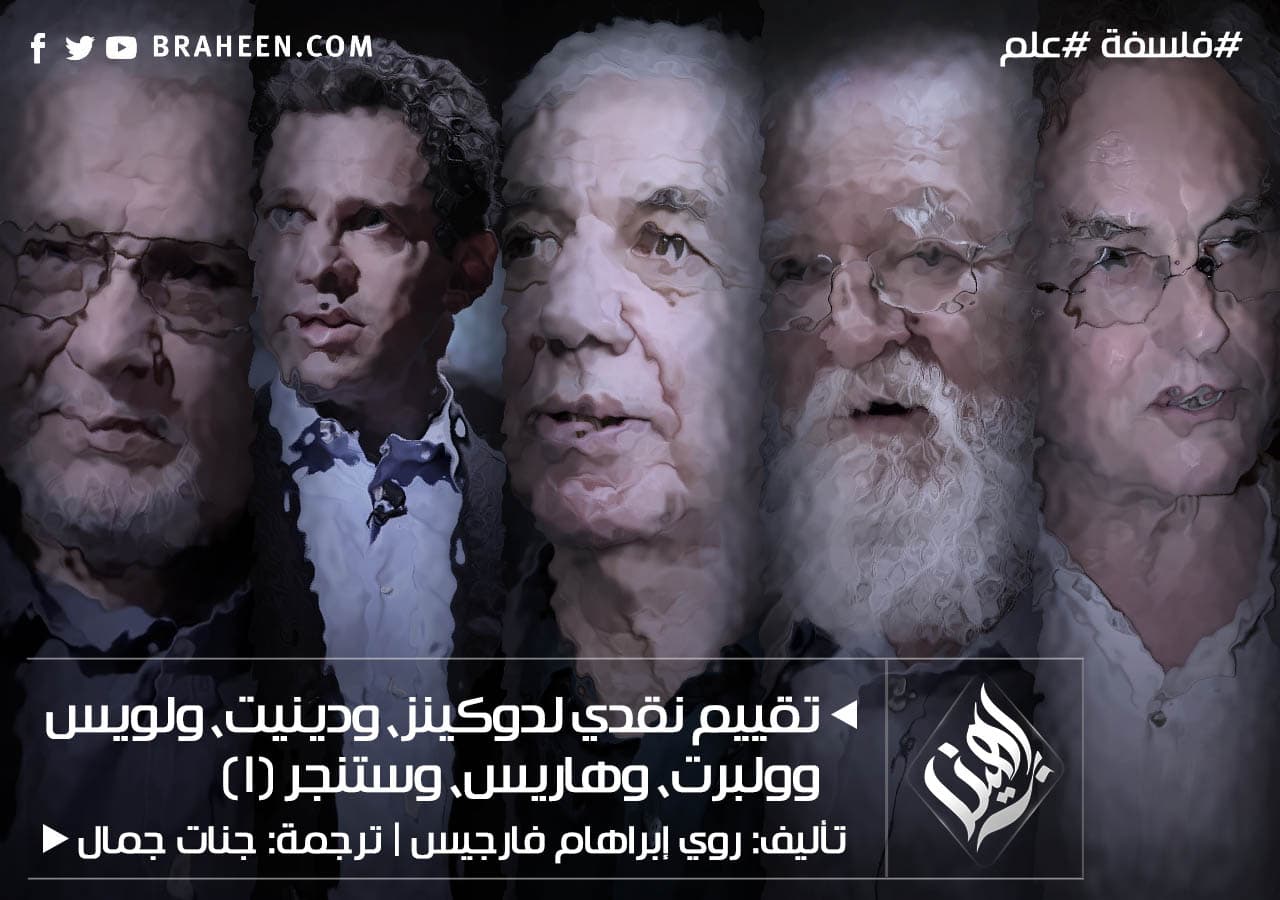
This series is from the first supplement of the book (There is a God: How the World's Most Powerful Atheist Changed His Thoughts?) For more see the book. The basis of "New Atheism" is the belief that there is no God; that there is no absolute eternal source for all...
Critical assessment of Dawkins, Dennett, Lewis, Wolbert, Harris, and Westinger (1)
This series is from the first supplement of the book (There is a God: How the World's Most Powerful Atheist Changed His Thoughts?) For more see the book.
That is the fundamental belief on which most arguments and other proofs must be based. Here, I register my objection, because “new atheists” – such as Richard Dawkins, Daniel Dennett, Louis Wolbert, Sam Harris, and Victor Stinger – have not only failed to form strong arguments for that belief, but have ignored phenomena closely related to the question of God’s existence.
What I see is that the five phenomena that manifest themselves through our immediate experience, which can only be explained by the existence of a god, are; first, the rationality embedded in all our experience of the physical world; second, the life and ability to walk and interact functionally independently; third, the perception and ability to perceive and feel the surroundings; fourth, conceptual thought and the ability to think abstractly by formulating and understanding semantically meaningful symbols, such as those contained in language; fifth, the human self, the axis of perception, mind, thought and human action.
Three things about these phenomena should be stated and applied to the existence of God. First, we are used to hearing arguments and proofs of the existence of God, but in my view, such arguments are useful in formulating some particular basic visions, but they cannot be considered “proofs” of the existence of God. In fact, the five phenomena presented here, each in its own way, constitute a presupposition of the existence of an eternal and absolute mastermind. God is the state that forms the basis of all that is self-explanatory throughout our human experience. Secondly, as must be clear from the previous point, we are not talking about probabilities and hypotheses, but about clashes with essential truths that cannot be denied without self-contradiction. In other words, we do not apply probabilistic theories to a particular matrix of facts and data, but rather consider a much more fundamental question, namely, how facts and data can in any way be evaluated. Third, atheists, both ancient and contemporary, have always complained about the lack of evidence to support the existence of God, and some believers in God have answered that free will can only exist if such evidence is not coercive. The approach taken here is that we have all the evidence we need in our first-hand experience and that only a deliberate refusal to “look” is responsible for any kind of atheism and like.
Let’s do an intellectual experiment, given our first-hand human experience. Imagine for a moment a marble table in front of you. Do you think that, even after a trillion years or an absolute infinite time, this table can suddenly or gradually become conscious? Simply put, that can't and won't happen, being essentially inconceivable. The same goes for the rest of the non-living stuff. Once you understand the nature of inanimate matter, as the nature of mass/energy, you realize that, by definition, you can never "realize" or "think," you can never pronounce "I." But the atheist's position is that at some point in the history of the universe, the impossible and unimaginable has already happened. At one point, undifferentiated matter (and here we include energy) became alive, then aware of its surroundings, then mastered the ability to understand, and then became “self.” But back to the example of the table, we see why this perception is laughable. The table has no ingredients for perception, even as infinite time passes, it cannot "acquire" these ingredients. Even if one agrees with a life-origin scenario that is difficult to ascertain, one can become completely irrational by assuming that a piece of marble can, in the light of certain circumstances, have a thought and a method. At the subatomic level, what applies to the table applies equally to all non-living materials in existence.
Over the last 300 years, experimental science has uncovered more information and facts about the physical world than our ancestors could have imagined. This includes a comprehensive understanding of the genes, networks, and neural connections that form the basis of life, consciousness, thought, and self. Beyond these four phenomena in their interaction with the physical infrastructure that has ever been better understood, science cannot explain anything about the nature or origin of the phenomena themselves. Although individual scientists have attempted to interpret them as manifestations of non-living matter, there is no possible way to prove that my understanding of this sentence is anything but a neural interaction. To be sure, there is a neural interaction that coincides with my thinking. Modern neuroscience has been able to identify areas of the brain that support the generation of different types of mental activity. Hence, it is logically incoherent to assume that perception and thought are simply only physical interaction.
Given the limited space here, I offer a very brief overview of the five fundamental phenomena that form the basis of our human experience of existence, and that cannot be explained within the framework of “New Atheism.” A more detailed study can be found in my forthcoming book, The Missing Link.
Rationalism
Dawkins and others ask, “Who created God?” Here, we see clearly, that both the atheist and the believer share in their agreement on one thing, which is; if something exists, there must be an origin, always existing, to which it is returned. How did this existing truth appear in perpetuity? The answer is that it did not appear, never developed. It was always existing.
Contrary to the objections of atheists, there is a fundamental difference between what a believer and an atheist claim to be an eternal being. Atheists claim that the explanation of the universe’s origin is simply eternal, but we cannot explain how this state of eternal existence came about. It is inexplicable, and it must be accepted.
The eternal existence of God must include in itself a logic that we can understand, because there can be no rationality embedded in the universe, except in the case that this mentality is based on absolute rationality. In other words, such singular facts as our ability to know and interpret facts, the correlation between the actions of nature and our abstract descriptions of those actions (what the physicist Eugene Wigner called the irrational effectiveness of mathematics). For example, Eleonore Stump and Norman Kretzmann discuss the absolute simplicity of God, which, when fully understood, helps to explain the impossibility of God's nonexistence.
Atheists can respond in two ways: the universe may have a subjective logic within its existence that we cannot see; and/or we do not need to believe that there must be a (divine) entity with its subjective logic. On the first point, believers respond by rejecting the existence of a universe that is beyond the total product of the set of things that make it up, and we know for sure that none of these components has an implicit logic of an infinite existence. As the mathematician Kurt G?del has pointed out, "being is rational".[1] The relevance of this rationality is that "the system of existence reflects a system of a poisonous mind that regulates it."[2] The reality of rationality cannot be circumvented by resorting to natural selection. Natural selection presupposes the existence of physical entities, which in turn react according to certain laws and codes that govern the processes of life.
Returning to the previous example of the marble table, we state that the real rationality on which our thinking is based, which we encounter in our study of the universe with infinite mathematical precision, would not have been born of a rock. God is not an absolute, blind truth, but an absolute rationality embedded in every dimension of existence.
There is a new, though implausible, twist to the question of the origin of material reality, appearing in Daniel Dennett's claim that the universe "created itself out of nothing, or from something that is mostly indistinguishable from nothing."[3] This idea has been more clearly presented by a contemporary atheist, physicist Victor Stinger, who ended up presenting his own solution to the problem of the origin of the universe and the laws of nature in his books (Not by Design: The Origin).
Stinger offered an innovative critique of the idea of the laws of nature and their supposed implications. In his book The Understandable Universe, he argued that those so-called laws were not made from above, nor were they built-in controls on the behavior of non-living matter. They are simply controls, on the way physicists can formulate their mathematical statements about their observations and observations. Stinger's argument is based on his interpretation of a central idea in modern physics, namely, the idea of symmetry. Stinger gave his readers an overview of this effective concept, but then proceeded to draw two conclusions that are not logically consistent. One is that the principles of symmetry negate the idea of the laws of nature, and the other is that nothing can produce something, because nothing is unstable!
It is surprising to see how Anthony Zee, one of the pioneers of analogs, in his book Fearful Symmetry, employed the same facts as Stinger, drawing a different conclusion:
Symmetries have played an increasingly central role in our understanding of the physical world...fundamentalist physicists continue to believe that absolute design has gradually spread with symmetries. Without the symmetries that guide us, contemporary physics would not exist...The further physics moves away from everyday experiences and gets closer to the absolute designer, the more our minds get rid of its traditional anchors...I prefer to think of the absolute designer defined by symmetry.4
Stinger argues that the "nothing" is entirely analog, because there is no motion, time, velocity, or acceleration in absolute space. In response to the question "Where did the symmetry come from?" he states that it is precisely the symmetry of space, since the laws of physics are only what would be expected if they came from nothing.
Stinger's intrinsic fallacy is ancient, it is wrong to treat "nothingness" as a race of "something". Over the centuries, those thinkers who have looked at the concept of "nothingness" have been careful to emphasize this point. Absolute nihilism means no laws, no voids, no spheres and forces, no energy, no constructs, or even no physical or mental entities of any kind can exist, and therefore there is no symmetry.
What about Stinger's view, which is inherent in his book God: The Failed Hypothesis, that the universe's appearance from nothing does not violate the principles of physics, because the net amount of energy in the universe is zero? That view was born on the horizon by the physicist Edward Tryon, who proved that the net amount of energy in the universe is almost zero, so there is no criticism that it originated from nothing, since it itself is negative.
In the same vein, the atheist philosopher J. J. C. Smart points out that assuming that the net amount of energy in the universe is zero, does not answer at all the question of why anything should exist. Smart added that the hypothesis and its new formulations still assume a spacetime dimension, a quantum field, and the laws of nature.
It seems clear from this analysis that Stinger did not answer two central questions; why is there something instead of nothing?
Anthony Zie employed the same facts of symmetry as Stinger pointed out, to reach the conclusion that the designer’s supreme mind is the source of symmetry. In fact, the laws of nature reflect the symmetries inherent in nature. That symmetry, not just the laws of nature, indicates the rationality and clarity of the universe; that rationality is inherent in the mind of God.
1. Hao Wang, A Logical Journey: From Gödel to Philosophy (Cambridge, MA: MIT Press, 1996), 316.
2. Palle Yourgrau, A World Without Time: The Forgotten Legacy of Gödel and Einstein (New York: Basic Books, 2005), 104–5.
3. Daniel Dennett, Breaking the Spell (New York: Viking, 2006), 244.
4. Anthony Zee, Fearful Symmetry (New York: Macmillan, 1986), 280–81.
5. J. J. C. Smart and John Haldane, Atheism and Theism (Great Debates in Philosophy) (Oxford: Blackwell, 2003), 228 ff.
- Roy Abraham Fargis.
—
Source: Brahin Center website - Published 2018-05-27 (archived at the Internet Archive)
https://braheen.com/articles/philosophy/تقييم-نقدي-لدوكينز-ودينيت-ولويس-وولبرت-وهاريس-وستنجر-1