
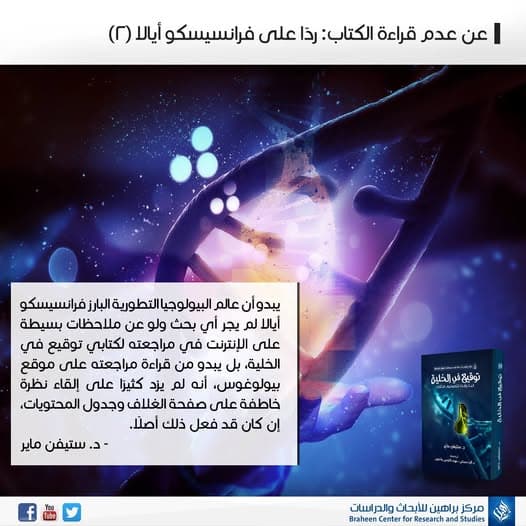
By: Dr. Steven Meyer The closest Ayala review has come to realizing the book's central positive argument is its clumsy attempt to refute the idea of intelligent design by insisting that the existence of "non-sense" sequences or junk in the human genome proves...
On Not Reading the Book: A Response to Francisco Ayala (2)
By: Dr. Stephen Mayer
Ayala’s closest review to realizing the book’s central positive argument is his clumsy attempt to refute the idea of intelligent design by insisting that the existence of “non-sense” sequences or junk in the human genome proves not to have originated with intelligent design.
Again, I wonder if Professor Ayala is looking at the pages of the book. My book is not about the emergence of the human genome, nor about human evolution, nor even about biological evolution in general. It is about chemical evolution, the emergence of first life and the genetic information necessary to produce it. I have simply admitted in the conclusion that anyone can, in principle, accept my argument about the intelligent design of early life, as well as the usual modern Darwinian explanation of how later life forms evolved. I do not believe in the "front-end loading" vision of design, but my book does not attempt to disprove this vision, nor the usual explanations for biological evolution. That is why Ayala's attempt to defend biological evolution and refute the theory that intelligent design played a distinctive role in the genesis of the human genome cannot be seen in any way as a response to a signature argument in the cell.
It is worth noting, however, that Ayala's argument against intelligent design of the human genome, based on the existence of a so-called "junk" or "meaningless" DNA signature, is based on two flawed, outdated, and invalid hypotheses. Ayala points out that no designer deserves the adjective "intelligent" to allow the human genome to be filled with meaningless DNA sequences that are scattered, and that the existence of these sequences and their apparent random distributions can be more fully explained. Of these, the 300 letters are the same. Meyer probably won’t think his editor is “smart.” Can any function be found for the nearly identical one million Alu sequences?
The result is that Ayala essentially claims that (1) the multiplicity of meaningless DNA sequences and (2) the random distribution of these sequences show that the human genome is impossible to design. But these two alleged facts on which Ayala bases his argument are wrong.
First, neither the human genome nor the genome of other organisms is dominated by junk DNA. As I documented in a signature book in the cell, it is now known that non-coding regions of proteins in genomes (in different organisms) that have long been thought to be "junk" or "meaningless" perform many important functions.
The Alu sequences that Ayala cites in particular, as prime examples of many meaningless sequences randomly distributed in the human genome, are not non-functional or "meaningless." The sequences of short scattering nuclear elements (SINE), of which Alu is a member, perform several coordination and regulatory functions in the genomes of all the organisms in them, and Ayala's claim to the contrary is incorrect.
SINES sequences (including Alu) allow genetic information to be retrieved in several different ways from the same DNA data files depending on the specific needs of the tissue or different cellular patterns (and in different organism-specific contexts). In particular, Alu sequences perform many lower-level genomic coordination functions, such as:
1 Introduction of alternative starter sites for promotor units in gene expression, similar to computer hard disk fragmentation (Faulkner et al., 2009; Faulkner and Carninci, 2009)
(2) Curb or "silence" RNA transcription (Trujillo et al., 2006)
(3) Dynamic division of one gene file from other files on chromosome (Lunyak et al., 2007)
(4) Introduction of a DNA contract for signal transduction pathways or binding sites for hormonal receptors (Jacobsen et al., 2009; Laperriere et al., 2004)
5 Coding RNA molecules modulate transcription (Allen et al. 2004; Espinoza et al. 2004; Walters et al. 2009).
6 Coding or regulation of mRNA molecules (Gu et al., 2009; Lehnert et al., 2009).
In addition to these functions in genomic coordination at the lower level, SINEs (including ALu) also perform generic coordination functions at the higher level such as:
1 Chromatin modification of signal transduction genes and GC-rich housekeeping genes (Grover et al., 2003, 2004; Oei et al., 2004; Eller et al., 2007)
(2) "bar coding" for custom parts of chromatin lugs between enhancers and enhancers (Ford and Thanos, 2010)
(3) Recombination in sequences where Alu is present (Witherspoon et al., 2009)
4 Assisting in the coordination of 3D chromosome regions or "chambers" in the nucleus (Kaplan et al., 1993; Pai and Engelke, 2010).
Alu sequences also assign many qualitative RNA codes to the type, where they are especially rendered:
1 Signals for splicing alternative RNA molecules (i.e. generating several different messenger RNA molecules from the same initial version) (Gal-Mark et al., 2008; Lei and Vorechovsky, 2005; Lev-Maor et al., 2008)
2 Alternative open reading frames (Exons) (Lev-Maor et al., 2007; Lin et al., 2008; Schwartz et al., 2009)
(3) Determines the retention of selected RNA molecules in the nucleus to suppress their expression (Chen et al., 2008; Walters et al., 2009)
(4) RNA polymerase II is regulated during transcription (Mariner et al., 2008; Yakovchuk et al., 2009; Walters et al., 2009)
5 RNA modulation sites provide adenine to inosine, which is an essential function for human and species-specific brain development (Walters et al., 2009).
Contrary to Ayala's claim, Alu sequences (and other SINEs in mammals) are not randomly distributed but exhibit a similar "coding and name" distribution pattern along their chromosomes (Chen and Manu-Elidis, 1989; Gibbs et al., 2004; Korenberg and Rykowski, 1988)
The distribution of the "bar code" of Alu sequences - similar to the distribution of italics, semicolons, and spaces used to format a computer program's code - reflects (with other SINEs) clear functional logic, not careless typing or random mutagenesis entries. For example, Alu sequences tend to localize in and around protein-coding genes suitable for their role in regulating gene expression (Tsirigos and Rigoutsos, 2009). It is found mainly in the adsorbent regions (RNA production initiation sites) and in introns (cuts that separate protein-coding distances).The number of Alu sequences is severely reduced outside these regions. We also now know that Alu sequences are directed to (or entangled in) certain preferred active regions in the genome by protein complexes or the "integral machine" of a cellular information processing system (Levy et al. This targeted distribution of Alu sequences improves semantic and syntactical regulation of human DNA, and does not appear to be evidence of random input mutations, contrary to Ayala's argument and his example of a "neglected writer".
Critics repeatedly claim that intelligent design theory is based on religion rather than science, but Ayala's answer to my book is a logical one that is based on a religious argument, and repeatedly distorts the scientific literature in a flimsy attempt to support it. He claims that the human genome exhibits meaningless sequences and negligent editing that is not worthy of a true intelligent designer.
*Note: This series will publish a translation of the book "Signature of Controversy", which discusses some of the issues in the book "Sign in the Cell" and responds to objections published since the publication of the original book.
—
Source: Published on Facebook's "Braheen Center" page
https://www.facebook.com/braheen.org/posts/pfbid0Jbr7aj5cSHTSNZEdP3A6MqQL5mPEt88h7jLzo4gV4soTBqCybcEb8heNM6o52wvHl