
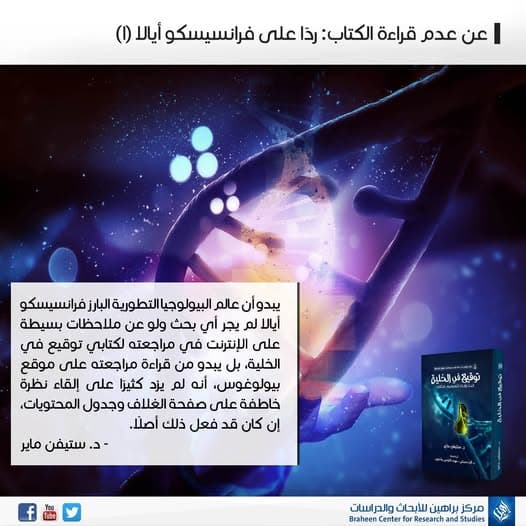
By: Dr. Stephen Mayer There is no doubt that this always happens, there must be many reviews written by reviewers who have barely opened the pages of books they claim to review, but those who decide to write such blind reviews usually make an effort to get...
On Not Reading the Book: A Response to Francisco Ayala (1)
By: Dr. Stephen Mayer
There is no doubt that this always happens, there must be many reviews written by reviewers who barely opened the pages of the books they claim to review, but those who decide to write such blind reviews usually make an effort to get information about the book so that they can at least describe its content accurately, to avoid embarrassing themselves at least.
The title of my book is not Signature of the Cell as Ayala repeatedly refers to it, but Signature in the Cell.
The book's thesis is not that "coincidence alone cannot explain the genetic information found in the genomes of living organisms" as he claims, but rather that intelligent design can explain it, and that it provides the best explanation (of many competing hypotheses, not just chance) for the origin of the information necessary to produce the first living cell.
Nor does the subject of the book address the emergence of the genomes of living organisms, or the human genome as Professor Ayala's critique suggests, but the emergence of early life and the uncertainty surrounding the origin of the information necessary to produce it.
Ayala begins his review by attempting to downplay a signature argument in the cell, but he does so by misrepresenting his thesis. "The basic argument for signing a cell [sic] is that chance alone cannot explain the genetic information found in the genomes of living organisms," says Ayala. He then refers - as I pointed out in the book - to the acceptance of all evolutionary biologists of course to this conclusion.
A signature in the cell constructs an argument in favor of the design hypothesis as the best explanation for the emergence of the biological information necessary for the production of the first organism. To do so follows a well-studied standard method of historical scientific thinking, one that Darwin himself endorsed and partly intended to use in his book The Origin of Species. The method is called several names such as the method of multiple competing hypotheses, or the method of best explanation, and inevitably entails an examination of the main competing hypotheses that scientists have usually cited to explain an event in the ancient past.
In the process of applying multiple competing hypotheses to construct my argument for intelligent design in a signature book in the cell, I examined the coincidence hypothesis of the emergence of life because it is one of several competing hypotheses proposed to explain the emergence of first life and the emergence of biological information. I began by criticizing it because it was the first hypothesis proposed to explain the emergence of life at the beginning of the discovery of the properties of information-bearing DNA.
In addition, a critique of the chance hypothesis provides a basis for evaluating some of these newer evolutionary chemical theories, which Ayala supposedly realizes are self-inflicted competing theories for evolutionary biologists where they are based on chance in association with other processes. For example, the current famous RNA scientist's scenario assumes that self-replicating RNA catalysts arise first as a result of random interactions between chemical building blocks or RNAs, and then after the first self-replicating RNA molecule appears, natural selection intervenes in the next process. My analysis of the possibilities of producing different, information-rich biomolecules is important not only to prove that “coincidence alone cannot explain” the emergence of genetic information, but also to show why theories based on chance, as well as prebiotic natural selection, fail.
However, a signature in the cell not only argued against the physical theories of information necessary to produce the first life, but also built a positive argument in favor of intelligent design by proving that the activity of rational conscious actors is the only known reason that large amounts of new functional information can arise, at least from purely physical and chemical precursors.
Follows...
*Note: This series will publish a translation of the book "Signature of Controversy", which discusses some of the issues in the book "Sign in the Cell" and responds to objections published since the publication of the original book.
—
Source: Published on Facebook's "Braheen Center" page
https://www.facebook.com/braheen.org/posts/pfbid027AisiuRuwebUmqN8MGJ36JU55JZRWViZkpJim7iHC5ySHsny1Z5kw6jF9RZTs85Bl