
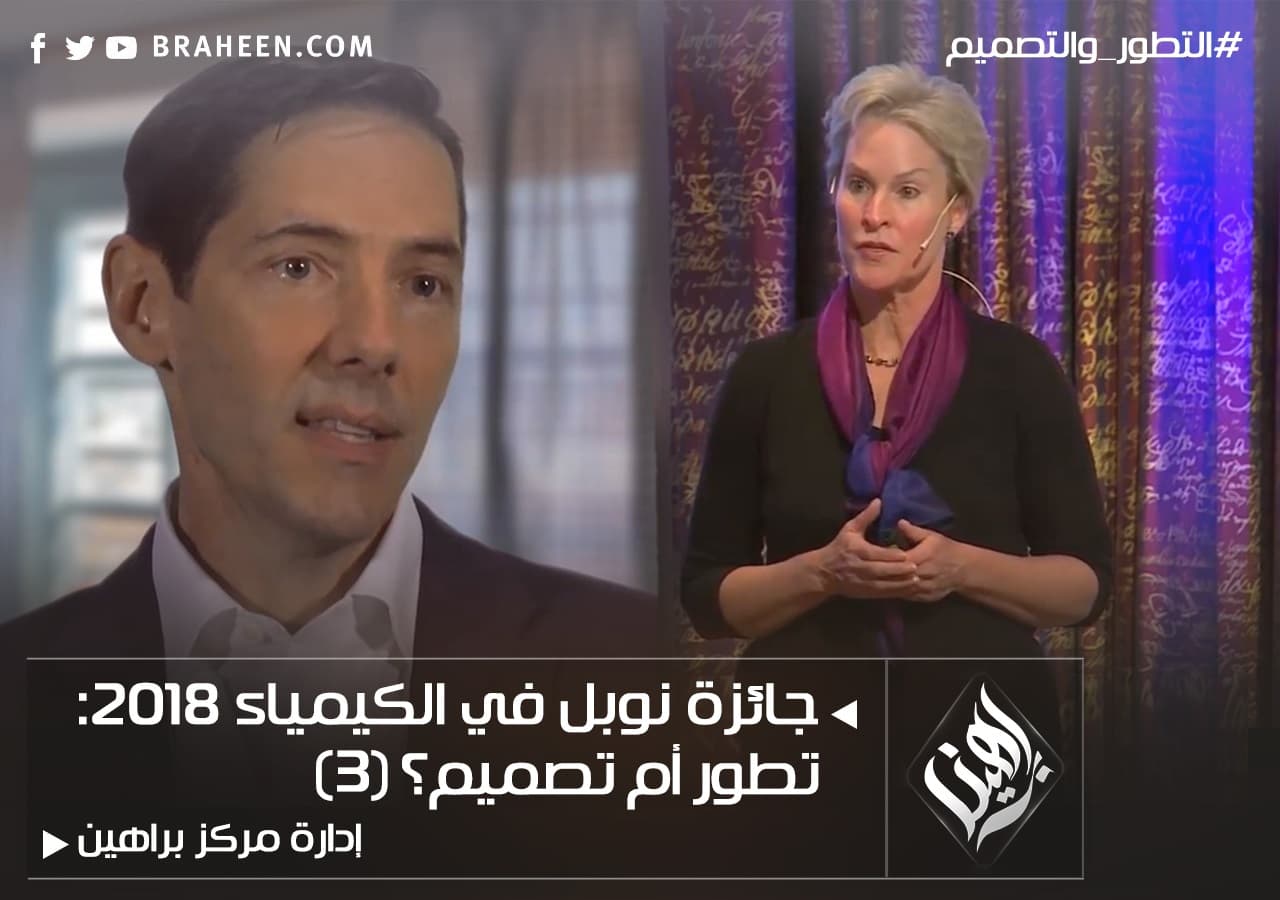
This video is basically a clip of Douglas X two years ago answering a question: When did you start doubting Darwinism?
Nobel Prize in Chemistry 2018: Evolution or Design? (3)
This video is basically a clip of Douglas X two years ago answering a question: When did you start to doubt Darwinism? To answer this question he was exposed to the story he went through during his career, which is closely related to the directed development in enzyme engineering and this year's Nobel Prize-winning Frances Arnold in chemistry.
Axe was completing her Ph.D. in chemical engineering at the same time that Frances Arnold was founding her lab at Caltech (California Institute of Technology), and the field was young and ambitious, as Frances Arnold explains that they thought in the early 1990s that they would solve the problem of designing new synthetic proteins within five years, but 30 years later, the problem still remains.
In a 2011 paper I co-authored, Arnold says that "efforts to date to produce new catalysts have essentially shown that we are getting better at making worse enzymes. Making new enzymes will require a whole new level of insight, or whole new methodologies."
In Arnold's words, she keeps talking about design and the problem of design, although of course she believes in Darwinian evolution, and that evolution over billions of years has given us everything alive, and that nature has designed all those proteins through evolution.
As we explained in our previous publication, the process of directed evolution in enzyme engineering has succeeded in improving the functions of enzymes so that we can use them in industrial conditions, but this has nothing to do with the debate about the formation and evolution of proteins, where the creation of a new protein in the laboratory is still a very distant hope ...
But what if scientists actually succeeded in creating a new protein or enzyme in the lab?
Of course not, because, as explained in the previous publication, what happens in the laboratory has nothing to do with what evolution assumes to happen in nature. The theory assumes that there is no end, and there is a predetermined end in the laboratory; the theory assumes the formation of protein through a single mutation by chance, and in the laboratory all possible mutations are tried until the desired result is reached; the theory assumes that the process occurs without an intelligent actor and blindly, and in the laboratory there is an intelligent actor who behaves sensly.
The environment in directed evolution is entirely artificial, and if it proves anything, it validates the assumption that it is impossible to create anything in life without design and intelligence. The field in which natural conditions are simulated that evolution is actually happening, is the field of experimental evolution, such as the experiments of Richard Lenski and others, and this is the subject of our next publication, God willing.
(1) Brustad, Eric M, and Frances H Arnold. “Optimizing Non-Natural Protein Function with Directed Evolution.” Current opinion in chemical biology 15.2 (2011): 201–210. PMC. Web. 11 Oct. 2018.
- Management of the Brahin Center
—
Source: Brahin Center website - Published on 2018-10-12 (archived at the Internet Archive)
https://braheen.com/articles/evolution-design/جائزة-نوبل-في-الكمياء-2018-تطور-أم-تصميم؟-3