
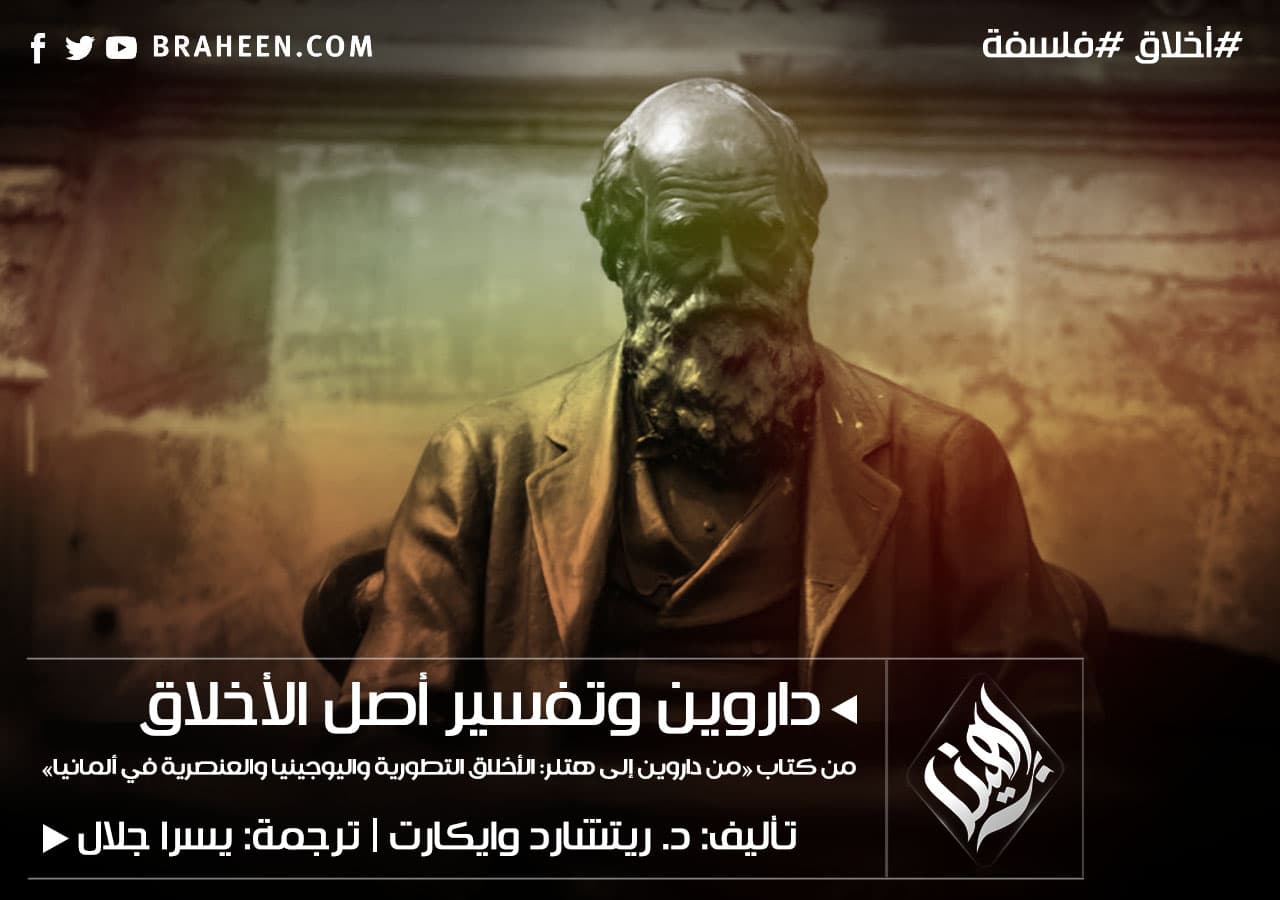
Note: This article is from Darwin to Hitler: Evolutionary Ethics, Eugenia and Racism in Germany. For more, please check out the book. Darwin carefully summarized his views on ethics and the value system...
Darwin and the interpretation of the origin of morality
Note: This article is from Darwin to Hitler: Evolutionary Ethics, Eugenia, and Racism in Germany.
Darwin carefully summed up his views on morality and the value system in his own memoirs, in which he said that a man who does not believe in God or in life after death, just like himself, "can take the law of his life, I see, only by following the impulses and appeals of stronger or better instincts." Morality, where Christianity relies on divine revelation, Kant and other Renaissance thinkers built morality based on human rationality, so that British moral philosophers regarded morality and virtues as an unchanging part of human nature, whatever their origin. The philosopher David Hull, in his book The Metaphysics of Evolution, emphasized the revolutionary nature of Darwin's theory of morality: "Because so many theories of morality and political theories are based on one or more conceptions of human nature, Darwin's theory has put all these theories into question."
Even before Darwin wrote his memoirs, many opponents of Darwinism feared the moral consequences of Darwinism, and Darwin's comments about following instincts certainly did not assuage their fears. After Darwin wrote this phrase in his memoirs about following our instincts, he rushed to add that social instincts in man and moral feelings are more powerful than egoistic or adversarial tendencies.
But not all of Darwin's supporters agreed with him on the ethical implications of his theory, and Darwinists debate whether Darwin overruled, modified, or affirmed traditional moral views.
Although some rejected all morality and the traditional value system as subjective and unscientific, many took an intermediate approach, emphasizing the importance of altruism and brotherly love, while rejecting most doctrines of Jewish and Christian ethics. These late Darwinists hoped to save the very core of religious ethics, while discarding what they saw as excess religious traps that would no longer matter in the age of civilized science.
To Darwin, the explanation of the origin of morality was not a trivial side issue, but a central one he had to face if his theory of evolution was to become accepted and valid. Many people throughout history, after all, view morality as a unique human concept, elevating man above all other beings. Darwin first needed to prove that morality was not a humanistic singularity, and secondly, he needed to explain its mechanism of action or its mechanics. His famous memoir, M, published in 1838, was full of reflections on human evolution and contained several connotations of morality.
In The Origin of Man, Darwin tried to prove that all human traits, including moral behavior, differed in their degrees rather than in their kind. He showed that other beings lived in communities and collaborated, and the social instinct that produced that collaboration was genetic. Whereas in man, social instincts evolved more than in other species and were organized together through man’s vast cognitive abilities, producing what we call morality. For Darwin, the mechanism for producing this flood of social instincts was natural selection through the struggle for survival. Groups with cooperative and sacrificial elements will triumph over groups with more selfish elements, either directly through war or indirectly through overpopulation.
By making human instincts the basis from which morality emerges, Darwin's explanation of evolution provided a logical and scientific reason for the evolution of irrational human whims. From this point of view, Darwin embodied his scientific theory of rationality in the Renaissance. (7) Darwinism, however, also helped to undermine rationality, especially in the realm of ethics. The growing respect for science in general and Darwinism in particular in the late 19th century helped to promote biological determinism. Darwinists never denied human rationality, but began to interpret human behavior in Darwinian terms, emphasizing the importance of instincts in interpreting human behavior. If a Darwinian interpretation of human behavior is possible, humans must share many traits with animals, as Darwinism argues that human rationality is not the primary driver of human behavior.8
Darwin was never the first to portray morality as innate and irrational. In fact, Darwin received considerable support from British moral philosophers before him. For example, Shaftesbury, who was a central figure in the development of moral sense in philosophy, contributed decisively to the emergence of rationalism in moral theory. Many prominent figures, such as Francis Hutcheson and Joseph Butler, also believed that moral feelings were instilled in man by God. Others, such as David Hume, could talk about the idea of moral philosophy without reference to a celestial origin, and simply build it on human nature. Because many 18th-century philosophers considered human nature to be static, most believed that moral feelings were common, unchanging public feelings. In 1838, Darwin read his wife's uncle James MacIntoch's book, A Treatise on the Evolution of the Philosophy of Morals, and MacIntosh stated that morality was innate because it was both morally motivated and rational.
Even before the rise of Darwinism, many of the late Darwinists tried to build a "scientific ethical system", but in his 1851 formulation of ethics he still invoked the existence of God as a source of human morality. After Darwin published his theory, however, Spencer disposed of the existence of God and developed a completely naturalistic moral system. Thomas H. Huxley (11)
A Darwinian interpretation of the origin of morality found fertile soil in Germany, but German Darwinists disagreed among themselves on the effects of Darwinism on the current moral situation. Some saw it as a revolutionary theory, completely overthrowing the traditional moral order, especially Christian ethics.
(1) Charles Darwin, Autobiography (New York: Norton, 1969), 94.
(2) David Hull, The Metaphysics of Evolution (Albany: State University of New York Press, 1989), 75.
(3) Darwin, The Descent of Man (London, 1871; rprt. Princeton, 1981), 1:106.
(4) Adrian Desmond and James Moore, Darwin (London, 1991), xxi, 243, 263, 269.
(5) Charles Darwin, Metaphysics, Materialism, and the Evolution of Mind: Early Writings of Charles Darwin, ed. Paul H. Barrett (Chicago: University of Chicago Press, 1974).
(6) Darwin, Descent, 1:71-80.
(7) Neal Gillespie, Charles Darwin and the Problem of Creation (Chicago, University of Chicago Press, 1979).
(8) Robert J. Richards, Darwin and the Emergence (Chicago, 1987), 108-9; Robert J. Richards, "Darwin's Romantic Biology: The Foundations of His Evolutionary Ethics," in Biology and the Foundation of Ethics, ed. Jane Maienschein and Michael Ruse (Cambridge: Cambridge University Press, 1999), 113-53. See also Paul Lawrence Farber, The Temptations of Evolutionary Ethics (Berkeley, 1994), ch. 1.
(9) Michael Bradie, The Secret Chain: Evolution and Ethics (Albany: Suny Press, 1994), ch. 2.
(10) Richards, Darwin and the Emergence (Chicago, 1987), 116-17.
(11) Paul Lawrence Farber, The Temptations of Evolutionary Ethics (Berkeley, 1994); C. M. Williams, A Review of the Systems of Ethics fiunded an the Theory of Evolution (London, 1893).
(12) Kurt Bayertz, "Darwinismus als Politik: Zur Genese des Sozialdarwinismus in Deutschland 1860-1900," in Welträtsel und Lebenswunder: Ernst Haeckel¬Werk, Wirkung und Folgen, ed. Erna Aescht et al. (Linz, 1998), 247-9.
- Richard Waikart. - Translated by Ysra Jalal.
—
Source: Brahin Center website - Published 2019-07-02 (archived at the Internet Archive)
https://braheen.com/articles/ethics/داروين-وتفسير-أصل-الأخلاق