
It is very sad to find a Muslim who gives a blind surrender to the validity of what the evolutionists say, only because he thinks that science is what most scientists say! A Muslim doctor who loves her religion, goes out to try to reconcile evolution and Islam, and we find her repeating the same myth...
It is very sad to find a Muslim blindly surrenders to the validity of what the evolutionists say, just because he thinks that science is what most scientists repeat!
A Muslim doctor who loves her religion, she goes out to try to reconcile evolution and Islam, and we find her repeating the same Dokinsian myth that the eye is defective because of the blind spot! Although she knows Dawkins and knows his atheistic premises and expresses her complete rejection of those premises and tries to refute them logically, but swallows (she and others) evolutionary lies without even trying to verify!
We will continue with Dr. Jonathan Wells (specialist in cellular and developmental biology) the history of superstition, from Chapter 7 of his new book (Zombie Science):
In 1986, Richard Dawkins made his derogatory assessment of vertebrate eyes:
"Any engineer would have naturally assumed that the photocells were directed toward light, with their conductors pointed backwards towards the brain. He would have laughed at any suggestion that the photocells were far from light, with the conductors as close to light as possible. However, this is exactly what happens in all vertebrate eyes.
Despite this statement, Dawkins believes that vertebrate eyes work well! But “the same principle would offend any designer with an organized mind.”
Six years later, evolutionary biologist George C. Williams followed with a harsher statement: "There would be no blind spot if the eyes of vertebrates were indeed intelligently designed," he also said.
Similarly, in 1994, biographer and textbook author Kenneth Miller wrote that the human eye, "which is the ideal model for intelligent design," is poorly designed. He also said, "The intelligent designer, who deals with the elements of those synaptic extensions, will inevitably pick the direction that achieves the best and highest degree of visual quality; for example, no one can decide to put neural connections in front of light-receiving cells rather than behind the retina."
In 2005, renowned biologist Douglas Futuyma published a textbook in which he claims that "no intelligent engineer is expected to design ... the foolish functional arrangement" of retinal neurons.
That same year, noted biologist Jerry Coyne wrote that the human eye "is not the kind of eye an engineer can create from scratch."
From the perspective of evolutionary theory, the human eye seems to be poorly designed, and the theory doesn’t make any more sense. But, what if we look at the eye from the perspective of function? What if its supposedly bad design can actually work better?
If we review the published scientific literature before the evolutionists publish their words, we will find in it what proves the validity of their words.
The two basic types of light-sensitive cells in vertebrate retinas are rods and cones. The former are very sensitive to light and function well in dim light or at night. They can actually sense even a single photon, but they only see black and white. The cones are much smaller than the rods, and they are not sensitive to light, but they do see colors.
Both sticks and cones require large amounts of nutrients and a tremendous amount of energy. One classic book of the eye describes them as "greedy".7 In mammals, they have the highest metabolic rate of all body tissues.
About three-quarters of the blood supply to the eye flows through a dense network of capillaries called the placental capillaries, which lie behind the retina.(9)(10) Oxygen and nutrients, including modified vitamin A, are transported from the blood in the capillaries to the sticks and cones through an intermediate layer of specialized cells called (11)(12) (retinal pigment epithelium).
In addition to transporting oxygen and nutrients, the pigmented epithelial layer performs another essential function. The rods and cones contain heaps of disks that are packed with light-sensitive chemicals. During the light-sensing process, toxic chemicals are formed that must be disposed of so that the light-sensitive cells continue to function.
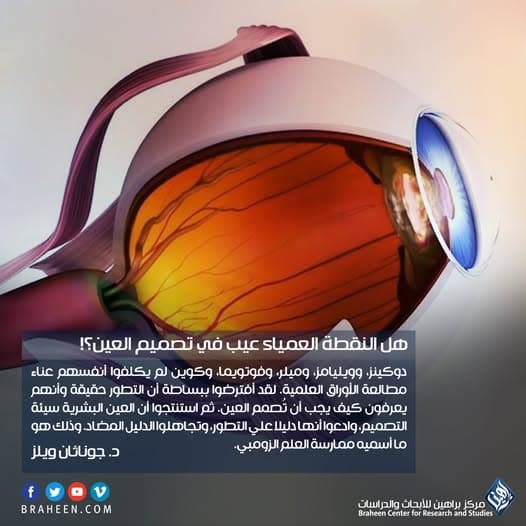
If sticks and cones had to face the incoming light directly as the evolutionists had to, the blood-filled capillaries and pigmented epithelial layer would have to be in front of the retina where they block almost all light. In contrast, neurons are relatively transparent, blocking very little light. Because of the metabolic needs of sticks and cones and their need to renew themselves, the reversed retina is actually much more efficient than the "organizing" design that biologists imagine.
Blind spot is not a serious problem, because firstly it is very small, and secondly because the blind spot of the left eye is not in the same place as the right eye. This means that in a person with healthy eyes, the visual field of one eye covers the blind spot of the other eye, and vice versa.
Most of the research documenting the basic functions of placental capillaries and epithelial tissue was published before 1986, but Dawkins, Williams, Miller, Futoima, and Quinn did not bother to read scientific papers. They simply assumed that evolution was a fact and that they knew how the eye should be designed.
—
Source: Published on Facebook's "Braheen Center" page
https://www.facebook.com/braheen.org/posts/pfbid0mZQdm5yr4f7tVp526vYLBhbUPGmxP16Qmk71sHkxbCX6GPcQiawLkeUnpjjnUHt2l