
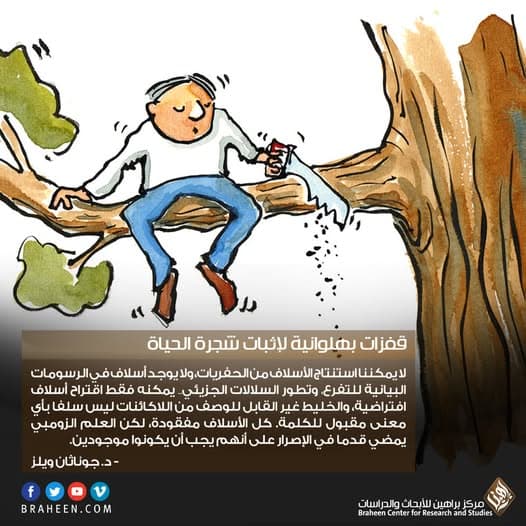
- Dr. Jonathan Wells If there is a single tree of life, then it is supposed to be a single "common ancestor". A single stem. But the contradictions in the evolution of molecular strains convinced some scientists that the history of life can not be presented in one tree...
Acrobat jumps to prove the tree of life
- Dr. Jonathan Wells.
If there is a single tree of life, then it is supposed to be a single "common ancestor". A single stem. But the contradictions in the evolution of molecular strains convinced some scientists that the history of life could not be presented in a single tree. Evidence for a common ancestor, or in other words a common stem, is missing. Some evolutionists have decided that the evidence is missing because the stem is a mirage.
Living cells are usually classified into two broad domains; prokaryotes (without a membrane-bound nucleus) and eukaryotic truths (with a nucleus). The first contains bacteria, and the second contains single-celled organisms such as yeast and multicellular organisms such as plants and animals. However, based on molecular comparisons, Carl Woese and George Fox declared in 1977 that some eukaryotic organisms should be classified as third.
The archaea are quite different from bacteria in the chemical structure of their cell wall and their DNA transcription mechanism. In fact, some of the enzymes that archaea use to copy DNA are similar to those used in eukaryotes. Woz concluded that the differences between archaea and bacteria, and between them and eukaryotes, were far too great to be explained by a regression from the common common ancestor, as the term is commonly understood. Woz wrote in 1998 "The ancestor cannot be a specific organism, or the offspring of a single organism. It was an unconnected, diverse and complex cluster of primitive cells that evolved as a single unit, eventually reaching a stage where they separated into many different communities, which in turn became three basic lines of ancestors." According to Woz, primitive cells (which he called "progenotes") were "completely different from modern cells." The progenote "was in one way or another a bag of semi-autonomous genetic elements" that "had come and gone", so the proto-genotes were not "organisms in any conventional sense".
But if our common ancestor with archaea and bacteria was not an organism, in what sense was it an ancestor? Why do we stop at a community of primates? Why not say that our common ancestor was primordial soup? Or elements in the periodic table?
But evolutionary biologists – even those who agree with Woz’s views – still defend the idea of a common common ancestor. For example, W. Ford Doolittle wrote in 2009 that he doubts “if there is a common ancestor in the first place,” but “that doesn’t mean that life lacks a common ancestor,” because “the common strain doesn’t require a common ancestor.”
So we can’t deduce ancestors from fossils, and there are no ancestors in branching diagrams. The evolution of molecular strains – even if all their systematic problems and conflicting results are solved – can only suggest hypothetical ancestors.
- Paragraphs from the book of Dr. Jonathan Wells (Zombie Science: Icons of Evolution Again) pp. 44-46.
—
Source: Published on Facebook's "Braheen Center" page