
Like emotions, memories, and perception, we hope that our speech will not be understood as any reduction to these mental functions, but rather as a study of the necessary conditions that must be met in the human brain in order to be able to perform these functions in a way that...
A meeting is not like any meeting, a meeting that will be determined by a lot...
Like what?
Like emotions, memories, and cognition, we hope that we will not only understand any reductionism of these mental functions, but that we will study the necessary conditions that must be met in the human brain to be able to perform these functions properly.
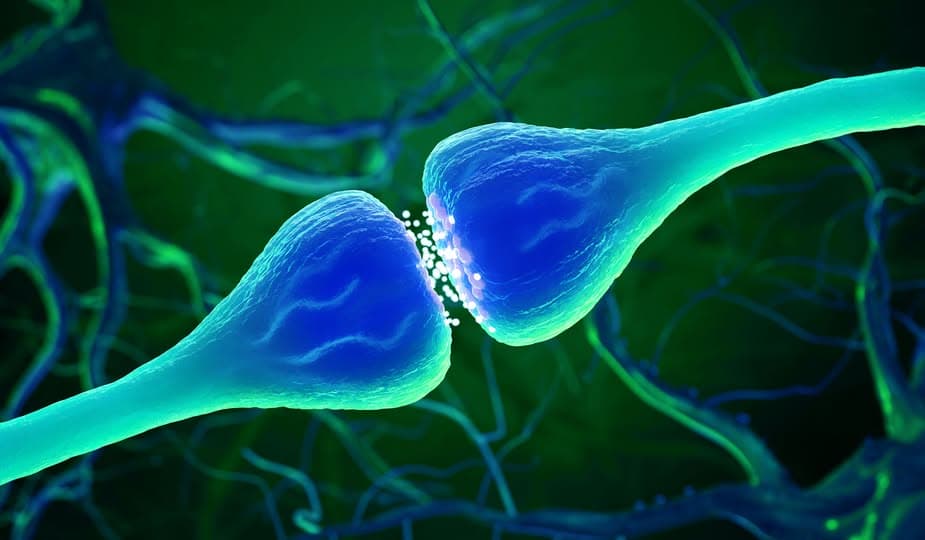
The encounter we are talking about now is the encounter of two neurons, known as synapses, which are essential components of neurons that allow information to move in a coordinated way through the nervous system.
The majority of neurons are polarized cells; that is, they have one part of the cell to receive input and another part to send output.
The parts of cells that are specialized to receive input from other cells are called arboreal appendages, neurotoxins, or dendrites. The word dendrite comes in English from the Greek word dendron, which means "tree". The arboretum has a branched structure that is actually similar to trees. A signal is passed by the arboreal appendage to the cell body.
There are two types of clamps; electric clamps, and chemical clamps.
Electrical synapses are less common in our nervous systems. But we will start with them because they are easier to explain. Electrical synapses (as in the picture) are basically pores between two cells that allow the passage of ions. And then allow the passage of the electrical signal to a neighboring cell without much fuss.
There are a lot of reasons why we need synapses like these, they are fast, and they allow cells to be combined with a high degree of synchronization.
But most neurons are connected to each other by a more complex structure called the chemical synaptic. In chemical synapses, instead of just passing an electrical signal from one cell to another, the action potential moves to the end of the axon and causes a chemical to be released in a very small space between the neurons called the synaptic cleft. This chemical is absorbed by the neurons downstream on the other side of the cleft.
This chemical step is slower than transmission via an electrical clamp, but it opens the door to a very diverse range of different and more complex types of signals.
Synaptic function plays an important role in the computations of neurons. Optimal synaptic connectivity is therefore required in order to have proper brain function.
Minor disruptions in synaptic function can lead to extreme disruptions in brain function!
In fact, growing evidence has demonstrated the importance of synaptic dysfunction as a major determinant of many neurological diseases. This idea has led to the emergence of a branch of pathology called Pathologia synaptopathy, brain diseases that have arisen from problems with synapses.
The study of the physiology of anomalous synapses contributes to a better understanding of many neurodevelopmental disorders such as autism, Down syndrome and epilepsy, as well as neurodegenerative disorders such as Alzheimer's and Parkinson's disease.
We have about 86 billion neurons in the brain, each of which has a synapse with at least a thousand other cells, or maybe 10,000 more cells, meaning that the number of synapses is between 100 and 500 trillion synapses, and some estimates have brought this number to quadrillion or a thousand trillion synapses!
If we take even the lowest estimate of the number of synapses in the brain, a thousand synapses on average per cell, multiplied by 86 billion neurons (which is the average number of neurons in an adult according to the research of Susana Herculano-Huselle and her team), we are talking about 86 trillion synapses in the brain!
There are about 16 billion devices connected to the Internet, and if we assume that there is communication between each device and a thousand other devices, that is, we are talking about 16 trillion connections, so to be able to familiarise the human brain with its cells and nerve entanglements, we need to understand data five times more than the data of the current Internet !!!
And while I admit the inaccuracy of the analogy, but it's just to zoom in, looking at the human brain up close has stunned everyone, so regardless of the contradictory philosophical implications of interpreting those studies, everyone agrees on how incredibly complex this small area of our bodies is.
- Ayesha.
—
Source: Published on Facebook's "Braheen Center" page
https://www.facebook.com/braheen.org/posts/pfbid03XQG2jH595KnH9jcrpCfAjqrHZXt5JjXrtWZHofSXDXVx6wdy37KtB7wgB3aSBTpl