
A research team from Fudan University in Shanghai has published a new paper in the journal Cell Research on the invasive zone in human liver cancer identified by Stereo-seq technology promotes cross-talk between liver and tumor cells and immunosuppression.
A research team from Fudan University in Shanghai has published a new paper in the journal Cell Research on the invasive zone in human liver cancer identified by Stereo-seq technology that promotes cross-talk between liver and tumor cells, local immunosuppression and increased tumor growth.
Anatomy and understanding of the cancer ecosystem – especially those around the edges of the tumor, which have strong effects on cancer cell infiltration and invasion – is essential to exploring the mechanisms of tumor proliferation and developing effective treatments.
The team used a new model to scan and digitize tumor boundaries called Stereo-seq to identify an area 500 micrometers wide around the edges of the tumor in liver cancer patients, which is referred to as the invasive zone.
They found that the gaseous region suffered from strong immune suppression, metabolic reprogramming and severe liver cell damage.
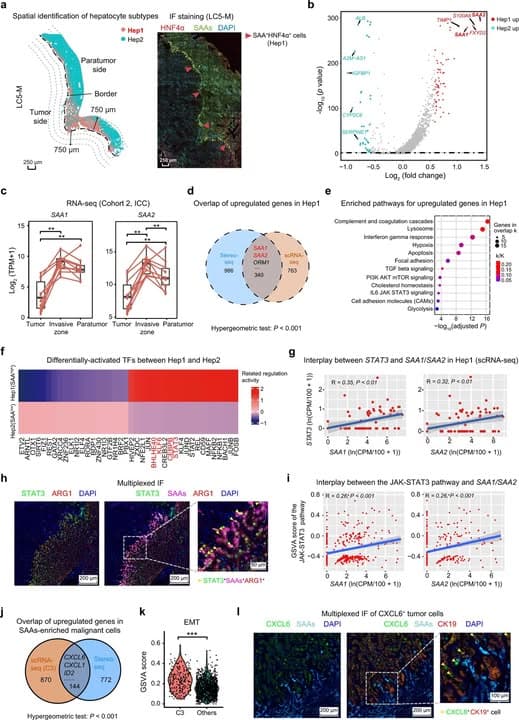
A subgroup of damaged liver cells was identified with increased expression of amyloid serum A1 and A2 (later referred to as SaaS) near the border on the side of the tumor.
Overexpression of CXCL6 in adjacent tumor cells can activate the JAK-STAT3 pathway in nearby liver cells, leading to overexpression of SaaS in these hepatocytes.
Overexpression and excretion of SaaS by hepatocytes in the invading region can lead to macrophages recruitment and M2 polarization, further enhancing local immunosuppression and possibly leading to increased tumor growth.
Clinical association analysis in five additional independent groups of patients with primary and secondary liver cancer showed that patients with overexpression of SaaS in the invasive region had worse progression of the disease.
Further trials in vivo using mouse liver tumor models confirmed that reducing the expression of SaaS-encrypted genes using the Gene Knockdown technique in liver cells reduced macrophages buildup around the edges of the tumor and delayed tumor growth.
The identification and characterization of the invasive zone in human cancer patients adds an important layer of understanding regarding the mechanisms of tumor invasion and metastasis, and may pave the way for the development of new therapeutic strategies for advanced liver cancer and other solid tumors.
—
Source: Published on Facebook's "Braheen Center" page
https://www.facebook.com/braheen.org/posts/pfbid0yKkdXMZiX1RQ4g4qzyzjZ5HenLNnV4FpAwyDFXPtP8jFLLxoP6rzbkR1w12N7qv1l