
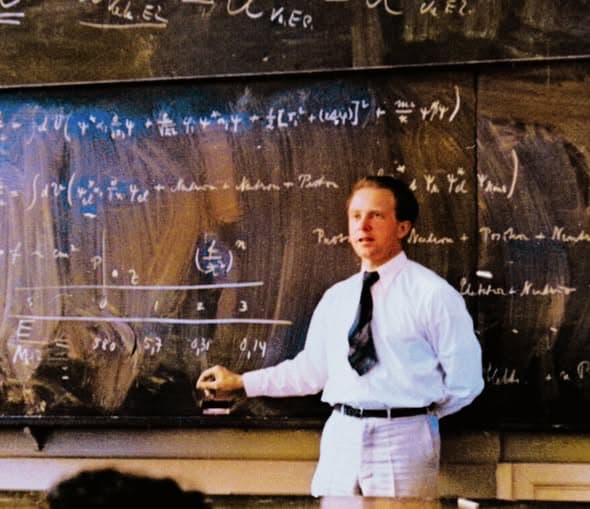
A consequence of "particle-wave duality" is that it limits the amount of information that can be known about the quantum system at a time. Either we choose to monitor the wave characteristics of light by passing it through the...
Heisenberg’s Uncertainty Principle (1)
One consequence of "particle-wave duality" is that it limits the amount of information that can be known about the quantum system simultaneously. Either we choose to observe the wave properties of light by passing it through the two-slit screen without any observation of the passage of photons from one of them, or we choose to observe those photons as they pass through one of the two slits. It is possible to consider the observation of the passage of a photon from one of the two slits as a measure of its position, and that the observation of the interference pattern is closer to the measurement of the "Momentum". It is impossible, because of the "wave-particle dichotomy", to measure the position of any quantum particle and the amount of its motion at the same time.
It is possible to apply the Heisenberg idea to the two-slit experiment, but due to the high resolution that this entails, we will find a more obvious example, where we will study the light passing from a single slit with a specific width. If we analyze that behavior using the wave model of light, we will find that the light beam will scatter and diffuse into a new "Diffraction Pattern" as shown in (Image 1.23).
The principle of inevitability relates to what we can expect from the properties of the photon passing through the device. We know that the photon has passed through the notch, but we don’t know exactly where it has passed. So there is a measure of inevitability in the position of that photon and that magnitude is equal to x, where x is the width of that notch. When the photon leaves the notch it will reach the screen at some point, but we don’t know beforehand where it will hit it. Since all we know is that the photon will arrive somewhere within the limits of the diffraction pattern, the width of this pattern represents the amount of inevitability in the amount of motion.
If we narrow the width of that notch to reduce the inevitability of the photon pass-through position, this will lead to the wideness of the diffraction pattern, thus increasing the inevitability in the amount of motion in the x-direction. It turns out that the product of inevitability is the same as how much we change the width of the notch, and further calculations show that i.e. the constant h is equal to the fundamental quantity constant, i.
∆x ∆p>h/4π
Our previous analysis of the diffraction experiment is clearly consistent with this principle.
The principle of inevitability has had profound effects on our view of scientific measurements and experiments. It has long been observed that there are practical limitations that determine the accuracy of any measurement; but theoretically, “before quantum physics,” there was nothing to prevent the accuracy required while improving measurement techniques. Although the principle of inevitability relates to our ability to predict the results of successive experiments and measurements; in practice, it also places basic limitations on the accuracy of measuring two physical quantities simultaneously, such as the position of a photon and its quantum of motion. As we will see in the next chapters, the prevailing explanation of quantum physics is that it makes no sense to describe a particle that has a specific position. The principle of inevitability is one of the strange and revolutionary consequences of quantum physics and its philosophical ideas, which are the subject of this book.
-----
(1) Several Arabic renderings of “The Uncertainty Principle” exist: “the principle of uncertainty” or “non-certainty,” “the principle of indeterminacy,” and “the principle of suspicion” or “the principle of doubt.” After long reflection, I chose the expression I believe comes closest to Heisenberg’s intended meaning. Much of the debate in Arabic literature about this well-established fundamental principle stems from misunderstandings caused by its translation. The principle, its meaning and the debate surrounding it require fuller discussion and clarification, which lie outside this passage. (Translator)
More: https://braheen.com/publications/فيزياء-الكوانتم-حقيقة-أم-خيال
—
Source: Published on Facebook's "Braheen Center" page