
Despite the great media hype about hominin fossils, but these fossils are very fragmented and a point of great attraction in the scientific community, we will examine in the following paragraphs a number of these fossils and assumptions based on them.
Despite the great media hype about hominin fossils, but these fossils are very fragmented and a point of great attraction in the scientific community, we will examine in the following paragraphs a number of these fossils and assumptions based on them.
- The human-like Chadian coastal monkey (Tomay's skull):
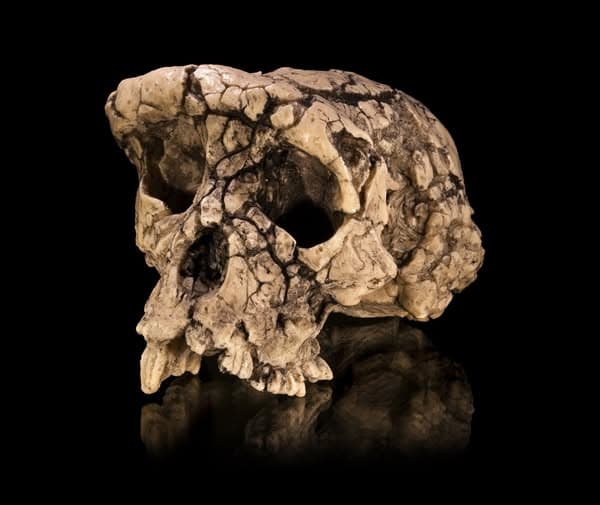
Sahelanthropus Tchadensis: “Toumai Skull”
Although this species is only known from a single skull and several parts of the jaw, it is the first of its kind among hominids and is placed directly on the line of human lineage.
When the fossil was first announced, Brigitte Senut, a famous researcher at the Museum of Natural History in Paris, said, “I used to think that this skull belonged to a female gorilla.”
Senut and her colleagues Milford H. Wolfoff, Martin Pickford, and John Hawks wrote in Nature that they observed "many features linking the specimen to chimpanzees, gorillas, or both, except for the rest of the great ape species."
This controversy continued, and a number of prominent human paleontologists declared in the minutes of the U.S. National Academy of Sciences that skull and tooth fragments alone are insufficient to classify the specimen or say it belongs to a hominin:
"Our results show that tooth and cranial traits, which are used to this day, cannot be relied upon in the drawing of dynastic trees for humans and their relationship to higher primate species and genera, including humans."
Let us recall once again what Ronald Weathernton said in one of the hearings on the theory of evolution in the state of Texas: "Every fossil we find supports the sequence that we assume before its existence, and does not go outside that framework"(26), but this fossil, which was revealed in 2002 is a flagrant example contrary to this testimony!
Bernard Wood of George Washington University comments on the Tumay skull in the journal Nature in the article's editorial: "It is the single fossil that may radically change the way we build the tree of life."27 He then went on to say: "If we accept only these pieces as sufficient evidence for classifying the Chadian coastal ape as one of the earliest species of great apes in the lineage of modern humans, this will not destroy the ordered model of human origin and origin." The length of the human lineage in the evolutionary tree in large numbers of species."
That is, if we accept that the Toumai skull represents a pre-human species in the stem of their evolutionary lineage, we cannot accept that many other late species, such as southern monkeys, are ancestors of humans of the same evolutionary lineage, Wood concludes that "the fossils of the Chadian coastal monkey show conclusive evidence that tracing our evolutionary lineage is as complex and difficult as tracing the origins of any other species."[29]
More: https://braheen.com/publications/العلم-وأصل-الإنسان
—
Source: Published on Facebook's "Braheen Center" page
https://www.facebook.com/braheen.org/posts/pfbid024PRFtL3guPMegBhKw1VwBwBsdaL8gyXLoR2T1z6eLKEVKix4NxiCSx3kT3ekiz9Ml