
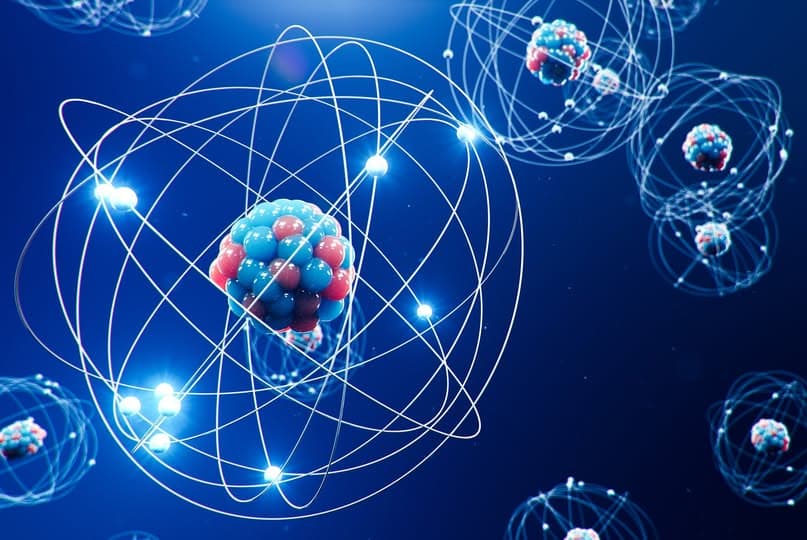
The precise physical nature of the atoms was illustrated by a series of elegant experiments conducted between 1895 and 1915. The most notable of these achievements was Ernest Rutherford’s famous experiment on alpha scattering in 1911, which proved that...
The exact physical nature of the atoms was illustrated by a series of elegant experiments conducted between 1895 and 1915. The most notable of these achievements was Ernest Rutherford’s famous experiment on alpha scattering in 1911, which proved that:
Almost all of the mass of an atom is contained within a small (and therefore very dense) nucleus that carries a positive electric charge and, depending on its value, the elements are differentiated; it is known as the atomic number of the element.
Almost the entire size of an atom consists of an empty space in which electrons, the basic carriers of a negative electric charge, are present.
The extremely small mass of an electron (part of 1840s hydrogen nucleus mass) makes it behave like a quantum particle, meaning that it cannot be located at any moment, and the best we can do is describe its behavior in terms of its probability of appearing at any point in space.
It is common (but somewhat misleading) to describe the size of the place where there is a high probability of the electrons of an atom being found as an electronic cloud; in fact the cloud has no specific outer boundary, and so does the atom.
The radius of an atom must be arbitrarily determined, such as the limit at which an electron can be found with a probability of 95%. The atomic radius is usually between 30 and 300 picometers.
The nucleus itself consists of two types of particles; protons, which are the carrier of a positive charge in the nucleus. The charge of the proton is exactly the same as the charge of the electron, but with the opposite signal. This means that in any [electrically equivalent] atom, the number of protons in the nucleus (often referred to as the nuclear charge) is balanced by the same number of electrons outside the nucleus.
The other nuclear particle is a neutron. As its name suggests, this particle carries no electric charge. Its mass is roughly the same as the mass of a proton. Most nuclei contain roughly equal numbers of neutrons and protons, so we can say that these two particles together account for almost all of the mass of an atom.
—
Source: Published on Facebook's "Braheen Center" page
https://www.facebook.com/braheen.org/posts/pfbid0bAnbSmMTKUXZQbNF69W3QLB1E6jTYkqQjsrFcS4huL4jmku8vcTP7eG4G5T9SQNkl