
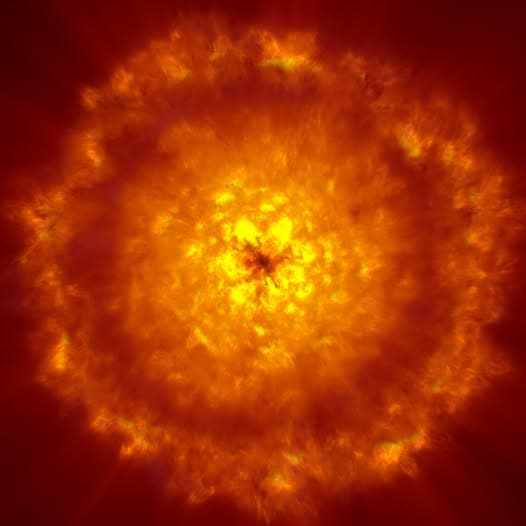
The transformation of hydrogen (the simplest atom, with its nucleus consisting of one proton) into helium (the second simplest atom, consisting of two protons and two neutrons) fuels the Sun. So far, attempts have been made to harness fusion as a source of energy (controlled fusion).
The transformation of hydrogen (the simplest atom, with its nucleus consisting of one proton) into helium (the second simplest atom, consisting of two protons and two neutrons) fuels the Sun.
So far, attempts to harness fusion as an energy source have failed, owing to the difficulty of reaching the required temperature of millions of degrees Celsius, and the more difficult problem is to physically restrict this superheated gas in the laboratory – of course it will melt any hard vessel – and it should instead be locked up by magnetic forces.
But the Sun is too massive for gravity to pull on the colder upper layers, thereby “keeping the core” covered. The Sun has modified its structure so that nuclear energy is generated in the core and diffused outward at the exact rate necessary to compensate for the heat lost from the surface, which is the core of life on Earth.
More: https://braheen.com/publications/فقط-ستة-أرقام-القوى-العظمى-التي-تشكل-الكون
—
Source: Published on Facebook's "Braheen Center" page